Last updated September 25, 2026
Italy
8-Day Dolomites Road Trip from Venice, Italy: Cortina, Alta Badia & Val Gardena
Three bases, no backtracking, and a spare day in every valley for the weather. This loop from Venice leaves the lakes and cities out and stays in the Dolomites: three nights in Cortina d'Ampezzo for the Tre Cime and the First World War ridges, two in Alta Badia for the passes around the Sella, two in Val Gardena for Seceda and Alpe di Siusi. Each move between bases is about an hour of driving, and each base has two days that can swap places on the forecast. Every day has an easy version and a harder one, from flat meadow tracks to an optional three-thousand-metre summit — for people who would rather see three valleys properly than ten from the car.
Quick facts
- Duration
- 8 days
- Pace
- Relaxed
- Best time to go
- Mid-June to early October
Route map
Trip overview
| Day | Region | Main highlights | Book ahead | Pace |
|---|---|---|---|---|
| Day 1 | Up the Piave Valley to Cortina | Collect the car at Marco Polo; Into Cortina, and the Corso on foot | — | Balanced |
| Day 2 | Around the Tre Cime di Lavaredo | Up the toll road to Rifugio Auronzo; Round the towers to Rifugio Locatelli | Up the toll road to Rifugio Auronzo | Balanced |
| Day 3 | Cinque Torri, a Free Afternoon, and Passo Giau at Dusk | Cinque Torri and the wartime trenches | — | Relaxed |
| Day 4 | Over Falzarego and Valparola to Alta Badia | Lagazuoi by cable car, and the way down; Santa Croce, under the Sas dla Crusc | — | Balanced |
| Day 5 | Around the Sella | Passo Pordoi and the Sass Pordoi cableway; Passo Sella | — | Balanced |
| Day 6 | To Val Gardena, and Up to Seceda | Seceda and its ridge | Seceda and its ridge | Relaxed |
| Day 7 | Alpe di Siusi on Foot | The gondola up to Mont Sëuc; Across the meadows to Compatsch | — | Balanced |
| Day 8 | Val di Funes, Then the Drive Home | South to Marco Polo | — | Relaxed |
Transportation & practical information
Self-drive from the first afternoon. Collect the car at Venice Marco Polo rather than in the city — the rental desks are at the airport, the A27 north starts a few minutes away, and Venice itself has no roads to use it on. From there it is motorway to the edge of the mountains, then the old Alemagna road up the Piave and Boite valleys into Cortina, and after that pass roads: fully paved, well signed, hairpinned from bottom to top, and shared in summer with cyclists, motorbikes and coaches. Counted up, it is roughly thirteen to fourteen hours at the wheel across the eight days, nearly a third of it on the last day, and none at all on Day 7. Every drive time on this page is an approximate summer figure from live routing, already rounded up — but a slow coach on a pass, a queue for a car park or a closed road can still add a lot, so treat the times as a minimum rather than a schedule. Italy drives on the right, the motorways are ticket-and-barrier tolls, and each base is somewhere you park once and walk.
A car is what makes this route work. The Tre Cime toll road, the Falzarego and Valparola crossing, the loop around the Sella and the move into Val Gardena all run between places buses reach slowly or on thin timetables. Book a small car — the pass roads are narrow at the hairpins and the village car parks are tight — and take it from the airport terminal, not a city office.
Day-by-day itinerary
Day 1: Up the Piave Valley to Cortina
Arrival day, kept short on purpose. From Venice the motorway runs north to the edge of the mountains, and then the old Alemagna road follows the Piave and Boite valleys into Cortina, so the Dolomites arrive gradually through the windscreen rather than all at once. About two hours and twenty minutes of driving in total, with one optional stop halfway, and an evening on foot in the town you will come back to for three nights.
Landing late? Skip Pieve di Cadore and drive straight through — the stop is a break, not a sight you would miss. The last hour is on a good, well-lit valley road with no passes, so arriving after dark is fine.
Tonight: Cortina d'Ampezzo (three nights)
- Midday
Collect the car at Marco Polo
The rental desks are at the airport, and the A27 north begins a few minutes from the car park — the reason to take the car here rather than anywhere near the city. Photograph the bodywork and the fuel gauge before you leave the bay, and check the drop-off terms match the plan: this page returns the car here on Day 8. Then north on the A27 toward Belluno.
Time here: 45 min
Compare car rental prices - Afternoon · Optional
A break in Pieve di Cadore
1 hr 35 min from the previous stop
An hour and a half from the airport, the motorway ends and the road starts climbing the Piave valley, and Pieve di Cadore is the natural place to stop. Titian was born here, and his statue stands in the main square; the house the town keeps as his birthplace is a few minutes away. Give it half an hour for a coffee and a walk round the square. It is a stop to break the drive, not a destination — skip it if you are tired.
Time here: 45 min
- Evening
Into Cortina, and the Corso on foot
45 min from the previous stop
Forty-five minutes more up the Boite valley, with the Antelao and then the Tofane walls filling the windscreen as you get close. Park at the hotel and walk into the centre: Corso Italia is pedestrianised and runs past the parish church and its tall bell tower, which is the easiest landmark to steer by. Cortina was part of Austria until the First World War, when it passed to Italy. That's all for today. An early-evening stroll along the Corso is all a first night needs.
Time here: 1 hr 30 min
Day 2: Around the Tre Cime di Lavaredo
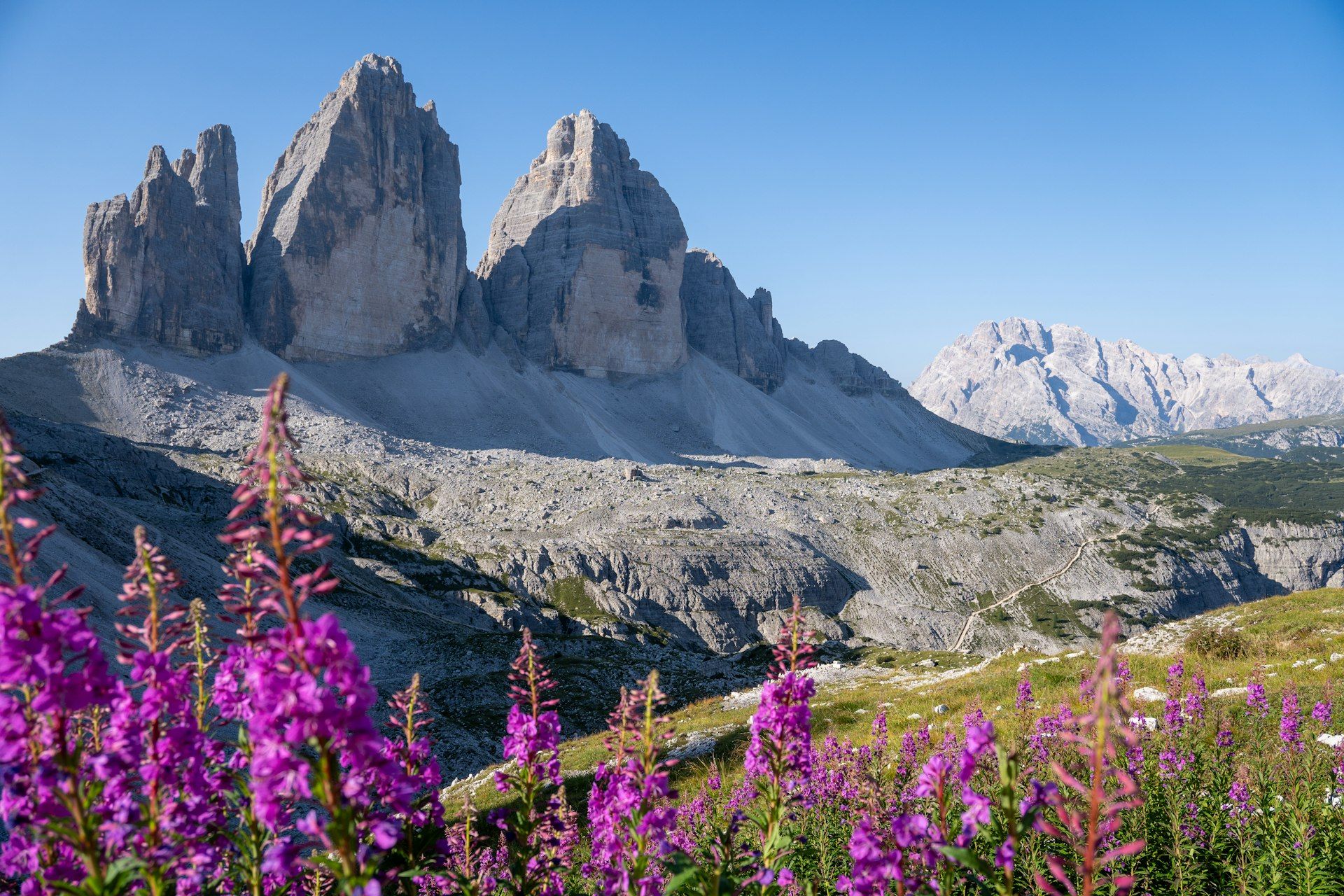
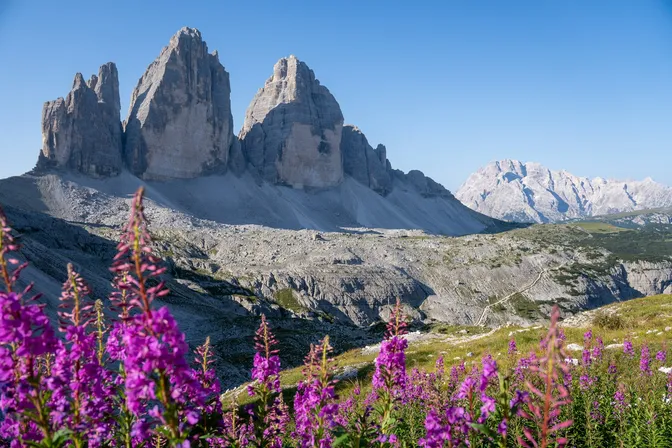
The walk this part of the Dolomites is known for, done as a full loop rather than a photo stop. A toll road climbs from Misurina to Rifugio Auronzo at the foot of the three towers, and a well-used path circles them — past the south faces, through the gap on the east side, and round to the view of the north faces from Rifugio Locatelli. Moderate walking, most of a day, and Lago di Misurina on the way home if there is anything left in your legs.
This day only works in clear weather, and the toll road has to be booked the night before, which makes it easy to postpone: if the forecast for Day 2 is poor, do Day 3 first and move this to the next day. In steady grey, Lago di Braies — about an hour's drive north, with its own parking reservation needed between 09:00 and 16:00 from July to mid-September — is a lake that still rewards a flat walk. The easy version of the loop is the wide track from Rifugio Auronzo to Rifugio Lavaredo and up to Forcella Lavaredo, then back the same way: about two hours, with one short climb.
Tonight: Cortina d'Ampezzo
- Morning
Up the toll road to Rifugio Auronzo
Fifty minutes from Cortina, over Passo Tre Croci and past Lago di Misurina, to the barrier where the toll road starts. In 2026 entry was by online booking only, made by 23:59 the night before, and the ticket covered twelve hours of parking from the time booked. Aim for an early slot: the car park at Rifugio Auronzo sits at the foot of the south faces, and the loop is better walked before the day's crowds arrive. Lace up in the car park, not at the hut — there's nothing to wait for.
Time here: 20 min
- Midday
Round the towers to Rifugio Locatelli
1 hr 30 min from the previous stop
Go anticlockwise: the flat track east past Rifugio Lavaredo, a short climb to Forcella Lavaredo, and then the path drops around the north side, where the three towers turn from a wall into three separate blocks of rock. It takes about an hour and a half to Rifugio Locatelli, and the hut sits exactly where the north faces line up, so eat there. The loop back is the part people underestimate: down into the basin below, then a steady climb up the far side before a gentle return to the car. Allow three and a half to four hours for the whole circuit without rushing.
Time here: 2 hr 30 min
- Afternoon · Optional
Lago di Misurina on the way home
1 hr 40 min from the previous stop
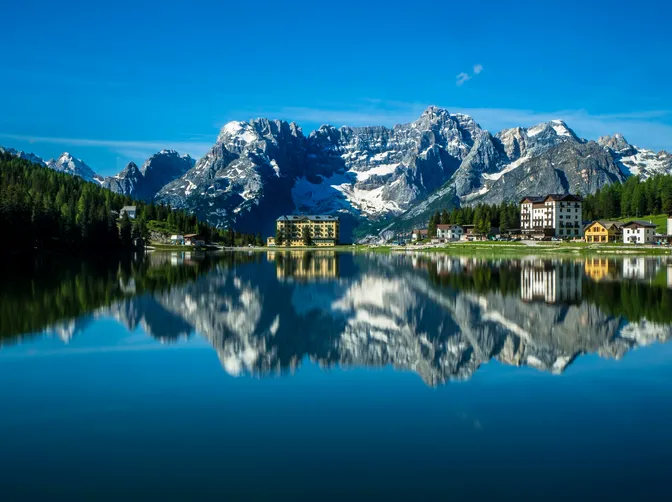
Back at the car, it's a quarter of an hour down the toll road to Lago di Misurina, then twenty-five minutes on to Cortina. The lake is small and flat, with a level path all the way round, and in the late afternoon the Sorapis group reflects in it from the far side. Walk as much of the shore as you want, or just sit. This stop is optional — if the loop took everything you had, drive straight home and leave it.
Time here: 45 min
Day 3: Cinque Torri, a Free Afternoon, and Passo Giau at Dusk
The lighter day, and deliberately placed after the Tre Cime. A chairlift from the Falzarego road lifts you to the Cinque Torri, five rock towers standing on open grass above Cortina, where the Italian army dug trenches and gun positions in the First World War that you can now walk through. Then the afternoon is yours, back in Cortina, before the short drive up to Passo Giau for the evening light.
For something harder than the Cinque Torri, walk to Lago di Sorapis from Passo Tre Croci instead — a longer, rougher half day with some exposed stretches protected by cables, ending at a milky-blue lake under the Sorapis wall. In rain, Cortina's museums (modern art, fossils and local history, run by the Regole d'Ampezzo) make a better morning than a lift into cloud. Giau also works at sunrise, if you would rather get up early than go out again after dinner.
Tonight: Cortina d'Ampezzo
- Morning
Cinque Torri and the wartime trenches
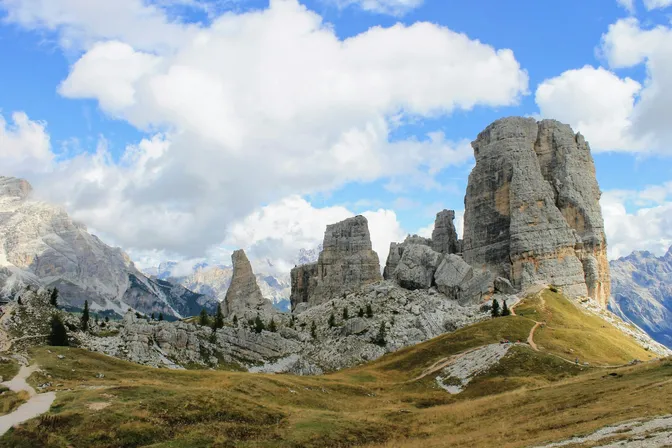
Twenty-five minutes from Cortina on the Falzarego road to the Bai de Dones chairlift, which runs from 09:00. At the top, by Rifugio Scoiattoli, a marked path loops around the base of the towers and through the restored trenches, gun positions and dugouts of the open-air museum, with information boards along the way. It is easy walking on a good path, one to two and a half hours depending on how much you stop, and entry is free. The last chair down is at 17:00, so there's no hurry — have lunch at one of the two huts before you ride back.
Time here: 3 hr
- Evening · Optional
Passo Giau at sunset
35 min from the previous stop
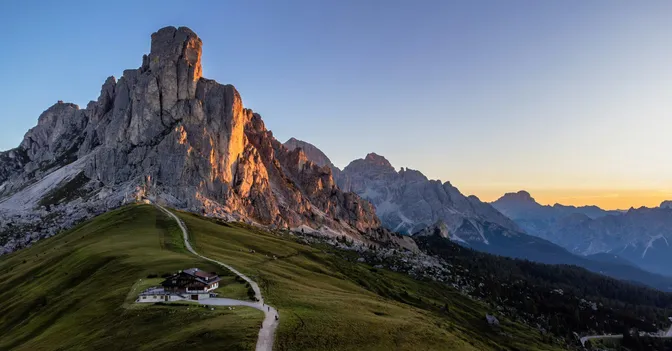
From the chairlift it's half an hour to Passo Giau, and much the same from Cortina — back through Pocol and up a sequence of hairpins onto a wide grassy saddle at about 2,230 metres. In the last hour of light the Ra Gusela wall above the pass turns orange, and the Marmolada and the Civetta line the horizon. Walk a few minutes up the path beside the hut for a clear view over the road. Bring a warm layer and a torch for the walk back to the car; the drive down is slow in the dark, so take your time.
Time here: 1 hr 30 min
Day 4: Over Falzarego and Valparola to Alta Badia
The first move, and a short driving day that still crosses two passes. You leave Cortina on the Falzarego road, stop at the top for the Lagazuoi cable car, and drop over Passo Valparola into Alta Badia, one of the Ladin-speaking valleys of South Tyrol. The front line of the First World War ran along this crest, and the morning is spent inside it. The afternoon goes to Santa Croce, a pilgrimage church under a sheer limestone wall on the other side of the valley.
The Lagazuoi tunnels are one of the few high outings that still work in poor weather — the operator itself recommends them on grey days — as long as the cable car is running. In rain or low cloud, skip Santa Croce and spend the afternoon at the Museum Ladin in the castle at San Martin de Tor, a short drive north of the La Crusc lift. Santa Croce is also the part to drop if the morning runs long: Corvara is a quarter of an hour from its lift.
Tonight: Corvara, Alta Badia (two nights)
- Morning
Lagazuoi by cable car, and the way down
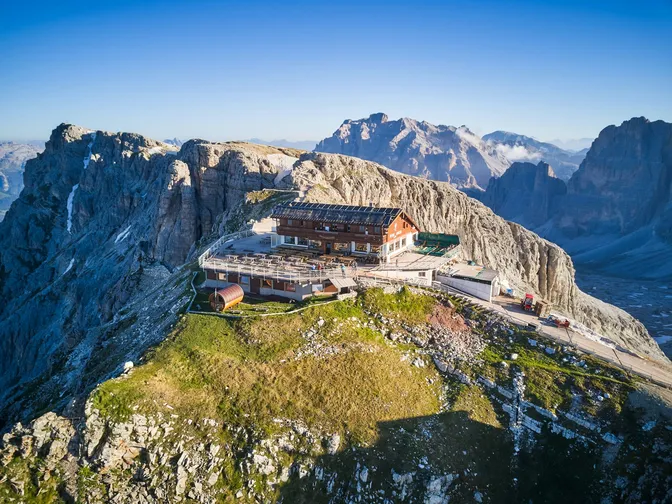
Check out, then half an hour on the Falzarego road to the top of the pass, where the cable car climbs the cliff in a single span in a few minutes. At the top, Rifugio Lagazuoi's terrace looks across to the Tofane, the Civetta, the Marmolada and the Sella. There are three ways down, and they are different things. The cable car is the easy one. The ordinary footpath — trails 401 and 402, past Forcella Lagazuoi and Forcella Travenanzes beside the ski slope — is an hour to an hour and a half on foot to the pass on an open, marked path that needs only walking boots. The third is the Lagazuoi tunnel, more than a kilometre dug by Italian troops inside the mountain during the war: steep, dark and wet, with a helmet, a headlamp and gloves needed — bring them or rent them at the valley station before you ride up. The operator grades it easy, but it is not for anyone uneasy in enclosed spaces or on slippery steps, and from the top to the car takes two and a half to three hours.
Time here: 3 hr
- Afternoon
Santa Croce, under the Sas dla Crusc
1 hr from the previous stop
Over Passo Valparola and down through San Cassiano and La Villa — about half an hour's drive to the La Crusc lift at Badia. Two gondolas in a row lift you to the small pilgrimage church and hut at the foot of the Sas dla Crusc, a limestone wall that runs straight up behind them. From there the path heading north across the open meadows toward Armentara is level, easy walking; go as far as the afternoon allows and come back the same way. The last gondola down is at about 17:15. From the bottom it's a quarter of an hour to Corvara.
Time here: 2 hr 30 min
Day 5: Around the Sella
The day this base is here for, and the fullest of the trip if you choose to make it so. Corvara sits on the ring of four passes around the Sella massif, so the loop starts and ends at the hotel door: Campolongo, Pordoi, Sella and Gardena in that order, keeping the massif on your right the whole way round. The plan itself is gentle — about an hour and fifty minutes of driving, a cable car and two short walks. The one strenuous option on it, Piz Boè, is an upgrade for experienced hikers, not part of the day.
The passes are pointless in low cloud. If today is grey and tomorrow looks better, use today for Santa Croce or the Museum Ladin, and drive to Val Gardena tomorrow the long way — Campolongo, Pordoi and Sella, then down into Selva — instead of over Passo Gardena.
Tonight: Corvara, Alta Badia
- Morning
Passo Pordoi and the Sass Pordoi cableway
Forty minutes from Corvara: over the wooded saddle of Campolongo, down through Arabba, and up the long run of hairpins to Passo Pordoi. The cableway from the pass lifts you to the Sass Pordoi terrace at 2,950 metres in a few minutes, onto a bare limestone plateau that feels nothing like a viewpoint, with the Marmolada glacier across the gap. The plan here is an easy hour walking around the edge of the plateau, then lunch at the pass. The optional, strenuous upgrade is Piz Boè, the highest point of the Sella at 3,152 metres: about two hours each way on a stony path with a short roped section near the top, which turns this into a four-to-five-hour mountain outing before the rest of the loop. Only in settled weather, and only if you are sure of your footing on rock.
Time here: 3 hr
- Afternoon
Passo Sella
25 min from the previous stop
Twenty-five minutes on from Pordoi, the road climbs to Passo Sella directly under the south face of the Sassolungo, the massif you will spend the next two days looking at from the other side. Park at the long pull-out near the top and walk for an hour through the Città dei Sassi, a field of huge fallen boulders below the Sassolungo, on an easy, marked path. It is a sheltered walk, and a good one to keep if the wind has come up at Pordoi.
Time here: 1 hr 15 min
- Evening · Optional
Passo Gardena, and back down to Corvara
25 min from the previous stop
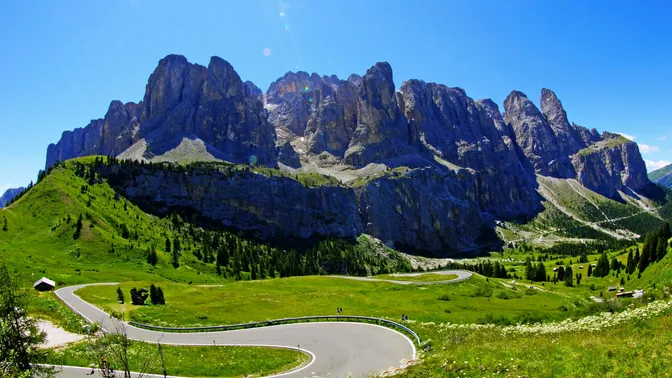
Down through Plan de Gralba and up again to Passo Gardena, about twenty-five minutes. By late afternoon the crowds have mostly gone, and the low light picks out the Sella's walls and the Cir towers above the pass. Walk a few minutes up the path from the road for the view down into Alta Badia. Corvara is twenty minutes below, which makes this the easiest pass of the week to stay on until the light goes.
Time here: 1 hr
Day 6: To Val Gardena, and Up to Seceda
The second move, and a short one: fifty-five minutes over Passo Gardena, down through Selva and Santa Cristina to Ortisei, where the Seceda cable car leaves from the edge of the village. That puts Seceda's ridge on the day you arrive, while the car is still loaded and the legs are fresh. The hotel can wait until afternoon.
If the cloud is down on the ridge, swap today with tomorrow — Alpe di Siusi holds up far better under a grey sky than Seceda does. The harder version of Seceda is to walk down instead of riding: past the Pieralongia hut to the Col Raiser gondola, down to Santa Cristina, and back to Ortisei by valley bus. In rain, Ortisei's Museum Gherdëina covers the valley's woodcarving and Ladin history, and the Ötzi museum in Bolzano is forty-five minutes away.
Tonight: Ortisei, Val Gardena (two nights)
- Morning
Seceda and its ridge
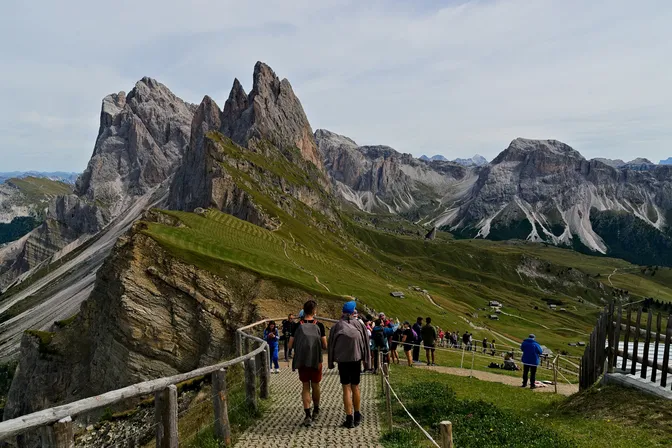
Leave Corvara by about 08:30 to be in Ortisei before 09:30, and park at or near the valley station. Two stages of cable car take you to the top at about 2,500 metres, where the grass tilts gently up to the edge and then stops, with the Odle spires dropping away on the far side. The walk along the ridge is the reason to be here: easy to moderate, on a wide path, as far as you like and back. The huts on the slopes below serve dumplings and speck with the view. Give it three or four hours, and ride down while the light is still good.
Time here: 4 hr
- Evening · Optional
Ortisei in the evening
40 min from the previous stop
Check in, then walk the pedestrian centre in the early evening. Ortisei has been a woodcarving town for centuries, and some of the workshop windows along the main street are worth stopping at. Street signs are in Ladin, Italian and German, in that order. That's all the programme there is — tomorrow is a walking day.
Time here: 1 hr 30 min
Day 7: Alpe di Siusi on Foot
No driving today at all. The gondola from the middle of Ortisei lands on Alpe di Siusi, a high rolling meadow that runs on for kilometres, and the day is spent walking across it at whatever pace suits. It is the gentlest day of the eight by design: the last full day before the drive home, spent on your feet rather than behind the wheel.
For sunrise or sunset on the plateau, you would need to drive up: the road is closed to private cars from 09:00 to 17:00, and outside those hours only with an online parking reservation at Compatsch, which can be booked up to six days ahead. Harder walkers can climb from the plateau toward the Sciliar, whose flat-topped wall closes the view to the south — a long, steep day that needs an early start. In rain, the plateau is still walkable in a light shower, but in a real storm stay low and take the museum options from Day 6.
Tonight: Ortisei, Val Gardena
- Morning
The gondola up to Mont Sëuc
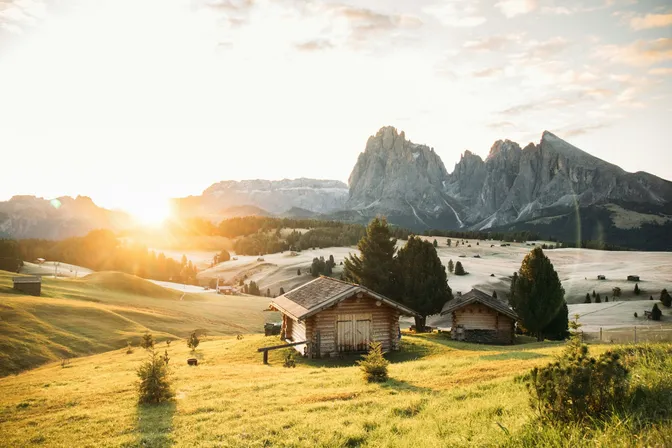
The Mont Sëuc cabin leaves from the middle of Ortisei, a walk from the hotel, from 08:30. Ten minutes later you step out at 2,000 metres onto the northern edge of the plateau, with the Sassolungo and the Sassopiatto on your left and the Sciliar wall far off to the south. Take a few minutes at the top to get the lie of the land: the farm tracks fan out across the meadows below you, and all of them are signposted.
Time here: 45 min
- Midday
Across the meadows to Compatsch
1 hr 30 min from the previous stop
The walk to Compatsch is about five kilometres of farm track and meadow path, gently downhill, an hour and a half at a slow pace — and the obvious way to spend the middle of the day is to make it longer. Detour to one of the huts scattered across the plateau for lunch, sit in the grass, and let the afternoon go. Hay barns, grazing cows, and the Sassolungo on the skyline the whole time. Come back the way you came — the plateau bus only runs between Compatsch and Saltria, so it won't take you back to the gondola — and ride down to Ortisei before the last cabin.
Time here: 4 hr
Day 8: Val di Funes, Then the Drive Home
The longest drive of the trip, placed on the day it can't be avoided. Val di Funes lies just off the motorway on the way south, and the church of Santa Maddalena with the Odle behind it is a fitting last view. Then it's motorway to Venice: about four hours of driving in all today, which is why this stop is optional.
With a flight before about 17:00, skip Val di Funes and drive straight to the airport — about three and a quarter hours from Ortisei. Flying out of Verona instead of Venice takes an hour off, if a one-way drop-off works for your rental. With an early-morning flight, don't try it on the day at all: spend the last night near Marco Polo and make the drive the afternoon before.
- Morning · Optional
Santa Maddalena, Val di Funes
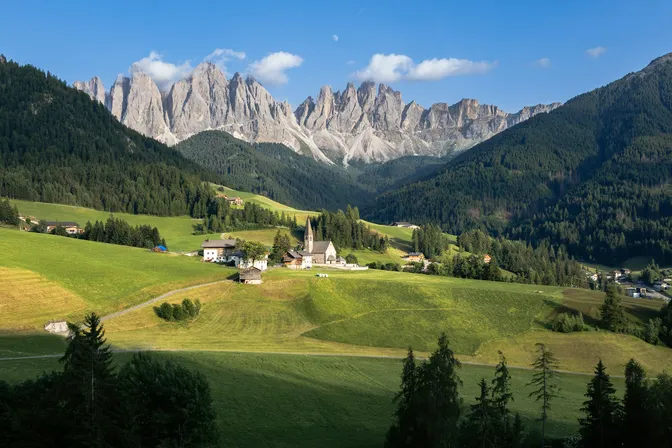
Fifty minutes from Ortisei, down to the motorway at Chiusa and then up the side valley. Day visitors can no longer drive up to the church or the viewpoint from May to November: park in the car park in the village and walk up — twenty to thirty minutes, with the church, the meadows and the Odle wall together at the end of it. Give it an hour and a half at most — the drive ahead is long.
Time here: 1 hr 30 min
- Afternoon
South to Marco Polo
3 hr 20 min from the previous stop
Back down to the A22 at Chiusa, then motorway most of the way: south past Bolzano and Trento to Verona, then east on the A4 across the Veneto plain. About three hours and ten minutes to the airport, with the rental car to refuel and return at the end. Leave room for a stop — this is a long run at the end of a week of hairpins.
Time here: 30 min
Don't do this
- Don't pair the Tre Cime loop with Lago di Braies on the same day. Either one is most of a day once you count the driving, the parking rules and the walk; Braies is here as a grey-weather swap, not an add-on.
- Don't bolt Lake Garda, Venice or a city day onto this week. Each costs a full day of driving or sightseeing that this route spends in the mountains instead. If that is the trip you want, the 7-day Venice loop through Val Gardena and Lake Garda is built for it.
- Don't plan a pass day without checking the event calendar. On Sellaronda Bike Day the four Sella passes close to cars for most of the day, on Dolomites Bike Day it is Campolongo, Falzarego and Valparola, and the Maratona dles Dolomites in early July shuts the passes on its course, Giau, Falzarego and Valparola among them, until early afternoon. The dates are in the facts below.
Useful travel information
Budget estimate
Estimate only, and for lifts and access rather than the whole trip. Riding every lift on the route with a return ticket comes to roughly €235 per adult outside August: Seceda €74, Alpe di Siusi €41, Sass Pordoi €32, La Crusc to Santa Croce €30.60, Lagazuoi €29.50 and Cinque Torri €27.50. August fares are a few euros higher on the Cortina lifts, and both Cortina operators take 5% off for card payment. The Tre Cime toll road is €40 per car on top, and motorway tolls apply at both ends of the trip. Walking down from Lagazuoi through the tunnels instead of riding back saves a few euros but means renting a helmet and headlamp at the pass unless you bring your own. Prices checked September 2026; operators change fares from season to season.
Tips
- The weather strategy is built into the bases: each one has two days that can trade places. In Cortina, Days 2 and 3 swap. In Alta Badia, if Day 5 is grey, drive to Val Gardena on Day 6 the long way over Pordoi and Sella instead of over Passo Gardena. In Val Gardena, Seceda and Alpe di Siusi can switch. Decide each evening on the next morning's forecast, and ride lifts early — summer cloud in these mountains builds through the day far more often than it clears.
- Book the Tre Cime toll road the evening before, not weeks ahead. In 2026 bookings closed at 23:59 the day before you drove, and the booking wasn't valid without the car's plate number — so watch the forecast, choose Day 2 or Day 3 the night before, and book then with the rental car's plate to hand.
- Buy the Seceda ticket online the evening before. Tickets are sold at the valley station too, but the operator recommends buying online because Ortisei's parking fills early on clear days.
- Fill the tank in the valley towns — Cortina, Corvara, Ortisei — rather than counting on a station at a pass, and carry a layer in the car at all times. At Sass Pordoi or Lagazuoi you step out of the lift at around 2,750–2,950 metres, where it can be cold in August.
- Eat at the huts. Rifugi on this route serve proper mountain food at lunchtime, and the menu shifts with the valley: casunziei (beetroot-filled pasta) around Cortina, then dumplings, speck, barley soup and Kaiserschmarrn once you cross into South Tyrol. Lunch on the mountain is part of the day, not a break from it.
- Read this page in two layers. The route, the bases, the drive times and the logic of where the car helps are stable — they are why the trip is shaped this way. The opening dates, lift fares, toll-road and parking reservations and pass-closure days are not: several of them moved during 2026 alone. Everything perishable is gathered in the facts below with the date it was checked, so re-read that list a week before you travel and again the night before any day built around a lift or a booked road.
Good to know (19)
- The toll road from Misurina to Rifugio Auronzo, below the Tre Cime di Lavaredo, costs €40 per car in 2026 and can only be used with an online booking made by 23:59 on the day before. The booking must include a valid licence plate, which can be changed once, up to the same deadline. The ticket covers parking for 12 hours from the access time chosen. The road is generally open from late May to late October, depending on conditions.Checked September 25, 2026
- From 1 July to 15 September 2026, between 09:00 and 16:00, the road into the Braies valley to Lago di Braies is open to cars only with an online parking reservation. Outside those hours and dates no reservation is needed, subject to space in the car parks.Checked September 25, 2026
- The Cinque Torri chairlift, from Bai de Dones at 1,889 m to 2,255 m, runs 6 June to 11 October 2026, 09:00 to 17:00, with the last rides up and down both at 17:00. An adult return is €27.50 (€30 in August) and a single €20.50 (€22.50 in August), with 5% off for card payment.Checked September 25, 2026
- The First World War open-air museum at the Cinque Torri — restored Italian trenches, gun positions and shelters around the towers, with information boards — is free to visit, and a visit takes between one and two and a half hours depending on the route.Checked September 25, 2026
- The Lagazuoi cable car from Passo Falzarego runs from 30 May to 18 October 2026, every 15 minutes from 09:00, with the last ride up at 16:40 and the last ride down at 17:00. An adult return is €29.50 and a single €21, rising to €34 and €24 in August, with 5% off for card payment.Checked September 25, 2026
- The Lagazuoi tunnel descent, from the top of the cable car back to Passo Falzarego, takes 2.5 to 3 hours in total, of which the passage through more than a kilometre of tunnel takes under an hour. The operator lists appropriate footwear, gloves, a headlamp and a helmet as the gear needed, rents equipment at Passo Falzarego, and describes the route as a good choice in poor weather.Checked September 25, 2026
- The marked footpath from Rifugio Lagazuoi (2,752 m) down to Passo Falzarego (2,105 m), on trails 401 and 402 past Forcella Lagazuoi and Forcella Travenanzes, takes 1 to 1.5 hours and is graded easy by the cable-car operator.Checked September 25, 2026
- The two La Crusc gondolas from Badia up to the Santa Croce sanctuary run 13 June to 4 October 2026 — La Crusc 1 from 08:30 to 17:30, La Crusc 2 from 08:45 to 17:15. An adult summer return covering both stages is €30.60.Checked September 25, 2026
- The Sass Pordoi cableway from Passo Pordoi runs 14 May to 1 November 2026, 09:00 to 17:00, closing at 16:30 from 19 October. A return ticket is €32 for adults.Checked September 20, 2026
- Piz Boè, at 3,152 m the high point of the Sella group, is about two hours on foot from the Sass Pordoi cableway's top station, on a stony path with a short section secured by ropes near the summit.Checked September 25, 2026
- The Sella, Pordoi, Gardena, Campolongo and Costalunga passes are all listed as open throughout the year, subject to temporary closures for snow and avalanche risk. Passo Fedaia, below the Marmolada, is open May to October only.Checked September 20, 2026
- On Sellaronda Bike Day — 5 June and 11 September 2027 — the Gardena, Campolongo, Pordoi and Sella passes are closed to motor traffic and given over to cyclists. The published closure window for the 2026 editions ran 09:00 to 16:00; confirm the hours for your date.Checked September 22, 2026
- On Dolomites Bike Day — Saturday 19 June 2027 — the Campolongo, Falzarego and Valparola passes close to motor traffic from 09:00 to 15:00.Checked September 25, 2026
- The Maratona dles Dolomites cycling race closes the passes on its course from early morning until early afternoon, reopening gradually once the riders have passed; on the Cortina side that includes Passo Giau, Passo Falzarego and Valparola. The 2026 edition was held on 5 July; check the date for your year before planning a pass day in early July.Checked September 25, 2026
- Passo Gardena’s planned restriction on day visitors’ cars did not take effect as a physical closure. The trial that began on 1 September 2026 runs as digital monitoring only — traffic is counted, with no roadblocks and no fines — and South Tyrol intends to use the data as the basis for later traffic-calming measures. The final rules had not been announced as of September 2026, so check before you drive it.Checked September 22, 2026
- The Seceda cable cars from Ortisei run 22 May to 2 November 2026, 08:30 to 17:30. A return ticket covering both stages is €74 for adults. Tickets are also sold at the stations, but the operator recommends buying online in advance because parking in Ortisei is limited, and Gardena Card holders must book on seceda.it.Checked September 25, 2026
- The Ortisei–Mont Sëuc cable car up to Alpe di Siusi runs 1 May to 5 June 08:30–17:00, 6 June to 16 October 08:30–18:00, and 17 October to 2 November 08:30–17:00. An adult ticket is €29 one way and €41 return.Checked September 20, 2026
- The road up to Alpe di Siusi is closed to private cars from 09:00 to 17:00; driving down from Compatsch is unrestricted at any hour, and outside those hours you may drive up only with an online parking reservation. From 29 June 2026, the two plateau car parks require an online reservation, bookable up to six days ahead — P1 Spitzbühl at €15 per car per day, P2 Compatsch at €30. Neither lot allows parking between 23:00 and 05:00.Checked September 20, 2026
- In Val di Funes, a barrier now restricts the road up to the Santa Maddalena church and its panorama viewpoint to residents and hotel guests from May to November; day visitors park in the valley and walk up. There is no booking system for the valley car park — once it fills, cars are directed to spaces further down the valley — and the daily parking fee is being raised.Checked September 20, 2026
Frequently asked questions
- Is 8 days enough for the Dolomites?
- Enough for three valleys done properly, not for the Dolomites as a whole. This route covers Cortina, Alta Badia and Val Gardena and leaves out Val di Fassa, the Pusteria side around Braies, the Pale di San Martino and the Brenta group, each of which would need its own base. Three bases in eight days is one more move than many planners suggest for a week — two bases, Cortina and Val Gardena, is the common split — and it only works here because Alta Badia sits between the other two, so each transfer is only about an hour of driving. If you would rather move only once, drop Alta Badia, give Cortina four nights and Val Gardena three, and drive the Sella loop from Ortisei.
- Venice or Verona — which airport works better?
- It depends on your flights and the rental terms as much as the map. Venice is the easier arrival: Marco Polo to Cortina is about two hours and twenty minutes by motorway and the Alemagna road, with no pass to cross at the end of a flight. Verona is the quicker exit: from Val di Funes on the last morning it is about two hours, against three hours and ten minutes to Venice, because Val Gardena sits on the A22 that runs south to Verona. This page returns the car to Venice because a same-place return keeps the rental simple; if a one-way drop-off prices well, flying out of Verona takes an hour off the longest drive of the trip.
- Where should I stay in Alta Badia — Corvara, La Villa or San Cassiano?
- Corvara, for this route. It sits where the roads to Passo Campolongo and Passo Gardena leave the valley, so Day 5's loop around the Sella starts and ends at the door and Day 6's drive to Val Gardena starts uphill straight away. San Cassiano is quieter and closer to the Valparola road you arrive on from Cortina; La Villa is between the two and closer to the Santa Croce lifts. Both work — they just add ten or fifteen minutes to each pass day.
- How hard are the hikes on this route?
- Every day has an easy version, and nothing harder is required. Easy, on good paths with little climbing: the Cinque Torri trenches, the footpath down from Lagazuoi, the walk out from Santa Croce, the Alpe di Siusi meadows. Moderate: the Tre Cime loop (around ten kilometres with one sustained climb after Rifugio Locatelli) and the Seceda ridge. The three harder options are a different undertaking. Piz Boè and Lago di Sorapis both have rocky, exposed stretches protected by fixed ropes or cables, and the Lagazuoi tunnel is steep, dark and slippery underfoot. Conditions change them more than any description can — wet rock, old snow into early summer and afternoon thunderstorms all do — so take them on only with proper boots, some mountain experience, a settled forecast and an early start, and be ready to turn back. If you would rather not go alone, local mountain guides lead all three.
- When is the best time to drive this route?
- Mid-June to early October is the window in which everything on this page was open at the same time in 2026. The La Crusc gondolas to Santa Croce set both ends (13 June to 4 October) and the Cinque Torri chairlift (6 June to 11 October) nearly does; the rest run longer — the Tre Cime road, Seceda and Sass Pordoi from late May into late October or early November. So the shoulders don't close the trip, they take pieces out of it, and operators set each year's dates in spring and move them for snow: check the facts below against the new timetables before you book. Inside the window, July and August bring the biggest crowds, heavy traffic on the passes and frequent afternoon thunderstorms; September is usually calmer and clearer, with shorter days and some huts beginning to close.