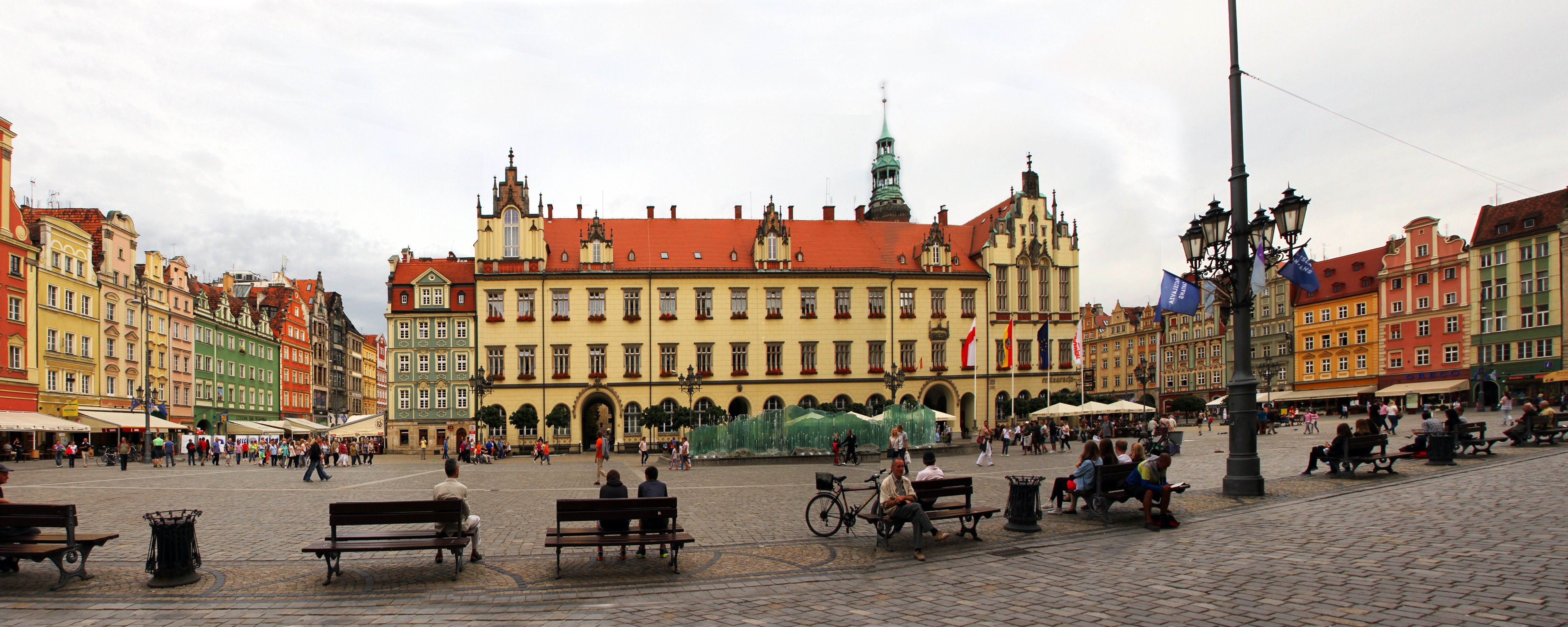
Wrocław's Market Square (Rynek) with the Gothic-Renaissance Old Town Hall at its center, framed by colorful merchant houses

Gerd Eichmann / Wikimedia Commons, CC BY 4.0

Poland

Where to Stay in Wrocław

Wrocław (formerly the German city of Breslau) is Poland's fourth-largest city and the historic capital of Lower Silesia, built where the Oder River splits into a dozen channels and islands. That layout gives it more bridges than almost any city in Europe outside Venice, Amsterdam, St. Petersburg, and Hamburg. Its rebuilt Rynek (Market Square) is one of the largest medieval squares on the continent, ringed by Gothic, Renaissance, and Baroque merchant houses centered on the pinnacled Old Town Hall. A short walk north across the Oder, Ostrów Tumski — Cathedral Island — is where the city began over a thousand years ago, and its surviving gas lamps are still lit by hand every evening by a working lamplighter. Wrocław spent centuries as a German city before its population was almost entirely replaced after 1945, when the war-shattered Breslau became Polish Wrocław and was resettled largely by people displaced from formerly Polish territory further east — a history the city is unusually open about telling. What's easy to miss walking the reconstructed streets today is how much sits within a few minutes of each other here: the University of Wrocław's Baroque Aula Leopoldina, Max Berg's pioneering early-concrete Centennial Hall, and hundreds of small bronze dwarf statues scattered around the city — a legacy of a 1980s anti-communist street art movement that's since become one of Wrocław's best-known quirks.
Quick facts

Best time to visit
Late May through June and September bring mild weather and thinner crowds than July and August, when the Rynek's outdoor cafés and the river islands are busiest. A Christmas market fills the Rynek from late November through the holidays, with mulled wine stalls beneath the Old Town Hall, though days are short and cold. Winters here are damp and grey more often than snowy, so pack for rain.
Renting a car
The Rynek and much of Stare Miasto are pedestrianized, and street parking in the center is limited and metered. Trams reach everywhere covered in this guide, and central Wrocław is compact enough to walk between the Rynek and Ostrów Tumski.

Where to stay

Compare neighborhoods

AreaBest forAdvantageTrade-off
Stare MiastoFirst-time visitorsAs central as it gets — the Rynek, its restaurants, and most of Wrocław's best-known sights are right outside the door.Rooms facing the square or its busiest side streets can be loud on weekend nights.
Ostrów TumskiCouplesThe most atmospheric, peaceful base in central Wrocław, with real history at every turn.Very few restaurants or bars of its own, and only a small handful of hotels to choose from.

Our picks for Wrocław

A handful of editorial calls across every neighborhood above, not just the highest star rating — see each hotel's own card further down for the full case for and against it.

A couple of hotels in Stare Miasto

Stare Miasto is the top-recommended area to stay in Wrocław.

Hotel Monopol

★★★★★
  • 🏛️ Best for architecture & design

Our take Hotel Monopol pairs a storied 19th-century building — sandstone facades, curved ceilings, black and sable marble inside — with five-star service, on a street quiet enough to sleep well while staying an easy walk from the Rynek.

Good for

  • Luxury travelers
  • Couples
  • Architecture lovers

Travelers who want a genuinely historic 5-star stay with real architectural pedigree, close to the Rynek without being on top of it.

Why we like it

  • A restored 1892 building with genuine architectural character rather than a generic luxury fit-out — sandstone facades, curved ceilings, and marble interiors throughout.
  • Individually designed rooms and suites, so the layout and decor vary from room to room.
  • A wellness and spa area plus two restaurants on site, useful for evenings you'd rather not go out.
  • On a quieter side street off Świdnicka, an easy walk from the Rynek without its late-night noise.

What to know

  • It's about a 5-8 minute walk from the Rynek itself rather than directly on the square.
Check availability on Booking.com

Hotel Europeum

★★★
  • 💰 Best value

Our take Europeum delivers a real Old Town address a few minutes from the Rynek, with soundproofed rooms and a free sauna that punch above what its 3-star rating suggests.

Good for

  • Couples
  • First-time visitors

Travelers who want a genuinely central Old Town base without paying luxury-hotel prices.

Why we like it

  • A five-minute walk from the Rynek and Plac Solny, at a noticeably lower price than most hotels this central.
  • Soundproofed windows in the rooms, a real advantage on a street a few blocks from Wrocław's busiest square.
  • Free access to a sauna and small fitness area, unusual for a boutique hotel in this price bracket.
  • Underground parking on site, useful given how limited street parking is in the Old Town.
Check availability on Booking.com

Useful travel information

Poland uses the złoty (zł), not the euro — cards are accepted almost everywhere, but small change helps for market stalls and tram ticket machines. English is spoken widely in the center's hotels, restaurants, and shops, especially among younger staff. Wrocław has no metro; an extensive network of trams and buses covers the city on a shared ticket system, and the historic core is flat and compact enough to explore on foot. Tipping isn't obligatory, but rounding up or adding around 10% at restaurants is common.

Tips

  • Budget an hour or two for dwarf-hunting — Wrocław has roughly a thousand small bronze krasnale statues tucked around the city, with a dense cluster near Świdnicka Street and the Rynek.
  • Climb the university's Mathematical Tower for a rooftop view over the Rynek's colorful facades and the twin spires of Ostrów Tumski.
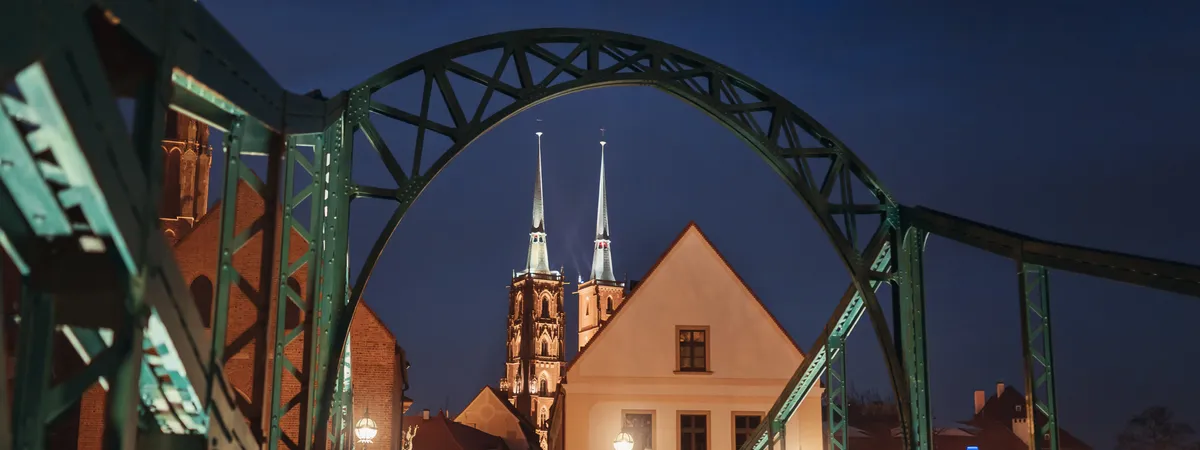
  • Cross the Tumski Bridge into Ostrów Tumski around dusk to watch the city's lamplighter hand-light the island's surviving gas lamps, a tradition kept alive in only one other European city.
  • The Centennial Hall and Japanese Garden, a short tram ride from the center, are worth a half-day if you have more than a weekend — the hall was one of the earliest large reinforced-concrete buildings in the world and is UNESCO-listed.

Frequently asked questions

How many days do I need in Wrocław?
Two to three days covers the Rynek, Ostrów Tumski, and a bit of dwarf-hunting comfortably. Add a half-day for the Centennial Hall and Japanese Garden if architecture interests you or you have more time to spare.
Is Wrocław walkable?
Yes — the Rynek and Ostrów Tumski are flat, compact, and connected by about a 15-minute walk across a handful of bridges, so most sightseeing happens on foot. Trams cover trips further out, like the Centennial Hall.
Is Wrocław's Old Town actually historic, or was it rebuilt?
Both — the street layout and much of the architectural detail are genuinely centuries old, but most of the physical buildings around the Rynek and on Ostrów Tumski were destroyed in the 1945 siege and rebuilt afterward from photographs and pre-war plans.