


The white spires of St. Louis Cathedral and the Andrew Jackson equestrian statue in Jackson Square, French Quarter

Rasrob1 / Wikimedia Commons, CC BY-SA 4.0

United States

Where to Stay in New Orleans

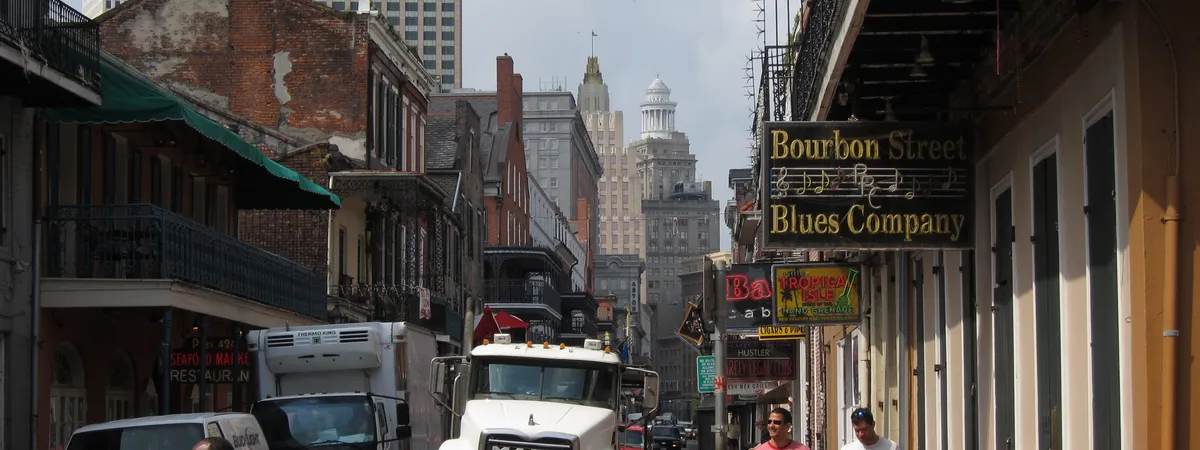
New Orleans is a 300-year-old port city built on jazz, Creole food, and architecture unlike anywhere else in the country. This guide covers the areas that matter most to visitors: the wrought-iron balconies and Bourbon Street energy of the French Quarter, the converted 19th-century warehouses and museums of the Warehouse District, and the local live-music scene along Frenchmen Street in Faubourg Marigny. Don't miss Jackson Square and St. Louis Cathedral, a beignet at Café du Monde, and a night of live jazz — on Frenchmen Street if you want it away from the crowds, or Bourbon Street if you want the classic scene.

Quick facts

Best time to visit
Visit between November and February for the mildest weather, or plan around Mardi Gras if you want the city at its biggest and loudest (the date moves each year with the Christian calendar). March and April bring spring festivals like French Quarter Fest and Jazz Fest. Summers are hot, humid, and prone to sudden downpours, and hurricane season runs June through November.
Renting a car
Skip the rental car for a trip centered on these three areas — parking is scarce and expensive, streets are narrow and often one-way, and everything here is walkable or a short rideshare away. Rent one only if you're planning day trips outside the city, like the River Road plantations or Cajun Country.

Where to stay

Compare neighborhoods

AreaBest forAdvantageTrade-off
French QuarterNightlifeJackson Square, Bourbon Street, and the riverfront are all within a short walk of each other.Bourbon Street's nightlife noise carries for blocks and doesn't quiet down until the early hours.
Warehouse DistrictArchitecture loversNew Orleans' museum row — the National WWII Museum, the Ogden Museum, and more — all within walking distance, with a quieter evening scene than the Quarter.It can feel like a business district after dark outside of restaurant rows, with fewer late-night options than the French Quarter or Marigny.
Faubourg MarignyNightlifeNew Orleans' live-music scene without Bourbon Street's crowds, a short walk from the French Quarter.Frenchmen Street's few blocks of clubs are the main draw — it's a quieter, more residential base than the Quarter.

Our picks for New Orleans

A handful of editorial calls across every neighborhood above, not just the highest star rating — see each hotel's own card further down for the full case for and against it.

A couple of hotels in French Quarter

French Quarter is the top-recommended area to stay in New Orleans.

Hotel Villa Convento

★★★
  • 💰 Best value

Our take A straightforward, well-kept way into the French Quarter at a fraction of what the bigger hotels charge — a few blocks from Bourbon Street, on a quieter residential stretch near Ursulines Avenue.

Good for

  • Budget travelers
  • First-time visitors

Budget-conscious travelers and first-timers who want a real French Quarter address without paying for a full-service hotel.

Why we like it

  • A genuine French Quarter address at a price point most of the neighborhood's hotels don't reach
  • A small courtyard gives it a quieter, more residential feel than hotels directly on the main tourist streets
  • Family-run for decades, with the kind of personal service a larger chain hotel doesn't offer

What to know

  • Rooms are compact and simply furnished — this is a budget-friendly guesthouse, not a full-service hotel
  • Some sections of the building have no elevator, worth knowing if stairs are an issue
  • It's a several-block walk to Bourbon Street and Jackson Square, longer than staying more centrally
Check availability on Booking.com

Hotel Monteleone

★★★★
  • 🏆 Our overall pick
  • 📍 Best location

Our take The grand-hotel choice in the French Quarter — big enough to feel like a proper hotel with a pool, spa, and restaurant, but still one block from Bourbon Street and steeped in more than a century of New Orleans history.

Good for

  • First-time visitors
  • Architecture lovers
  • Couples

First-time visitors who want a classic, full-service French Quarter hotel, and history or literature fans drawn to a hotel that's hosted generations of Southern writers.

Why we like it

  • The revolving Carousel Bar is a genuine only-in-New-Orleans experience, not a gimmick added for tourists
  • Rooftop pool and sun deck with views across the French Quarter's rooftops
  • Family-owned and run since 1886, with a real literary history — Tennessee Williams, Truman Capote, and other writers stayed and wrote here

What to know

  • It's a large hotel by French Quarter standards (570 rooms), so it can feel busier than the neighborhood's small boutique properties
  • Rooms facing Royal Street can pick up some street noise — ask for a higher floor or a courtyard-facing room if you want it quieter
Check availability on Booking.com

Useful travel information

The US dollar is the currency. The French Quarter, Warehouse District, and Faubourg Marigny are each walkable on their own and a short rideshare or streetcar ride apart. The Riverfront streetcar line connects the French Quarter to the Warehouse District along the river; the St. Charles Avenue line reaches the Garden District and Uptown. Hurricane season runs June through November — most visits are unaffected, but check the forecast if you're traveling then.

Tips

  • Mardi Gras and Jazz Fest both bring huge crowds and much higher hotel rates — book months ahead if your trip lines up with either one.
  • To-go cups of alcohol are legal on the street in New Orleans, unlike most US cities — just stick to plastic or paper cups, since open glass containers aren't allowed.

Frequently asked questions

Where should first-time visitors stay in New Orleans?
Stay in the French Quarter for the classic, walk-to-everything experience, or the Warehouse District if you'd rather be near the National WWII Museum and a quieter evening scene.
Is New Orleans walkable?
The French Quarter, Warehouse District, and Faubourg Marigny are each very walkable on their own, and close enough together to walk between if you don't mind a 15-20 minute stroll — otherwise rideshare or the streetcar covers the gap.
Do I need a car in New Orleans?
No — skip it for a trip centered on these areas. Parking is scarce, streets are narrow, and everything here is walkable or a short rideshare away.