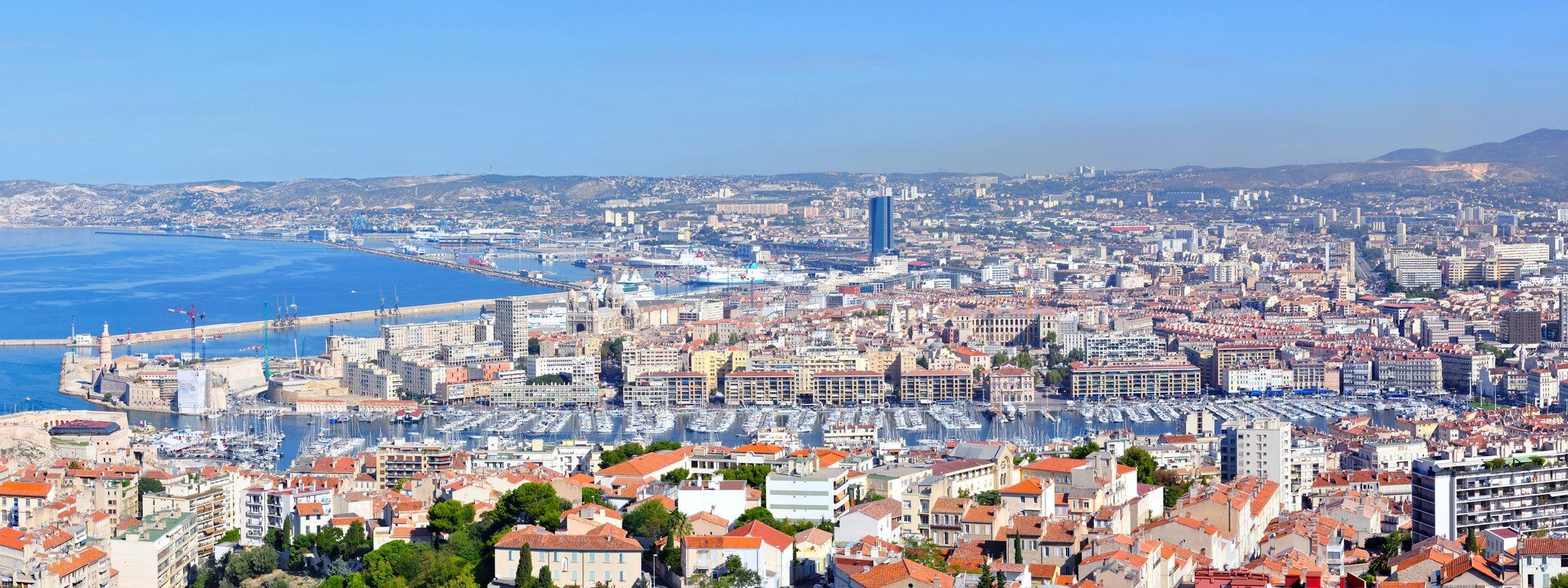
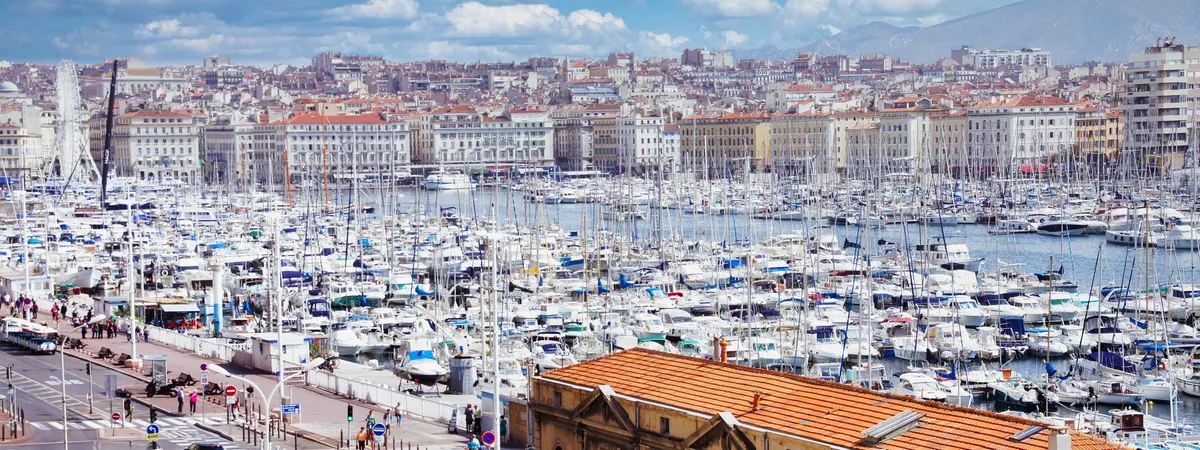
Aerial view from Notre-Dame de la Garde over Marseille's Vieux-Port, its marina packed with boats, and the city stretching out behind it

Tobi 87 / Wikimedia Commons, CC BY-SA 3.0

France

Where to Stay in Marseille

Marseille is France's second-largest city and, by most accounts, its oldest — founded around 600 BC by Greek settlers from Phocaea as the trading colony of Massalia. It wraps around the Vieux-Port, a natural harbor that's been in continuous use for roughly 2,600 years, with limestone hills and the white basilica of Notre-Dame de la Garde watching over the water from above. The city has a rougher, more lived-in feel than Nice or Aix-en-Provence nearby, and a reputation to match, but the areas visitors actually spend time in are busy, well-used public spaces rather than anything to be nervous about. Just outside the city, the limestone cliffs and turquoise inlets of the Calanques National Park make for a genuine day-trip highlight, reachable by bus, boat, or on foot.

Quick facts

Best time to visit
May, June, and September are the most comfortable months — warm enough to swim, without July and August's heat and crowds. The Mistral, a strong, dry wind from the north, can pick up in spring and winter and is sometimes strong enough to cancel calanques boat trips, so build some flexibility into your plans if you're visiting outside summer. Winters are mild but can be gray and windy.
Renting a car
Skip a rental car if you're staying centrally. Marseille has a permanent low-emission zone covering most of the city center that bars older, higher-polluting vehicles entirely, on-street parking is limited and metered, and the center's narrow, one-way streets aren't especially car-friendly. Public transport and walking cover the Vieux-Port, Le Panier, and most central sights easily; a car only really starts to make sense for reaching more remote calanques or towns further along the coast.

Where to stay

Compare neighborhoods

AreaBest forAdvantageTrade-off
Vieux-PortFirst-time visitorsThe most central, best-connected base in Marseille — walking distance to Le Panier, transit, and the ferry docks for Calanques and island day trips.Busy and touristy through the middle of the day, with the port-facing restaurant terraces charging a premium for the view.
Le PanierFirst-time visitorsThe most atmospheric, historic place to stay in Marseille, with steep, colorful streets a short walk from the Vieux-Port and MuCEM.Genuinely hilly, with stairs on many routes — awkward with heavy luggage — and fewer restaurants and late-evening options than the Vieux-Port.

Our picks for Marseille

A handful of editorial calls across every neighborhood above, not just the highest star rating — see each hotel's own card further down for the full case for and against it.

A couple of hotels in Vieux-Port

Vieux-Port is the top-recommended area to stay in Marseille.

Hôtel Carré Vieux Port

★★★
  • 🧭 Best for first-time visitors

Our take A solid, no-surprises mid-range option — independently run, close to the port, and easy to deal with from check-in to check-out.

Good for

  • First-time visitors
  • Couples

First-time visitors and couples who want a straightforward, well-run mid-range hotel close to the port without a big chain feel.

Why we like it

  • Family-run rather than part of a chain, with 24-hour reception and a more personal check-in than the bigger hotels nearby
  • A short, easy walk to the Old Port, the Opéra de Marseille, and La Canebière
  • Rooms come in several configurations, including options set up for triples and small families
  • Renovated, modern rooms for a mid-range 3-star price point in a central location

What to know

  • Rooms facing the street can pick up traffic noise, as with most hotels on this stretch near the Opéra
Check availability on Booking.com

Sofitel Marseille Vieux Port

★★★★★
  • ✨ Best luxury

Our take The full luxury package on the water — a rooftop terrace bar, a proper spa, and views that stretch past the port entrance out to sea.

Good for

  • Luxury travelers
  • Couples

Couples and travelers who want a full-service luxury hotel with sea views, right where the Old Port meets open water.

Why we like it

  • Positioned right where the Old Port opens to the Mediterranean, next to Palais du Pharo — many rooms get sea views rather than just port views
  • Dantès Skylounge rooftop terrace bar looks out over the water, a step up from a standard hotel bar
  • Spa with a heated pool, sauna and hammam on site, useful for a longer stay
  • Two restaurants on site, including Les Trois Forts for a proper sit-down dinner without leaving the hotel

What to know

  • This sits at the edge of the port near Pharo park, a 15-20 minute walk from the Quai des Belges heart of Vieux-Port
  • Priced at the top of the neighborhood, in line with its full-service five-star amenities
Check availability on Booking.com

Useful travel information

France uses the euro. Marseille Provence Airport sits about 27km northwest of the center; a direct shuttle bus (Lebus+ 91) runs to Marseille-Saint-Charles station in around 25–35 minutes. Saint-Charles is also the main train station, with high-speed TGV service to Paris (around 3 hours) and Lyon. Two metro lines and three tram lines, run by RTM, cover the city center well, and the Vieux-Port is a short walk or a quick bus ride from most central hotels. Marseille is generally fine for the areas tourists spend most of their time in — the Vieux-Port, Le Panier, and the Canebière stay busy well into the evening — but petty theft like pickpocketing is a real risk in crowded spots, and it's worth avoiding poorly lit backstreets late at night, as in any large city.

Tips

  • Set aside a full day for the Calanques National Park, the limestone inlets just east of the city. A boat tour from the Vieux-Port is the easiest way to see several coves in one trip; hiking in gets you further off the beaten track, but some trails close in high summer because of fire risk.
  • Try bouillabaisse at least once — Marseille's signature fish stew, traditionally served in two courses, broth first and then the fish. A proper version isn't cheap and quality varies a lot between restaurants, so it's worth asking locally for a recommendation rather than picking the first place you see near the port.
  • Walk or take a bus up to Notre-Dame de la Garde early in the day. The view over the city, the port, and the surrounding islands is the best in Marseille, and there's little shade on the climb up in summer.
  • If your trip falls outside summer, build a backup day into any calanques boat trip — the Mistral wind can cancel sailings at short notice, sometimes for more than a day at a time.

Frequently asked questions

Is Marseille safe for tourists?
The areas visitors spend most of their time in — the Vieux-Port, Le Panier, and the main shopping streets — are busy and generally fine to walk around, including in the evening. Petty theft is the main everyday risk in crowded areas; Marseille's more serious crime problems are concentrated in outlying neighborhoods tourists rarely have reason to visit.
Where should first-time visitors stay in Marseille?
The Vieux-Port puts you closest to restaurants, ferries, and transit, while Le Panier, just north of it, trades a little convenience for a quieter, more historic old-town feel.
How many days do you need in Marseille?
Two to three days covers the Vieux-Port, Le Panier, and Notre-Dame de la Garde at an easy pace. Add a day for the Calanques National Park if you want to hike or take a boat trip along the coast.