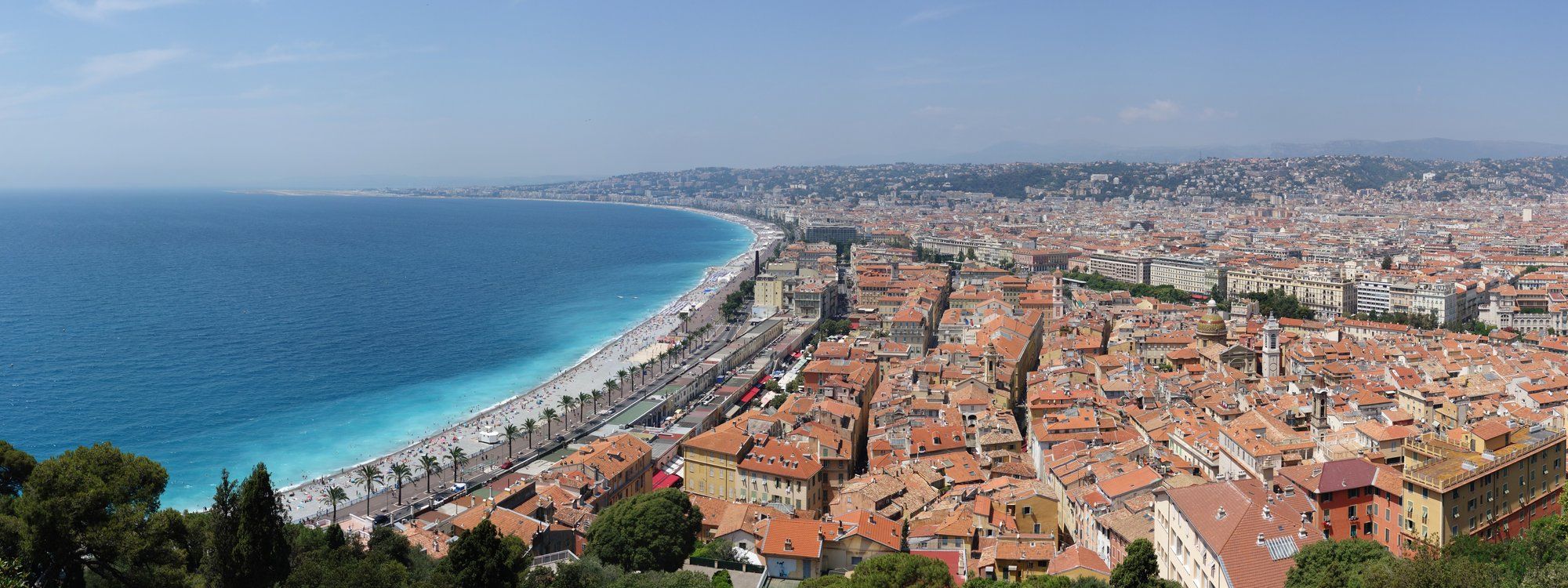
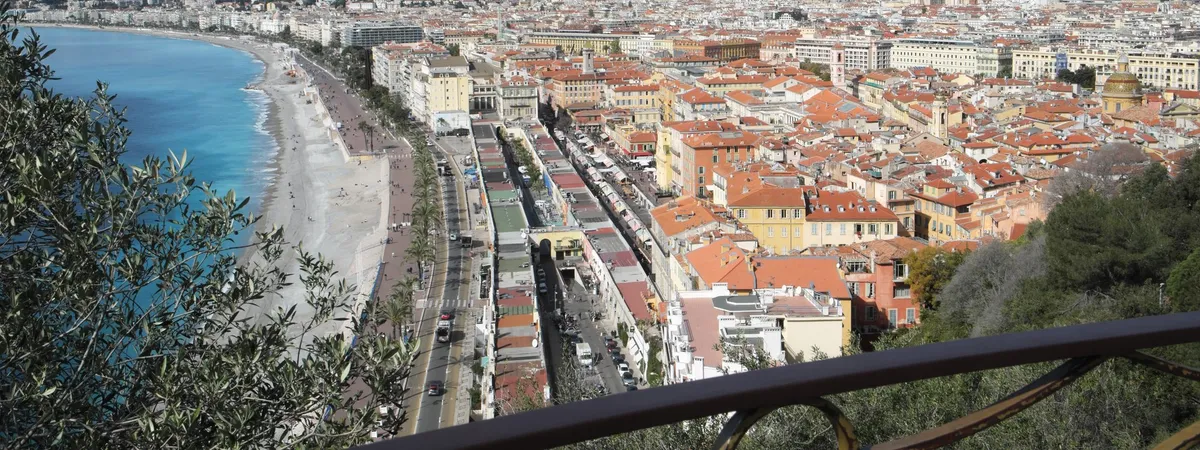
View from Castle Hill over Vieux Nice's red-tiled rooftops, the curve of the Baie des Anges, and the Promenade des Anglais

Spike / Wikimedia Commons, CC BY-SA 4.0

France

Where to Stay in Nice

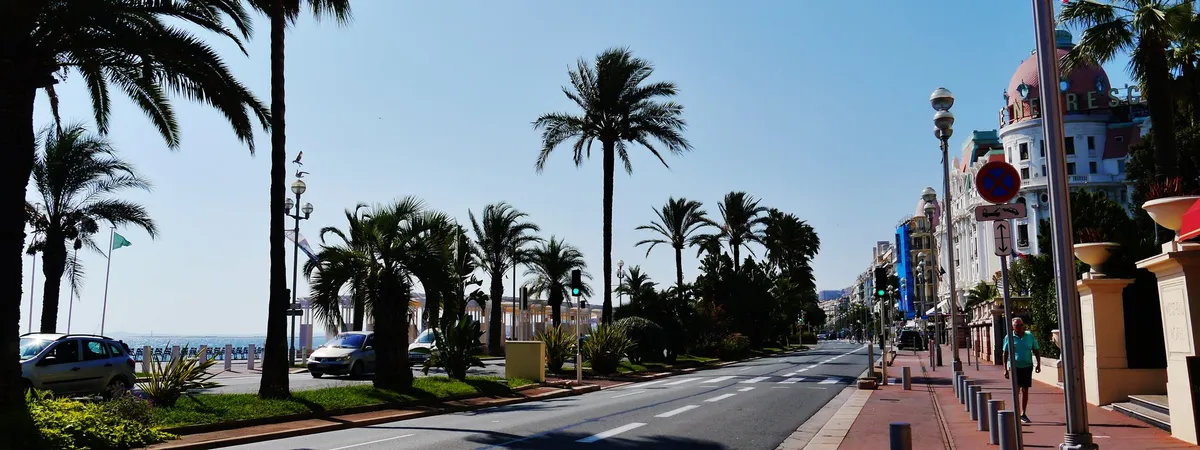
Nice is the largest city on the French Riviera, curved around the Baie des Anges on France's Mediterranean coast. The Promenade des Anglais runs the length of the bay, backed by grand Belle Époque hotels like the pink-domed Négresco, while Vieux Nice's pastel streets and Cours Saleya market sit just behind it at the foot of Castle Hill. The beaches are covered in smooth pebbles rather than sand, but the water is clear and the setting is hard to beat. Nice also works well as a base for the wider Côte d'Azur — Monaco, Antibes, Cannes, and Menton are all a short, scenic train ride along the coast.

Quick facts

Best time to visit
May, June, and September are the best months — warm enough to swim, without the peak-summer crowds and prices. July and August are hottest and busiest, when the beaches and Promenade fill up and hotel rates peak. Winter is mild rather than warm, rarely freezing, but many beach clubs close for the season and swimming isn't really an option.
Renting a car
Skip a rental car if you're staying in the center and sticking to the coast — the tram covers the city well, and trains reach most Riviera towns along the water faster than driving, especially in summer traffic. A car starts to make more sense if you want to reach hill villages like Èze or Saint-Paul-de-Vence, or the interior, where train and bus service thins out.

Where to stay

Compare neighborhoods

AreaBest forAdvantageTrade-off
Vieux NiceFirst-time visitorsAs central as it gets — the beach, the market, and most of the old town's restaurants and sights are all a short walk away.The busiest streets stay noisy into the evening, especially in summer, and rooms in older buildings tend to be small.
Carré d'OrCouplesA quieter, more polished seafront base than Vieux Nice, with easy tram access, the beach right there, and some of the city's best shopping.Fewer budget options and less nightlife on your doorstep than in the old town — you'll want to walk or tram over for that.

Our picks for Nice

A handful of editorial calls across every neighborhood above, not just the highest star rating — see each hotel's own card further down for the full case for and against it.

A couple of hotels in Vieux Nice

Vieux Nice is the top-recommended area to stay in Nice.

Palais Saleya Boutique Hôtel

★★★★
  • 🏆 Our overall pick
  • 📍 Best location

Our take A well-placed, character-filled base for exploring Vieux Nice on foot — the old building and central position matter more here than modern polish.

Good for

  • Couples
  • Nightlife
  • First-time visitors

Travelers who want to be genuinely inside the old town, close to its restaurants, market, and evening life.

Why we like it

  • Set in an 18th-century building near Place du Palais de Justice, right at the entrance to Vieux Nice
  • A short walk from the Cours Saleya flower and food market, the old town's restaurants, and the beach
  • Suite-style rooms with more space than a typical old-town hotel room

What to know

  • The old town's restaurant terraces and bars are close by, so rooms facing the street can pick up evening noise, especially in summer
Check availability on Booking.com

Aparthotel AMMI Vieux Nice

★★★
  • 🧳 Best for longer stays

Our take A straightforward, well-run apartment-hotel that happens to sit right on the old town's doorstep — a strong pick for value in an area where that's not always easy to find.

Good for

  • First-time visitors
  • Budget travelers
  • Families

Anyone staying more than a few nights who wants a kitchenette and an old-town-edge location without a high price tag.

Why we like it

  • A kitchenette in every unit makes it genuinely useful for stays of several nights or more, not just a place to sleep
  • Sits directly on Boulevard Jean Jaurès, which forms the edge of Vieux Nice — the old town's streets start just across the tram tracks
  • Between Place Masséna and Place Garibaldi, so both the tram and the Promenade du Paillon gardens are close

What to know

  • It's on the edge of the old town rather than deep inside its narrow streets, so it's a slightly different feel from staying right on Place Rossetti
Check availability on Booking.com

Useful travel information

France uses the euro. Nice Côte d'Azur Airport sits about 7km west of the center; tram Line 2 runs directly from the airport into the city center in around 20–25 minutes. Trains along the coast are frequent and reasonably priced, which makes Nice a workable base for day trips to Monaco, Antibes, Cannes, and Menton. Central Nice is generally safe for tourists; the main everyday risks are pickpocketing around the market, the beach, and crowded tram stops, plus unattended bags left on the sand.

Tips

  • Bring water shoes if you plan to swim — Nice's beaches are pebble, not sand, and walking into the water barefoot is uncomfortable for most people.
  • Visit the Cours Saleya market in the morning, when the flower and produce stalls are in full swing — it winds down by early afternoon and closes on Mondays, when an antiques market takes over instead.
  • Buy a multi-trip or day pass for the Lignes d'Azur tram and bus network if you'll be using it more than a couple of times — it works out cheaper than paying per ride.
  • The sea can turn choppy with little warning, especially when the wind picks up — check the beach flags before swimming out.

Frequently asked questions

Where should first-time visitors stay in Nice?
Vieux Nice puts you right by the beach, the market, and the old town's restaurants; the Carré d'Or, just along the Promenade des Anglais, is a quieter, more upscale option that's still an easy walk from the old town.
Is Nice walkable?
Yes — the seafront and old town are flat and compact, and most central sights are within about 20 minutes of each other on foot. The tram covers anything further out.
Are Nice's beaches sandy?
No — they're pebble beaches. Bring water shoes if you plan to swim, since the stones can be uncomfortable underfoot at the shoreline.