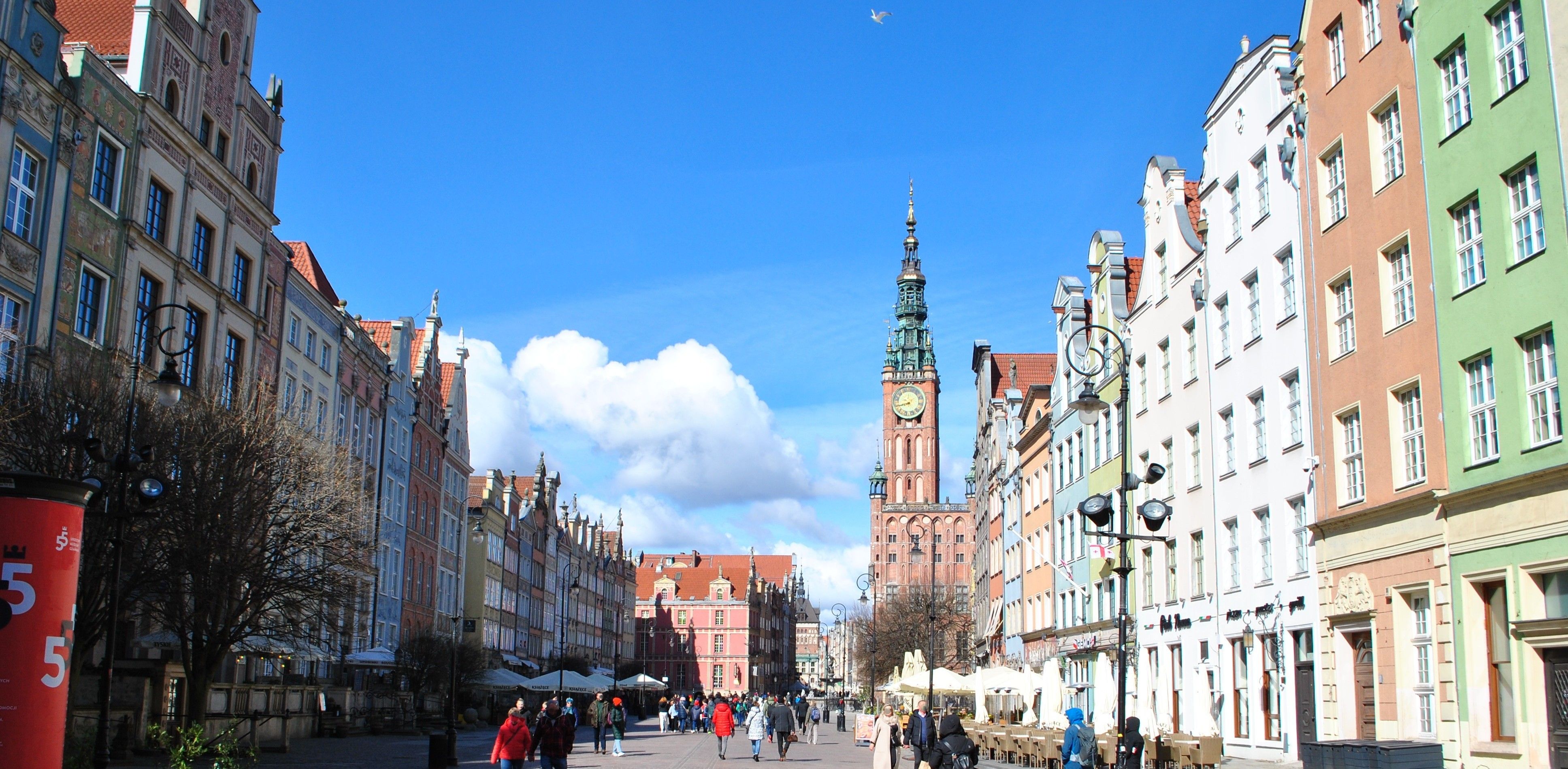
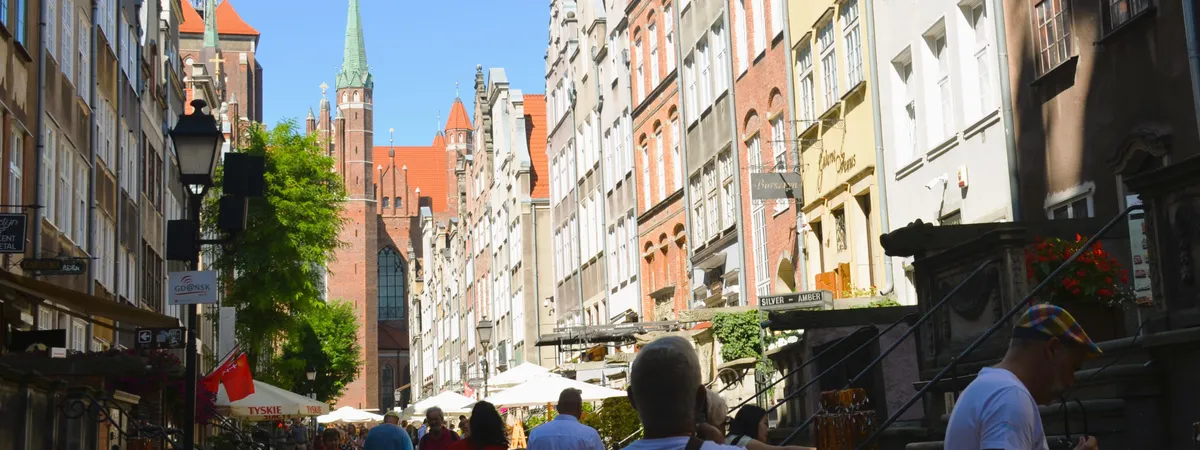
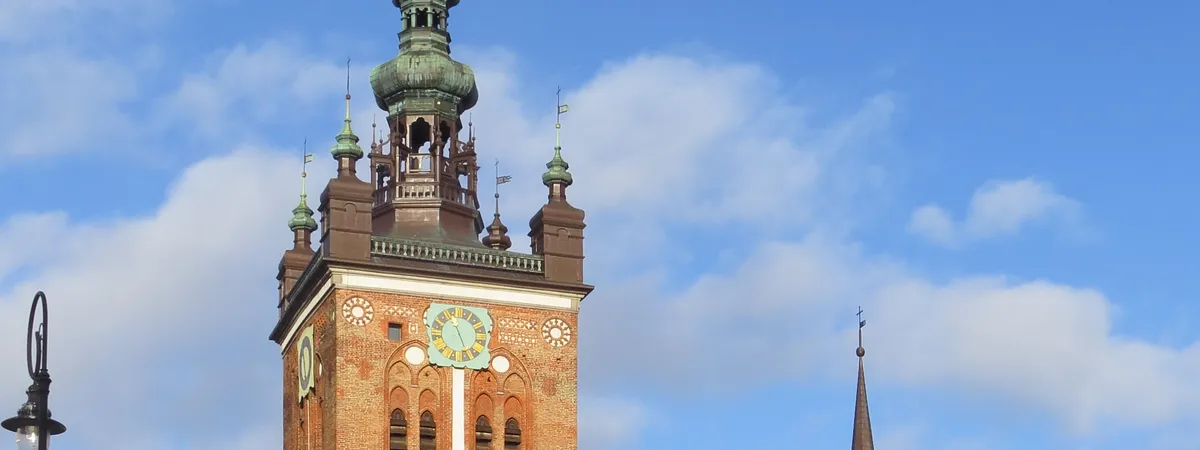
Długa Street in Gdańsk's Main Town, lined with colorful merchant houses and leading to the Main Town Hall's clock tower

Marek Mróz / Wikimedia Commons, CC BY-SA 4.0

Poland

Where to Stay in Gdańsk

Gdańsk is Poland's great Baltic port city, a Hanseatic trading hub for over 600 years and, more recently, the birthplace of the Solidarity movement that helped end communism in Eastern Europe. Its historic center sits on the Motława River and splits into two adjoining districts: Główne Miasto (the Main Town), the showpiece quarter of Gothic and Dutch Renaissance merchant houses along Długi Targ and Długa Street, anchored by St. Mary's Church and Neptune's Fountain; and Stare Miasto (the Old Town) just north, a quieter district of brick churches, the Motława's old canals, and the shipyard where Solidarity was founded in 1980. What makes Gdańsk's center remarkable is that almost none of it is original — roughly 90% of the historic core was destroyed in 1945, and what stands today was rebuilt over decades using old photographs, drawings, and, in many cases, the original brick. The city is also the traditional capital of the Baltic amber trade, sold along Mariacka Street's ornate stone porches, and forms the northern end of the Tricity (Trójmiasto) with Sopot and Gdynia, linked by a frequent commuter rail line that makes a half-day trip to Sopot's beach and pier an easy add-on.

Quick facts

Best time to visit
Late May through June and September offer the mildest weather with smaller crowds than midsummer. July and August are warmest and busiest, especially around the Main Town and the Tricity's beaches, and are also when the St. Dominic's Fair, one of Europe's oldest trading fairs, fills the streets for three weeks. December brings a Christmas market to Długi Targ, though days are short and cold.
Renting a car
Much of the Main Town is pedestrianized, and street parking near the center is limited and metered. Trams and the SKM commuter line reach everywhere covered in this guide, including day trips to Sopot and Gdynia, without needing a car.

Where to stay

Compare neighborhoods

AreaBest forAdvantageTrade-off
Główne MiastoFirst-time visitorsThe single most central base in Gdańsk, steps from every major Main Town landmark.The main streets, especially Długi Targ, stay crowded with day-trippers and tour groups for most of the day.
Stare MiastoFirst-time visitorsA quieter, less touristy base that's still an easy walk from the Main Town's sights.You're a 10-15 minute walk from Długi Targ and Neptune's Fountain rather than right next to them.

Our picks for Gdańsk

A handful of editorial calls across every neighborhood above, not just the highest star rating — see each hotel's own card further down for the full case for and against it.

A couple of hotels in Główne Miasto

Główne Miasto is the top-recommended area to stay in Gdańsk.

Hotel Artus - Old Town

★★★
  • 💰 Best value

Our take Hotel Artus delivers a genuinely central Piwna Street address at a more accessible price than most of its Main Town neighbors.

Good for

  • Budget travelers
  • First-time visitors
  • Couples

Travelers who want a central Main Town base without paying for a 4- or 5-star property.

Why we like it

  • A minute's walk from St. Mary's Basilica and close to Długi Targ, at a lower price point than most hotels this central.
  • An on-site restaurant with an extensive wine cellar and regular live music.
  • Free sauna access, unusual for a hotel in this price bracket.

What to know

  • Many rooms face an interior courtyard rather than the street, which helps with noise but means fewer rooms have views.
Check availability on Booking.com

Radisson Blu Hotel, Gdańsk

★★★★★
  • ✨ Best luxury

Our take Radisson Blu's address on Długi Targ puts it as close to the Main Town's landmarks as a hotel gets, backed by the amenities of a full-service international property.

Good for

  • Luxury travelers
  • Couples
  • First-time visitors

Travelers who want an international luxury brand right on Gdańsk's most famous square, with full hotel amenities like a spa and all-day restaurant.

Why we like it

  • Sits directly on Długi Targ, a short walk from Neptune's Fountain, St. Mary's Basilica, and the river.
  • An on-site spa with sauna and steam room, plus a brasserie serving Polish and international dishes through the day.
  • Around 145 air-conditioned rooms and suites, more scale than most boutique properties nearby offer.

What to know

  • Rooms facing Długi Targ get views over the square but also more street noise than courtyard-facing rooms.
Check availability on Booking.com

Useful travel information

Poland uses the złoty (zł), not the euro — cards are accepted almost everywhere, but small change is useful for market stalls. English is widely spoken in the center's hotels, restaurants, and shops. Gdańsk has no metro; trams and buses run on a shared ticket system, and a separate commuter rail line (SKM) connects the city to Sopot and Gdynia. The historic core is flat and compact enough to cover on foot. Tipping isn't obligatory, but rounding up or adding around 10% at restaurants is common.

Tips

  • Take the SKM commuter train to Sopot (about 20 minutes) for an afternoon at Europe's longest wooden pier and its beach.
  • Climb St. Mary's Church tower — about 400 steps, mostly a ramp rather than stairs — for a rooftop view over the Main Town's red rooftops.
  • Buy amber from a shop with a certificate of authenticity rather than a street stall; Gdańsk is the center of the Baltic amber trade, but quality and pricing vary a lot.
  • The European Solidarity Centre, by the old shipyard gate, is worth two to three hours if you're interested in the Solidarity movement's history.

Frequently asked questions

How many days do I need in Gdańsk?
Two to three days covers the Main Town and the Old Town comfortably, including the European Solidarity Centre. Add a half-day if you want to see Sopot's pier and beach, which is an easy short train ride away.
Is Gdańsk walkable?
Yes — the Main Town and Old Town are flat, compact, and connected by about a 10-minute walk, so most sightseeing in the historic center happens on foot. Trams and the SKM commuter rail cover trips further out, including to Sopot and Gdynia.
Is Gdańsk's Old Town actually historic, or was it rebuilt?
Both — the street layout, building footprints, and much of the architectural detail are genuinely centuries old, but around 90% of the physical structures were destroyed in 1945 and rebuilt afterward, often using the original brick and detailed pre-war photographs and drawings as reference.