Last updated September 25, 2026
Italy
7-Day Northern Italy Road Trip from Venice: the Dolomites, Alpe di Siusi & Lake Garda
Seven days, two hotels. That is the whole idea: one base in Val Gardena for four nights and one on Lake Garda for two, so a short trip spends its time on mountain roads and lakefronts rather than on check-in desks. The Dolomites half is deliberately narrow — one valley and the two lifts out of Ortisei, to Alpe di Siusi and Seceda, the four passes around the Sella massif, and the view of the Odle from the other side. The Garda half exists for contrast, not for coverage: after four days above two thousand metres, a warm lake and a boat are the point. The driving profile: two days with no driving at all, two more between two and three hours, and three long ones — the drive in, the transfer down to Garda and the drive out — at three hours or more.
Quick facts
- Duration
- 7 days
- Pace
- Balanced
- Best time to go
- Late May to mid-October
Route map
Trip overview
| Day | Region | Main highlights | Book ahead | Pace |
|---|---|---|---|---|
| Day 1 | Venice to Val Gardena, With Bolzano in the Middle | Collect the car at Marco Polo; Break the drive in Bolzano; Up into Val Gardena | — | Packed |
| Day 2 | Alpe di Siusi, the Easy Day First | Ride the gondola up to Mont Sëuc; Walk the plateau toward Compatsch | — | Balanced |
| Day 3 | Seceda's Ridge, Then the Other Side of It | Seceda by cable car from Ortisei; Over to Santa Maddalena in Val di Funes | Seceda by cable car from Ortisei | Balanced |
| Day 4 | Four Passes Around the Sella | Passo Gardena; Passo Campolongo and Passo Pordoi; Passo Sella and back down | — | Packed |
| Day 5 | Down to Lake Garda the Long Way | Down to Riva del Garda; The eastern shore road to Malcesine | — | Balanced |
| Day 6 | A Lake Day, On Purpose | Monte Baldo by rotating cable car; Cross to Limone sul Garda | — | Balanced |
| Day 7 | Sirmione, Then the Airport | Rocca Scaligera and the peninsula; The drive out | — | Balanced |
Transportation & practical information
A self-drive trip from the first afternoon to the last. Collect the car at Venice Marco Polo rather than in the city — Venice itself has no roads, the airport rental desks are in the terminal, and the A4 starts a few minutes away. From there it is motorway to Bolzano, then mountain roads for four days, then motorway again at the end. Italy drives on the right, the A4 and A22 are ticket-and-barrier tolls, and the pass roads are fully paved but relentlessly hairpinned, so a small car is a real advantage. Ortisei's centre is pedestrianised and Malcesine's old town is closed to traffic, which means both bases are places you park once and then walk — the car only comes out for the days it is needed.
A car is what this trip is. The pass loop on Day 4, the run across to Val di Funes, the descent past Lago di Carezza and the cliff road down the eastern shore of Garda are slow and fiddly to stitch together by bus in a single week. Book a small car — every road from Bolzano onward has hairpins, rock tunnels or a village gate built for something narrow. Take it from the airport terminal rather than a city office, and check whether your rate allows the drop-off you actually want: this route returns to Venice, but finishing at Verona instead is worth pricing, since it saves an hour on the last morning.
Day-by-day itinerary
Day 1: Venice to Val Gardena, With Bolzano in the Middle
Three hours of driving on arrival day, deliberately split rather than swallowed whole. Bolzano sits right on the A22, two and a half hours in, and is the last flat, warm, Italian-feeling place before the mountains — which makes it both a useful break and a good introduction to a province that has been speaking German since the early Middle Ages. Then forty minutes up into the valley, and the car stays parked all of tomorrow.
Landing late, or want the drive itself to be the day? The alternative from Venice is the A27 north through Belluno and over the passes into Val Gardena — about forty-five minutes longer than the motorway and an entirely different experience, but it is a mountain road at the end of a flight and not one to start after mid-afternoon. In bad weather or after a long-haul arrival, take the A22 and keep Bolzano.
Tonight: Ortisei, Val Gardena (four nights)
- Midday
Collect the car at Marco Polo
The rental desks are in the terminal and the motorway is a few minutes away, which is the main reason this trip starts at the airport rather than in the city — there is nowhere to put a car in Venice and nothing gained by trying. Check the fuel policy and photograph the bodywork before you leave the bay; arguments at drop-off are usually about a scratch nobody wrote down. Then straight onto the A4 west and the A22 north.
Time here: 45 min
Compare car rental prices - Afternoon
Break the drive in Bolzano
2 hr 35 min from the previous stop
Two and a half hours from the airport, and the first two of those are flat motorway across the Veneto before the Adige valley starts closing in. Park in one of the garages at the edge of the centre and walk: Piazza Walther, the arcaded Via dei Portici behind it, and the fruit market that has been trading in the same square since the Middle Ages — a town law of 1437 already restricted the sale of fruit, poultry and eggs to this one square. Give it an hour and a half. If you would rather have a room than a square, the archaeology museum five minutes away is where Ötzi the Iceman is kept — a body that came out of a glacier on the Austrian border in 1991 and has been kept refrigerated here since 1998. It closes on Mondays outside July and August, and last entry is half an hour before closing, so check the clock before you commit to it.
Time here: 2 hr 30 min
- Evening
Up into Val Gardena
40 min from the previous stop
Forty minutes on from Bolzano: the SS12 up the Isarco valley, then the turn at Ponte Gardena and a steady climb through Ortisei's lower villages. The last stretch is hairpins, and the valley opens out at the end of them with the Odle ridge standing behind the village. Arrive, unpack once, and do nothing else tonight — the centre is pedestrianised and everything you need is a few minutes on foot. Four nights here, which is the single most useful decision on this itinerary.
Time here: 1 hr
Day 2: Alpe di Siusi, the Easy Day First
An enormous rolling meadow sits on a shelf at two thousand metres directly above Ortisei — kilometres of open grazing where you would expect a rock face — and a gondola from the middle of the village delivers you onto it in ten minutes. That matters practically as well as scenically: the access road is shut to visitors' cars through the middle of the day and the plateau car parks now need booking in advance, so the lift is both the easiest way up and by far the least complicated. It is also the right day to run first — one ride, hours of flat walking, and nothing that punishes you for still being tired from the flight.
Keep this day where it is if the forecast is uncertain. Flat light does far less damage to a meadow than it does to a ridge or a pass road, so the plateau is the one that stays worth doing while the other two wait for a better morning. Genuine rain is a different matter: go back down to Bolzano for the archaeology museum, and take Alpe di Siusi tomorrow instead.
Tonight: Ortisei, Val Gardena
- Morning
Ride the gondola up to Mont Sëuc
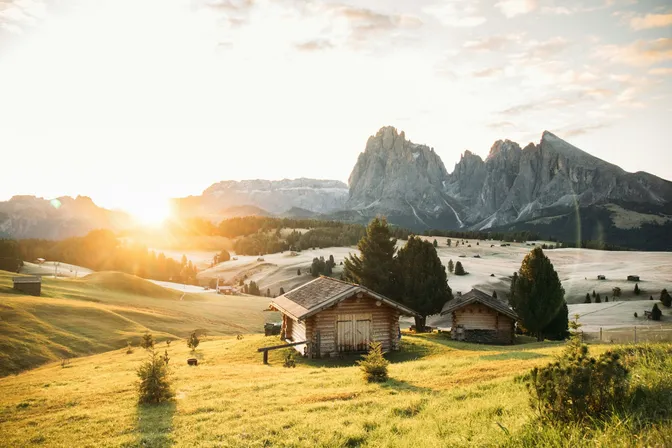
The cabin leaves from the middle of Ortisei — you can walk to it from most hotels in the village — and the first one goes at 08:30. Queues are rarely the issue at that hour; the reason to be on an early cabin is that the plateau light is better before the haze builds and the meadows are empty for the first hour. Ten minutes later you step out at Mont Sëuc, two thousand metres up, and the whole tilted expanse of Alpe di Siusi opens out to the south, with the Sassolungo standing across it. Sit down at the top station for a bit before you start walking. Nothing about the day is urgent, and the geography is worth getting straight first.
Time here: 1 hr
- Midday
Walk the plateau toward Compatsch
1 hr 30 min from the previous stop
This is the closest thing the Dolomites have to level ground: farm tracks running for kilometres across grass at two thousand metres, with hay barns, cattle and the Sciliar's rock wall on your left. The obvious line is Mont Sëuc to Compatsch and back, three or four hours at an unhurried pace, and you can keep going toward Saltria if it is still enjoyable. What makes it forgiving is that there is nothing to commit to: the tracks are wide and gentle, and you can turn round whenever you have had enough, since the way home is back to the Mont Sëuc gondola. The plateau bus only runs between Compatsch and Saltria, so it will not take you back to the lift. Lunch is a rifugio, which here means a working farm kitchen doing dumplings and barley soup rather than a restaurant. The tracks are signposted and busy enough that you will not get lost.
Time here: 1 hr 50 min
- Evening · Optional
Ortisei in the late afternoon
1 hr 40 min from the previous stop
Come back down on the gondola with the afternoon still going and give the village an hour before dinner rather than walking through it twice. Ortisei carves wood — it has done commercially since the seventeenth century, and the workshops along the pedestrianised main street still have things in the windows worth stopping for. The Luis Trenker promenade climbs gently out above the roofs and gives you the valley from slightly above, which is a different village entirely from the one at street level. Read the street signs while you are at it: Ladin first, then Italian, then German, and that order is not an accident.
Time here: 1 hr 30 min
Day 3: Seceda's Ridge, Then the Other Side of It
One mountain range, seen from above and then from below, with a drive round the end of it in between. The morning stands on the Odle; the afternoon looks up at them across a valley floor with two small churches on it. The whole day hinges on being early — the Seceda ridge collects a crowd from late morning and the cloud often thickens with it, which is why the Seceda ticket is the one thing worth sorting before you arrive.
This is the fullest day of the week, and the shorter version is genuinely good rather than a fallback. Drop Val di Funes, stay high, and walk from the Seceda station out toward the Pieralongia rocks and back down to the mid-station — two to three hours of straightforward ground, and the only part of the trip spent inside the Odle instead of looking at them. Reverse the choice if the sky is patchy: a ridge needs clear air, a valley floor does not.
Tonight: Ortisei, Val Gardena
- Morning
Seceda by cable car from Ortisei
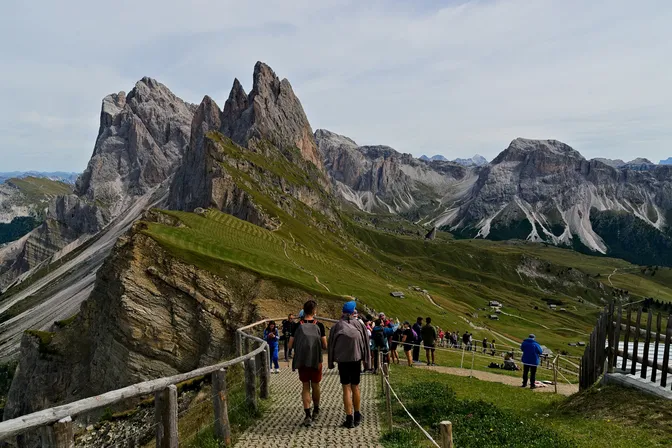
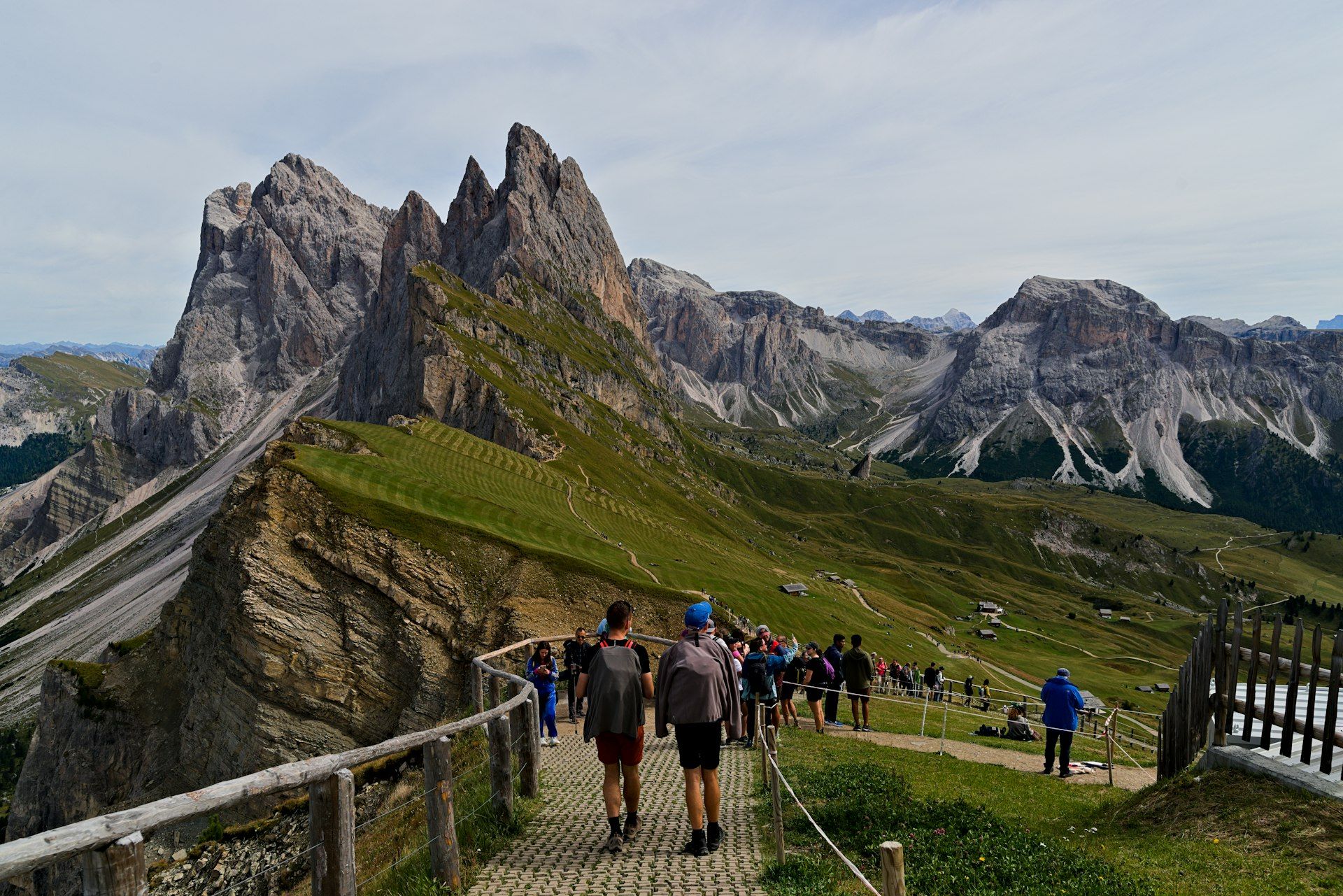
Two lifts get you there: a small gondola from the village to Furnes, then a bigger cabin on to the ridge at roughly 2,500 metres. It costs €74 return, making it the most expensive lift on the itinerary, but it is the one not to cut. The operator recommends booking through seceda.it in advance, so this is the one booking you make before leaving home, and you aim for the morning — cloud in these valleys more often thickens through the day than clears. From the top station, walk north for ten minutes until the buildings are out of sight. The ridge tilts away and drops into the Odle spires, and there is no arrangement of a photograph that prepares you for the scale of it. Three hours up here is a reasonable amount of time.
Time here: 3 hr
- Afternoon
Over to Santa Maddalena in Val di Funes
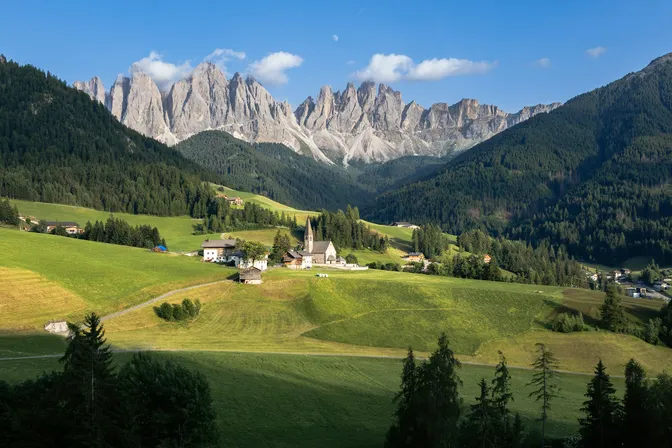
1 hr from the previous stop
Ride down, pick the car up, and drive forty-five minutes around the end of the Odle into the next valley north — an hour all in. One thing has changed recently and it will affect your afternoon: since 2026 a barrier keeps non-resident cars off the lane up to the church, so you leave the car in the village and walk up, twenty to thirty minutes on an easy path. Do not treat that as an obstacle. Arriving on foot is better than arriving in a car park, and the walk is what the view is for — Santa Maddalena on its green knoll with the entire Odle ridge standing behind it. You were on top of that ridge four hours ago. The valley car park has no reservation system and can fill on busy days, so earlier is easier.
Time here: 2 hr 30 min
- Evening · Optional
San Giovanni in Ranui
10 min from the previous stop
Ten minutes further up the valley and the smaller of the two churches everyone comes here for: an onion-domed baroque chapel alone in a hayfield, viewed from a fenced platform the neighbouring farm charges a couple of euros to use. You cannot go inside and there is no reason to want to. It is fifteen minutes, it is a photograph, and if the day has already given you enough, driving past it costs you nothing at all.
Time here: 45 min
Day 4: Four Passes Around the Sella
The road everybody comes to the Dolomites to drive, and the reason it gets a whole day rather than a morning: the circuit round the Sella massif is short on the map, but stopping is the entire point. Run it clockwise out of Ortisei — Gardena, Campolongo, Pordoi, Sella — and the massif stays on your right the whole way round, with the high cableway at Pordoi landing conveniently in the middle of the day.
There is nothing here in low cloud except wet hairpins, so if the morning is grey, trade this day for Day 2 and come back to the passes later in the week — that swap is what four nights in one hotel buys you. Check the calendar as well as the sky: on the two Saturdays of Sellaronda Bike Day each summer all four passes close to cars for most of the day and belong to cyclists — the dates are in the facts below. If one loop leaves you wanting more, Passo Fedaia and the Marmolada branch off below Pordoi, though that road only opens May to October.
Tonight: Ortisei, Val Gardena
- Morning
Passo Gardena
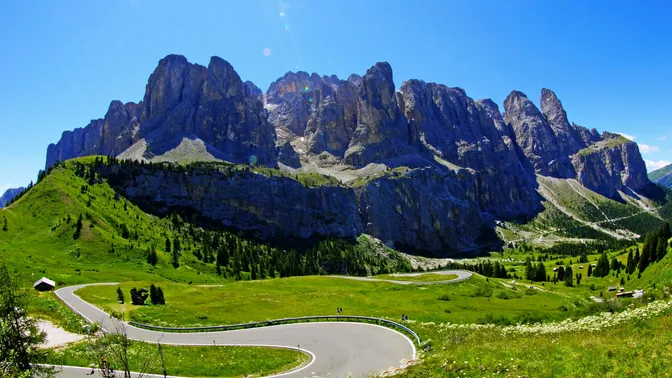
Forty minutes from Ortisei, on a road that climbs continuously past Santa Cristina and Selva without ever feeling steep. The pass itself is a wide green saddle at a little over two thousand metres, pinned between the Sella's northern walls and the Cir towers, with parking and two huts on it. The mistake is to photograph it from the car park and drive on. Walk five minutes up the path above the road instead — from there Alta Badia falls away east in a long series of terraces the pass keeps hidden from the road. An hour, including the walk.
Time here: 1 hr 15 min
- Midday
Passo Campolongo and Passo Pordoi
1 hr from the previous stop
An hour of driving links the two, dropping through Corvara and Arabba in the middle, and Campolongo is the quiet one — a wooded saddle you cross rather than stop at. Pordoi is the opposite: a numbered stack of hairpins climbing to 2,239 metres, and the reason everybody is here. Buy a ticket for the cableway at the top. It takes three minutes to reach the Sass Pordoi terrace at 2,950 metres, and what you walk out onto is not a viewpoint but a plateau of bare limestone with the Marmolada glacier hanging across the gap opposite. Give the whole stop three hours, including lunch at the pass — the huts here are used to cyclists and feed people quickly.
Time here: 3 hr
- Afternoon
Passo Sella and back down
25 min from the previous stop
Twenty-five minutes on, and if you only stop properly at one of the four, make it this one. The road traverses directly beneath the Sassolungo's south face, with the Sella massif filling the mirrors behind you, and there is a long pull-in where the whole thing composes itself without any effort. Give it an hour; in good evening light, give it more and eat late. From there it is half an hour down through Selva and back into Ortisei, which will be the fourth time this week you have driven the last stretch of that valley and the first time you know what is behind it.
Time here: 1 hr 15 min
Day 5: Down to Lake Garda the Long Way
Moving day, and the three and a half hours of driving are arranged to be worth having rather than merely survived. Instead of running the motorway end to end, the route detours up the Val d'Ega for one more mountain lake, then comes at Garda from the north — which means the lake introduces itself as a trench between cliffs rather than as the flat, built-up shoreline at the southern end. The final half hour along the ledge road to Malcesine is the payoff, and the reason to ignore the faster motorway exit at Affi.
Carezza is the skippable part, and it is a real hour: going straight down the A22 from Bolzano saves about that much and costs you one lake and one pass, which is a fair trade in rain and a poor one otherwise. Riva is not skippable in the same way — cutting it means arriving at Garda through car parks rather than from above. If you are short of time, leave Ortisei earlier rather than dropping either.
Tonight: Malcesine, Lake Garda (two nights)
- Morning · Optional
Passo Costalunga and Lago di Carezza
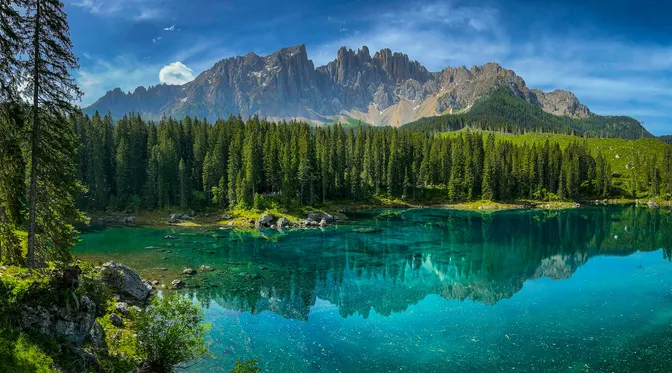
An hour from Ortisei: down the valley, past Bolzano's northern edge, then a long climb back up the Val d'Ega toward Costalunga. Lago di Carezza is small, sits immediately beside the road, and holds an almost implausible green — the Latemar's towers reflect in it when the surface is still, which in practice means before mid-morning, after which the wind arrives and the photographs stop working. Park in the paid lot and use the pedestrian tunnel under the road rather than crossing it. Twenty minutes walks the whole circuit; the platform at the north end is where the reflection lines up. An hour covers it comfortably, and it is the one stop today you can drop without regret if the weather has closed in.
Time here: 1 hr
- Afternoon
Down to Riva del Garda
2 hr from the previous stop
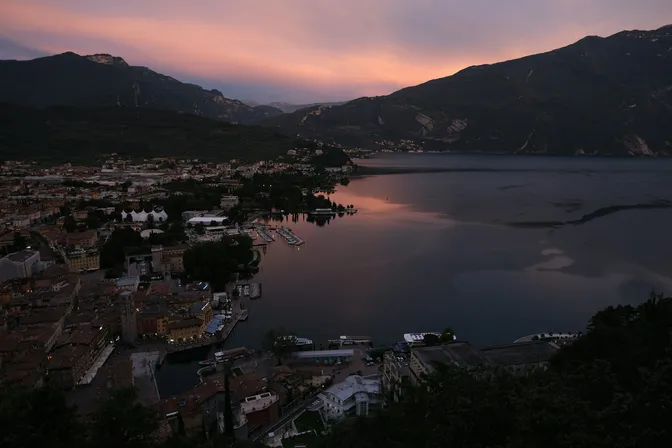
The long leg of the week: about two hours, mostly A22 south from Bolzano through Trento, turning west at Rovereto. What arrives at the end of it is not the Lake Garda of the brochures. Riva sits at the very top of the lake with cliffs rising fifteen hundred metres straight off the shoreline, and the effect is closer to a fjord than a riviera. Park once and cover the rest on foot — Piazza III Novembre with the Torre Apponale over it, the harbour, and the lakefront path out to where the old Ponale road begins its climb into the rock face. That road is a walking and cycling route now; ten minutes along it is enough to see why it is famous. Ninety minutes here, and the first genuinely warm air since the airport.
Time here: 1 hr 45 min
- Evening
The eastern shore road to Malcesine
25 min from the previous stop
Twenty-five minutes down the SS249 and a good ending to a driving day: a ledge cut into the base of Monte Baldo, a sequence of rock tunnels, and the lake sitting flat below the parapet the whole way. Take it slowly — it is a road to enjoy rather than cover, and the sun will be going down the far shore. Malcesine turns out to be a tangle of stone lanes climbing away from a small harbour with a castle above it on a rock spur. Park where your hotel tells you, because the old town is closed to traffic, then walk down to the water and eat there. Leave the castle for tomorrow evening; you will have walked past its gate several times by then anyway.
Time here: 1 hr 30 min
Day 6: A Lake Day, On Purpose
The day the whole trip is arranged around, and the second of the two where the car stays parked. A lift in the morning to see the lake end to end, a boat in the afternoon to a village on the opposite shore, and deliberately nothing scheduled between them. Four days of rock have earned this: Garda rewards sitting beside it far more than it rewards working through a list, and a week that ends on a lake feels twice as long as one that ends on a motorway.
Cloud on the summit is a reason to reverse the order, not to cancel: boat to Limone first thing, come back for lunch, and ride up later, by which time the afternoon wind has usually stripped the ridge clear. If the cable car is out of service altogether — it stops for maintenance in March and from November into mid-December — swap in the drive north and up onto the Tremosine plateau above the western shore, which spends most of its length pinned to the cliff face.
Tonight: Malcesine, Lake Garda
- Morning
Monte Baldo by rotating cable car
The lower station sits above the old town, a few minutes uphill on foot. The second stage is the unusual part: the cabins rotate slowly as they climb, so nobody has to fight for the window and the view arrives in a full circle on the way up. First ascent is 08:15, with departures guaranteed at least every half hour from 08:30; buy online and it is €28 instead of €30. What you get at the top is the inverse of the last four days — the same sort of altitude, aimed at water instead of rock, with the whole length of Garda on one side and the Brenta Dolomites on the other. There is an easy hour of ridge walking before the path turns into something that needs boots. Two to three hours in total.
Time here: 3 hr
- Afternoon
Cross to Limone sul Garda
1 hr 10 min from the previous stop
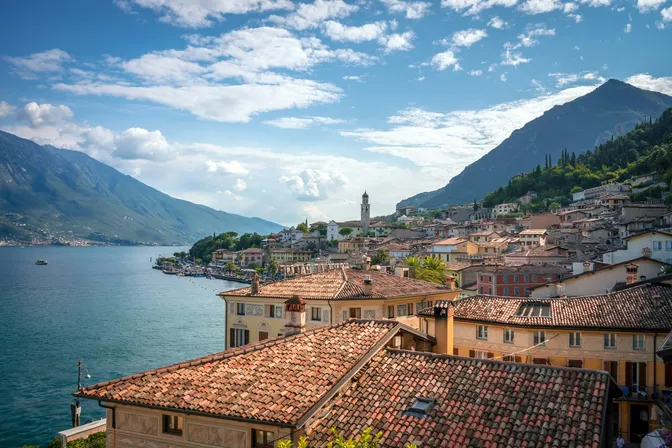
Back down to the harbour and onto a boat for the western shore. Budget a little over an hour door to door, once the lift descent, the walk to the pier and the wait for a sailing are counted in. It does not run all year and the frequency shifts with the season, so look up the actual timetable for your dates before building an afternoon around it. Leave the car in Malcesine — not needing it today is half the reason for sleeping here. Limone is a single strip of a town wedged between the lake and a rock wall, and the thing worth walking to is the Limonaia del Castèl, the terraced stone-pillared lemon greenhouses that supported the place for centuries at a latitude where citrus had no business surviving. Beyond that, do not plan the afternoon. Eat slowly, sit by the water, and take one of the later boats back.
Time here: 3 hr 30 min
- Evening · Optional
The castle, at the end of the day
55 min from the previous stop
A few minutes uphill from the harbour and worth saving for last light. Malcesine's Scaligeri castle stands on a spur of rock straight out of the water, and from the tower the lake goes south until it runs out of focus. Goethe was briefly arrested here in 1786 while sketching it, which the castle has never stopped mentioning. Forty-five minutes, then down into the lanes for dinner — they are touristy and the food is better one street back from the water.
Time here: 1 hr 15 min
Day 7: Sirmione, Then the Airport
Three and a half hours of driving with one stop in the middle of it, and the stop is what keeps this from being a pure transfer day. Sirmione sits on a long thin peninsula at Garda's southern end — a moated castle, thermal water, olive trees — and it is the last stop on the lake before the motorway. Go early: the causeway into the old town is a bottleneck by mid-morning in season, and everything after it is timed against a flight.
This day only works with an afternoon or evening flight. If yours leaves in the morning, skip Sirmione entirely and drive straight to the airport, or better, move the last night to Venice and give the city the day this itinerary never spends there. Sirmione is also the stop to drop if the weather is poor — it is a walking town and nothing about it improves in rain.
- Morning
Rocca Scaligera and the peninsula
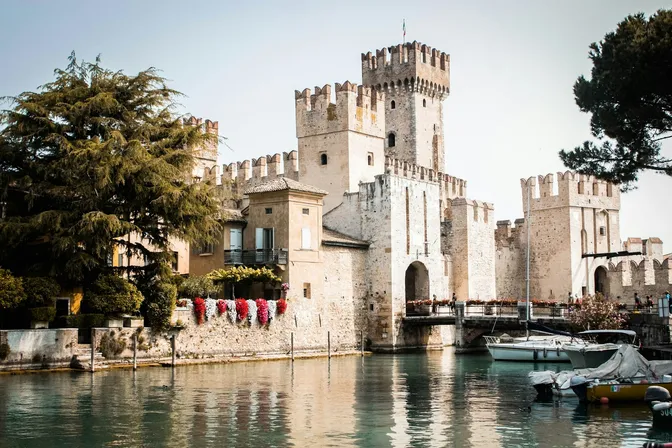
Ninety minutes down the eastern shore from Malcesine. The peninsula is closed to general traffic, so use the large lots at the landward end and walk in across the drawbridge — which is the right way to arrive at this one anyway. The Rocca is a thirteenth-century fortress built out into the water with a walled harbour of its own, and the approach across the moat is the best part of it, so do not feel obliged to buy a ticket to have seen it. Two hours gives you the castle, the lanes behind it, and enough of the walk out along the peninsula to leave the crowd behind. Keep going another twenty-five minutes on foot and you reach the Grotte di Catullo, the ruins of an enormous Roman villa spread through olive trees at the tip — worth it if the clock and the opening days allow, easy to leave for another trip if not.
Time here: 2 hr
- Afternoon
The drive out
2 hr from the previous stop
Two hours from Sirmione to Marco Polo on the A4, which with the morning's leg makes about three and a half hours of driving today. Leave real margin: return the car, and budget for the fact that airport rental returns at Venice take longer than the signs suggest in the afternoon.
Don't do this
- Don't try to add the eastern Dolomites. Tre Cime di Lavaredo and Lago di Braies are roughly two hours each way from Val Gardena, with a toll road or a shuttle reservation at the end of it, and adding either turns a relaxed day into a driving day. In seven days they belong to a different trip, not to this one.
- Don't schedule the pass loop as a half day and keep the afternoon for something else. Fifty-five kilometres sounds like a morning; in practice it is over two hours of hairpins before a single stop. Compressed into four hours it becomes a drive you did rather than a day you had.
- Don't drive straight from the airport to Val Gardena on Day 1 without a break. It is three hours of motorway at the end of a flight, and the last twenty minutes are steep hairpins in the dark if you have cut it fine. Bolzano sits right on the route and makes a natural break.
- Don't book a morning flight home on Day 7. Malcesine to Venice Marco Polo is about two hours and ten minutes without stopping, and this day has a stop in it.
Useful travel information
Budget estimate
Estimate only, and admissions rather than the whole trip. The lifts are most of it: Seceda is €74 return, Alpe di Siusi €41, Sass Pordoi €32 and Monte Baldo €30, with the Bolzano archaeology museum €13 on top — about €190 per adult if you ride everything here. Add motorway tolls of roughly €35 to €50 across the route. The Gardena Card doesn't pay for this trip as written. Only two of the four lifts above are on it — Seceda (€74) and the Ortisei–Alpe di Siusi cable car (€41), €115 in single tickets against €124 for a three-day card (valid only from early June to mid-October). Sass Pordoi (in Val di Fassa) and Monte Baldo (on Garda) aren't covered, so you pay for those either way, and the card only pays if you add a third Val Gardena ride. Note too that the wider Dolomiti Supersummer card is explicitly not accepted on the Seceda lifts at all. Prices checked September 2026; operators change fares and ticket conditions without notice.
Tips
- Buy the Seceda ticket online before you leave home and plan to ride up in the morning. The operator recommends booking it on seceda.it, it is the most expensive lift on the trip, and Dolomite cloud more often builds through the day than burns off.
- Four nights in one Val Gardena hotel exist partly so Days 2, 3 and 4 can be reordered on the morning's forecast. The pass loop is pointless in low cloud, Seceda is worse, and the Alpe di Siusi plateau is the one that still works under grey skies. Use that flexibility rather than sticking to the numbers here.
- Fill up in the valley towns — Ortisei, Corvara, Canazei — rather than at the passes, and check the pass roads the night before Day 4. Check the calendar too, before you book the trip: the Sella passes are listed as open year-round but can close temporarily at short notice for snow and avalanche risk, and on the two Saturdays of Sellaronda Bike Day each summer they are closed to cars for most of the day.
- Both lake towns on this route restrict traffic in their centres and enforce it with cameras — Malcesine's old town and most of Sirmione's peninsula. Use the signposted lots outside the gates and walk the last few minutes. You will usually notice nothing at the time; the fine reaches you through the rental company months later with a handling charge added.
- Sort the Malcesine parking out at booking time, not on arrival. Ortisei looks after itself — the centre is pedestrianised and valley hotels have space — but Malcesine's lanes predate cars entirely, and on a two-night stop a garage or a named reserved bay does more for the stay than a lake view does.
- Read this page in two layers. The route, the bases, the drive times and the logic of where the car helps are stable — they are why the trip is shaped this way. The opening dates, lift fares, ferry timetables, parking reservations and traffic-zone rules are not: several of them moved during 2026 alone. Everything perishable is gathered in the facts below with the date it was checked, so re-read that list a week before you travel and again the night before any day built around a lift or a boat.
Good to know (12)
- The Seceda cable cars from Ortisei run 22 May to 2 November 2026, 08:30 to 17:30. A return ticket covering both stages is €74 for adults. Tickets are also sold at the stations, but the operator recommends buying online in advance because parking in Ortisei is limited, and Gardena Card holders must book on seceda.it.Checked September 25, 2026
- The wider Dolomiti Supersummer card — €145 for three days out of four, valid 14 May to 8 November 2026 across around 130 lifts — is explicitly not accepted on the Ortisei–Furnes cable car, the Furnes–Seceda cable car or the Fermeda chairlift, which are the only lifts up Seceda. On that card the €74 Seceda ticket is still payable on top.Checked September 20, 2026
- The Ortisei–Mont Sëuc cable car up to Alpe di Siusi runs 1 May to 5 June 08:30–17:00, 6 June to 16 October 08:30–18:00, and 17 October to 2 November 08:30–17:00. An adult ticket is €29 one way and €41 return.Checked September 20, 2026
- A three-day Gardena Card costs €124 for an adult and €160 for six days, and covers 18 Val Gardena lifts — both Seceda cable cars and the Ortisei–Alpe di Siusi cabin among them. It is valid 6 June to 11 October 2026, and card holders still have to book the Seceda lifts on seceda.it.Checked September 20, 2026
- The road up to Alpe di Siusi is closed to private cars from 09:00 to 17:00; driving down from Compatsch is unrestricted at any hour, and outside those hours you may drive up only with an online parking reservation. From 29 June 2026, the two plateau car parks require an online reservation, bookable up to six days ahead — P1 Spitzbühl at €15 per car per day, P2 Compatsch at €30. Neither lot allows parking between 23:00 and 05:00.Checked September 20, 2026
- In Val di Funes, a barrier now restricts the road up to the Santa Maddalena church and its panorama viewpoint to residents and hotel guests from May to November; day visitors park in the valley and walk up. There is no booking system for the valley car park — once it fills, cars are directed to spaces further down the valley — and the daily parking fee is being raised.Checked September 20, 2026
- The Sella, Pordoi, Gardena, Campolongo and Costalunga passes are all listed as open throughout the year, subject to temporary closures for snow and avalanche risk. Passo Fedaia, below the Marmolada, is open May to October only.Checked September 20, 2026
- On Sellaronda Bike Day — 5 June and 11 September 2027 — the Gardena, Campolongo, Pordoi and Sella passes are closed to motor traffic and given over to cyclists. The published closure window for the 2026 editions ran 09:00 to 16:00; confirm the hours for your date.Checked September 22, 2026
- Passo Gardena’s planned restriction on day visitors’ cars did not take effect as a physical closure. The trial that began on 1 September 2026 runs as digital monitoring only — traffic is counted, with no roadblocks and no fines — and South Tyrol intends to use the data as the basis for later traffic-calming measures. The final rules had not been announced as of September 2026, so check before you drive it.Checked September 22, 2026
- The Sass Pordoi cableway from Passo Pordoi runs 14 May to 1 November 2026, 09:00 to 17:00, closing at 16:30 from 19 October. A return ticket is €32 for adults.Checked September 20, 2026
- The South Tyrol Museum of Archaeology in Bolzano, which holds Ötzi the Iceman, opens Tuesday to Sunday 10:00 to 18:00 with last entry at 17:30. It closes on Mondays except public holidays, and opens daily through July and August. A standard adult ticket is €13.Checked September 19, 2026
- The Malcesine–Monte Baldo cable car runs 4 April to 1 November 2026, first ascent 08:15 and departures at least every 30 minutes from 08:30; the last ascent is 18:00, or 16:00 from 5 October. A return ticket is €30 at the window and €28 online. The lift closes for maintenance in March, and again from November into mid-December.Checked September 20, 2026
Frequently asked questions
- Venice or Milan — which airport works better for this route?
- Venice, on both ends of the trip. Marco Polo to Ortisei is about three hours by road against three and a half from Malpensa, and the return leg from Malcesine is two hours ten to Venice against two forty to Milan — roughly an hour saved across the week, all of it motorway. Venice also gives you a second, slower option Milan doesn't: the A27 north through Belluno and over the passes, which reaches Val Gardena in about three and three-quarter hours and is a mountain drive rather than a transfer. Milan's argument is flights, not geography — Malpensa has the wider long-haul network, and if that is what you can book, the route works unchanged from there with one more hour behind the wheel at each end. The genuinely best exit is neither: Verona Villafranca is an hour and five from Malcesine, so if the flights line up, fly into Venice and out of Verona and price the one-way drop fee.
- Is 7 days enough for the Dolomites and Lake Garda?
- Yes, but only because this route stays narrow. Seven days covers one Dolomite valley properly and gives Lake Garda two nights; it does not cover the Dolomites. Adding Venice, Verona or the eastern Dolomites on top is what turns a week like this into a relay, and any extra days belong in the mountains rather than at the lake. If you have nine or ten days, add them in Val Gardena or give the eastern Dolomites their own base — don't spread the same seven across more ground.
- Where should I base myself in the Dolomites for four nights?
- Val Gardena, meaning Ortisei, Santa Cristina or Selva — and the argument is entirely about what you can reach without moving the car far. Alpe di Siusi and Seceda both start with a lift in the village, the four Sella passes close a loop that begins and ends at the head of the valley, and Val di Funes is forty-five minutes over the shoulder. The valley also hangs off the A22, which is what keeps the arrival and departure drives short. Cortina d'Ampezzo is the alternative and it is the right choice for Tre Cime and Lago di Braies — but it is ninety minutes further east, and in a seven-day trip that distance comes out of the lake half.
- Riva del Garda or Malcesine for the lake nights?
- Malcesine, for two nights on this particular route. Riva is the more dramatic arrival — the lake's northern end is walled in by fifteen-hundred-metre cliffs — which is why Day 5 stops there rather than sleeping there. But Malcesine has the cable car, the ferry pier for Limone and a castle on a rock spur within a few minutes of each other, so the one full lake day needs no car at all. Riva makes more sense if you are heading north afterwards rather than south.
- When is the best time to drive this route?
- You need every moving part running at once — the two Val Gardena lifts, the Sass Pordoi cableway, the Monte Baldo cabin and the Limone boats — and that overlap runs roughly from late May to the middle of October. Inside that window it is a trade rather than a single answer. June to September gives the fullest coverage — every lift running, every pass open, the Limone boats on their summer timetables — but July and August bring peak crowds and the Italian holidays. September generally thins those out and turns the plateau grass, at the cost of less settled mountain weather and shorter daylight. Push to the edges and you start losing pieces — the Malcesine lift shuts entirely for November, and several of the others change season in early May and late October. The Sella passes generally stay open through winter for ski traffic, but a winter version of this week is a different trip with different reasons.