Last updated September 25, 2026
Italy
14-Day Northern Italy Road Trip from Milan: Lake Como, the Dolomites & Venice
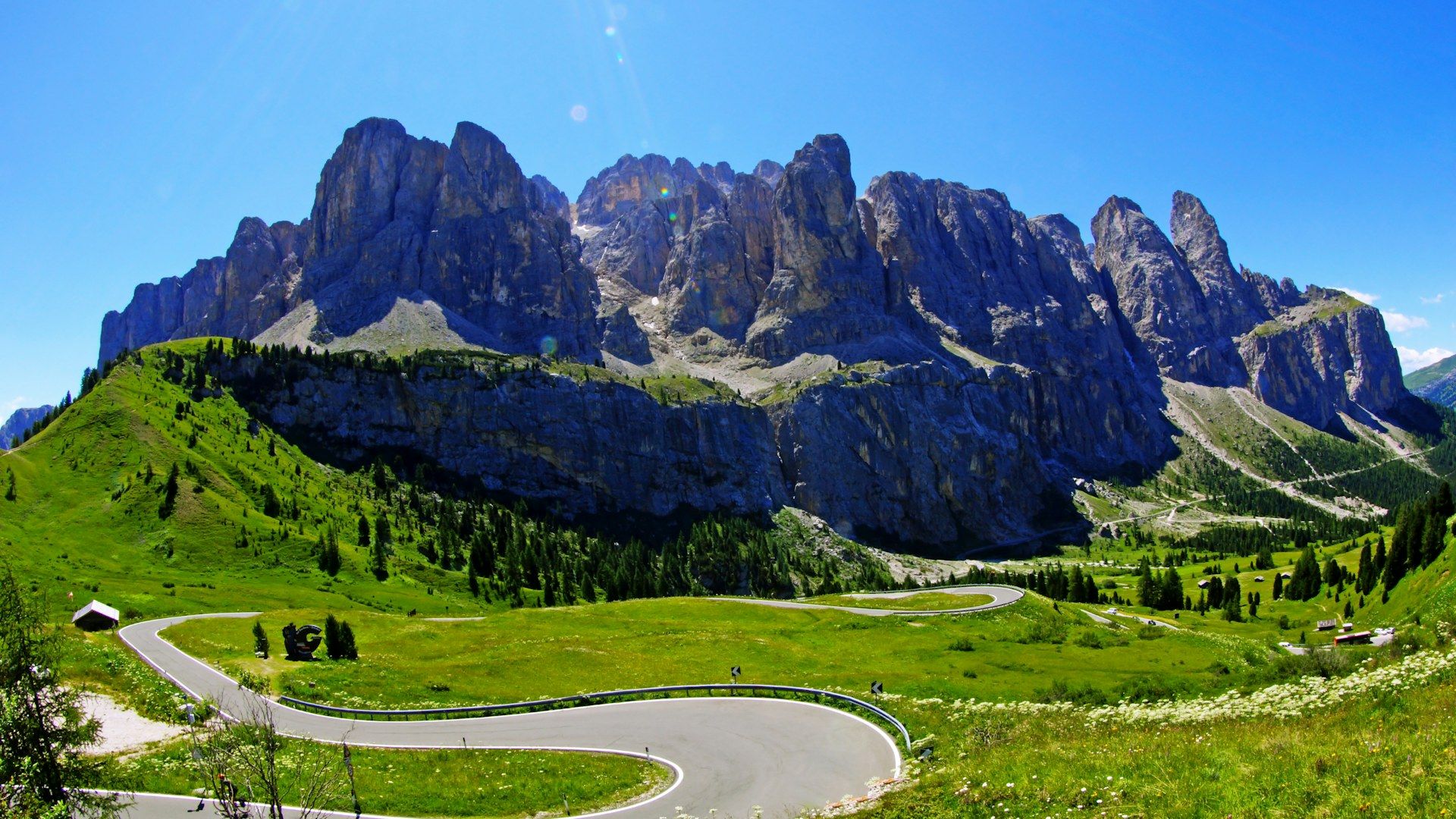
Fourteen days, six bases, and one rule: use the car where it opens the trip up, and get rid of it where it gets in the way. Two nights in Milan without one; the car collected at Milano Centrale on Day 3 and left parked in Varenna while the Lake Como ferries do the work; then four nights in Val Gardena, two on Lake Garda and one in Verona, where the car goes back and the train takes you to Venice for the last two. It is the broad version of Northern Italy rather than the deep one — the Dolomites get three proper days and Garda a deliberately slow one, and only two days, the transfers on Day 5 and Day 9, are long drives. What it leaves out on purpose: Cortina, Tre Cime, Lago di Braies and Tuscany. Adding any of them is what would turn it into a race.
Quick facts
- Duration
- 14 days
- Pace
- Balanced
- Best time to go
- June to September (late May and early October with checks)
Route map
Trip overview
| Day | Region | Main highlights | Book ahead | Pace |
|---|---|---|---|---|
| Day 1 | Land in Milan, Leave the Car Alone | Duomo di Milano and the roof terraces | Duomo di Milano and the roof terraces | Relaxed |
| Day 2 | One Full Day in Milan | The Last Supper, at your booked time; Pinacoteca di Brera | The Last Supper, at your booked time; Pinacoteca di Brera | Balanced |
| Day 3 | Collect the Car and Drive to Lake Como | Pick the car up at Milano Centrale; North to Varenna, then park for two days; Villa Monastero and its garden | — | Packed |
| Day 4 | A Day on the Water | Across to Bellagio on an early boat; Villa Carlotta at Tremezzo | Villa del Balbianello, if the boats line up | Balanced |
| Day 5 | Across the Plain to the Dolomites | Bergamo Città Alta; The long drive to Val Gardena | — | Balanced |
| Day 6 | Up onto Alpe di Siusi | The cable car up from Ortisei; Walking on Alpe di Siusi | — | Balanced |
| Day 7 | Seceda, Then Val di Funes | The Seceda ridge; Over to Santa Maddalena | The Seceda ridge | Balanced |
| Day 8 | The Four Passes | Passo Gardena; Passo Pordoi and the Sass Pordoi cableway; Passo Sella and back down | — | Packed |
| Day 9 | Down to Lake Garda the Long Way | The descent to Riva del Garda; The Gardesana Orientale to Malcesine | — | Balanced |
| Day 10 | A Slow Day on Garda | Monte Baldo by rotating cable car; Across to Limone sul Garda | — | Balanced |
| Day 11 | Sirmione, Then Verona — the Fullest Day | Rocca Scaligera; Grotte di Catullo and the point; The Arena and Piazza Bra | — | Packed |
| Day 12 | Verona in the Morning, Venice by Evening | Castelvecchio and the Ponte Scaligero; Hand the car back at Porta Nuova; The train east, and the Grand Canal | — | Packed |
| Day 13 | Venice on Foot | Basilica di San Marco; Palazzo Ducale | Basilica di San Marco; Palazzo Ducale | Balanced |
| Day 14 | One Last View, Then Home | Out to Marco Polo | — | Relaxed |
Transportation & practical information
A car-free start, a car-heavy middle and a car-free finish — use the car where it opens the trip up, and get rid of it where it gets in the way. It is collected on Day 3 at Milano Centrale, not on arrival: central Milan has a weekday congestion charge inside a wider low-emission zone, and the first two days run perfectly well on foot and on the metro. It goes back on Day 12 at Verona Porta Nuova, and the last leg to Venice is a train — Venice has no roads, and the garage at Piazzale Roma charges for a full 24 hours whether you move the car or not. In between, the car earns its keep, with one exception: on Lake Como it stays parked, because the ferries between Varenna, Bellagio and the western shore are usually quicker than the narrow shore roads once parking is counted. Italy drives on the right, the A4 and A22 are ticket-and-barrier toll motorways, and most historic centres on this route are camera-enforced limited-traffic zones — for this itinerary, the simplest option is to park outside the gate and walk in, unless your hotel has registered the car for access.
Days 3 to 12 are built around a car: the Dolomite passes, Val di Funes, the Gardesana Orientale and the run down to Sirmione have no realistic alternative at this pace. Days 1, 2, 13 and 14 do not need one and are worse with one. Book the smallest car your luggage allows — from Val Gardena onward the roads bring hairpins, rock tunnels and village gates built for a cart. Before booking, compare the one-way fee (this trip starts in Milan and ends in Verona, and that fee alone can change the total materially), the fuel policy, the insurance excess and the return procedure at Porta Nuova.
Day-by-day itinerary
Day 1: Land in Milan, Leave the Car Alone
The trip starts with no car, on purpose — Milan is easier on foot and by metro, and the rental desks will still be there on the third morning. Today is a cathedral, a roof, and a slow walk back through the arcades.
Landing late? Move the Duomo roof to tomorrow morning and take an afternoon Last Supper slot on Day 2 instead, if you can get one. What does not work is shifting the whole trip forward a day to save a night in Milan: the Dolomite section is the part that suffers, and it is the part you came for.
Tonight: Milan, within walking distance of the Duomo (two nights)
- Midday · Optional
Arrive, and get into town by train or metro
Malpensa Express trains run from Malpensa into Cadorna or Centrale, and the M4 metro runs from Linate to San Babila in twelve minutes; at the hours most long-haul flights land, both are more predictable than a taxi. Drop the bags, and go back out on foot or on the metro.
- Afternoon
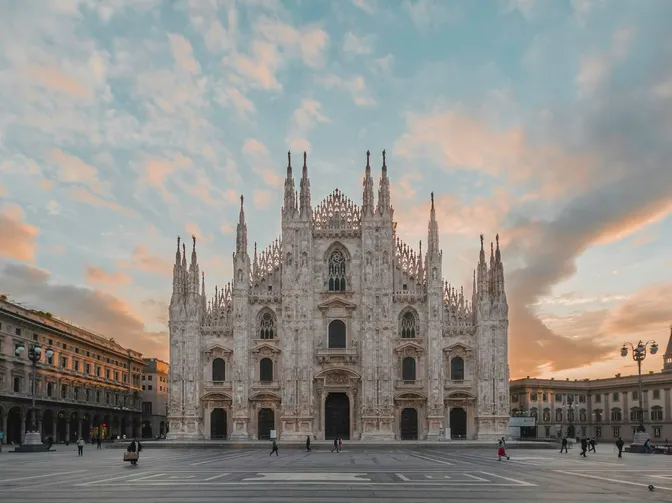
Duomo di Milano and the roof terraces
15 min from the previous stop
Book a timed entry before you leave home and take a mid-afternoon slot rather than a late one. The roof terraces stop admitting visitors noticeably earlier than the cathedral below, so an apparently late slot on the booking page can turn out to be a ticket for a closed staircase. Inside, twenty minutes is enough unless stained glass is a particular interest. The roof is the reason you are here: a forest of pinnacles and flying buttresses that you walk among rather than look at, with the Alps visible on a clear day. Take the stairs rather than the lift if you can — it is cheaper and it delivers you into the middle of the stonework instead of on top of it. Two hours covers both.
Time here: 2 hr
- Evening · Optional
The Galleria and Piazza della Scala at dusk
5 min from the previous stop
Leave the cathedral square through the Galleria Vittorio Emanuele II rather than doubling back across the piazza. It is a nineteenth-century shopping arcade under an iron-and-glass dome, and at dusk it fills with people crossing between the Duomo and the opera house without especially wanting to buy anything, which is when it is at its best. It puts you out in Piazza della Scala at the other end, five minutes on. Have a drink somewhere around here and call it a day — the flight has probably done enough.
Time here: 1 hr 15 min
Day 2: One Full Day in Milan
The day that separates this itinerary from the shorter Northern Italy loops, which treat Milan as an airport with a cathedral attached. It is arranged as a straight line west to east across the centre: a fifteen-minute appointment booked months in advance, then a castle, then the picture gallery, then the canals. All of it is walkable and none of it needs a car.
Check the day of the week before you book anything. Both the Last Supper and the Pinacoteca di Brera close on Mondays, so a Monday here empties the whole day of its anchors — the castle courtyards and the Duomo roof survive, and little else does. If your dates put Monday on Day 2, swap Days 1 and 2 around.
Tonight: Milan
- Morning
The Last Supper, at your booked time
This is the one thing on the whole fourteen days that cannot be improvised. Tickets are released in batches months ahead, every visitor needs a reservation including infants and free admissions, and the visit itself is fifteen minutes in a climate-controlled room with a fixed group size. Turn up half an hour before the slot with a passport or ID card, because the ticket is checked against a name. Fifteen minutes sounds absurd until you are in there, at which point it turns out to be about right: the wall is enormous, most of the paint is gone, and what survives is a piece of staging rather than a picture. Give the church of Santa Maria delle Grazie next door another twenty minutes afterwards — the domed east end is Bramante and it rarely has a queue.
Time here: 1 hr 15 min
- Midday · Optional
Castello Sforzesco and Parco Sempione
20 min from the previous stop
Twenty minutes on foot east, or two stops on the metro. The courtyards are free and open through the day, and for many people walking through them and out the other side into Parco Sempione is the whole visit — the scale of the place only registers once you are inside the walls. The museums, which take one inexpensive ticket between them, close on Mondays; the unfinished Pietà that Michelangelo was still working on in the last days of his life is in a former Spanish hospital ward at the back, and it is worth going in for that alone. An hour and a half if you go inside, half that if you do not.
Time here: 1 hr 45 min
- Afternoon
Pinacoteca di Brera
15 min from the previous stop
Fifteen minutes back east through the Brera quarter. This is the collection Napoleon assembled out of suppressed churches across northern Italy, which is why a gallery in Milan holds Piero della Francesca, Mantegna and Bellini in the same handful of rooms. Reserve ahead: entry is by booking rather than by queue. Two hours is honest — the rooms run long and the last third is heavy going if you have already spent a morning concentrating. If the weather is good and the morning felt like enough art, skip it and spend the afternoon in the Brera streets instead; the gallery will be the better choice on a wet day anyway.
Time here: 2 hr
- Evening · Optional
Aperitivo on the Navigli
25 min from the previous stop
Twenty minutes south-west on the M2, straight from Lanza to Porta Genova. The Naviglio Grande is one of the surviving arms of the canal network that once carried the Duomo marble into the city, and in the evening the towpath is where Milan stops being a business district. Walk out from the Darsena basin and pick a place by looking rather than by researching — on this particular stretch the ones with tables out and a crowd standing three deep are the safe bet. Then take the metro back; it runs late and the walk is longer than it looks on the map.
Time here: 1 hr 30 min
Day 3: Collect the Car and Drive to Lake Como
The road trip proper begins, and then almost immediately pauses. It is under an hour and a half from central Milan to Varenna, and once the car is in the hotel space it stays there for two full days while the boats do the work. Varenna is the base rather than Bellagio or Como town because the ferry pier, the railway station and a two-kilometre botanical garden all sit within a few hundred metres of each other.
Arriving on a Tuesday in spring or autumn? Villa Monastero's house museum is closed that day, but the garden stays open, and the garden is the reason to go — buy the garden-only ticket and you lose nothing. If you'd rather climb than stroll, walk up to the ruined tower at Castello di Vezio instead — twenty minutes of steps above the village, looking straight down on the point where the lake divides.
Tonight: Varenna, Lake Como (two nights)
- Morning
Pick the car up at Milano Centrale
Take the earliest slot the rental company will give you. Centrale sits outside Area C and the road north from it doesn't enter the charged zone — check that holds for the office you actually book — and the office is a short walk from the platforms rather than out at an airport. Two things before you drive off: check whether the fuel policy is full-to-full, and photograph every panel of the bodywork with the date visible. Arguments at drop-off are usually about a scratch nobody wrote down.
Time here: 45 min
Compare car rental prices - Midday
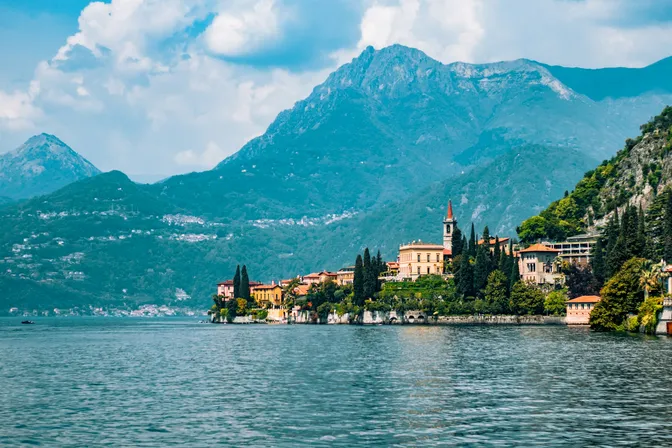
North to Varenna, then park for two days
1 hr 20 min from the previous stop
About an hour and twenty on the SS36 up the eastern arm of the lake. The first hour is unremarkable dual carriageway; the last fifteen minutes are not, with the road running under the Grigna massif and the water dropping away below. Confirm parking with the hotel at the time you book rather than on arrival — Varenna has very few spaces of its own and the public lots above the village fill by mid-morning in summer. Once the car is in, you are done with it until Day 5.
Time here: 1 hr
- Afternoon
Villa Monastero and its garden
10 min from the previous stop
A ten-minute walk south of the village, following the water the whole way. The house is a furnished nineteenth-century interior and pleasant enough, but the reason to come is the botanical garden, which runs along the water for nearly two kilometres — cypress, agave, citrus, and a sequence of statues and small pavilions with the lake a couple of metres below the path the whole way. The garden-only ticket is the cheaper one and it is enough if interiors leave you cold. Ninety minutes, and take the far end slowly: the path stays level the whole way, and the second half is the quieter half — don’t turn back at the first pavilion.
Time here: 1 hr 45 min
- Evening · Optional
The lovers’ walk at dusk
10 min from the previous stop
The Passeggiata degli Innamorati is a walkway bolted to the rock between the ferry pier and the old village, a short walk from anywhere in Varenna. It takes ten minutes to cover and most people do it twice, once each way, because the light on the water changes while you are on it. Afterwards go up rather than back: the stepped lanes behind the waterfront are where Varenna keeps its restaurants, and nothing up there is more than a few minutes from anything else.
Time here: 1 hr
Day 4: A Day on the Water
Leave the car at the hotel today: the ferries between Varenna, Bellagio and the western shore leave through the day and cross in fifteen or twenty minutes. The plan is one town and one garden — Carlotta or Balbianello, with the second only if the timetable hands it to you.
Villa del Balbianello opens on set days that shift through the season rather than on a fixed weekly pattern, and it needs a booking even for the gardens. If your date is not one of its days, Villa Carlotta on its own makes a full, unhurried afternoon and you have lost nothing. If you would rather do one villa than two, drop Carlotta and keep Balbianello.
Tonight: Varenna, Lake Como
- Morning
Across to Bellagio on an early boat
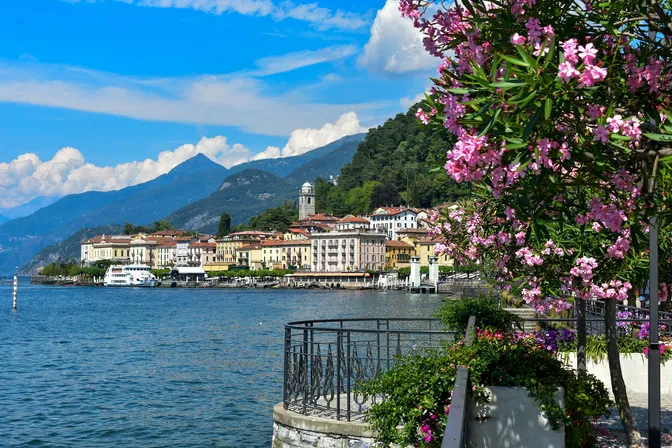
Take one of the first sailings. The crossing is short and the early boats are close to empty, which matters because Bellagio changes completely by late morning in July, once the day boats and the coach parties have landed. What earns its reputation is not the waterfront but the stepped lanes climbing away from it — Salita Serbelloni and the ones either side of it — and an hour of wandering those is the right amount. Then walk ten minutes north to Punta Spartivento, the tip of the promontory where the lake splits into its two southern arms: a bar, a few benches, and a view straight up both branches. Be back at the pier by late morning.
Time here: 3 hr
- Afternoon
Villa Carlotta at Tremezzo
30 min from the previous stop
Another short hop west, and the landing stage is effectively at the gate. The house is seventeenth-century and holds a nineteenth-century collection; the garden behind it climbs the hillside for around eight hectares, with rhododendrons and azaleas if you happen to be here in late spring and tree ferns, bamboo and citrus terraces at any time of year. Two hours is enough for the garden and a walk through the house without hurrying either. Check the closing time before you settle in — the last ticket goes well before the gates do.
Time here: 2 hr
- Evening · Optional
Villa del Balbianello, if the boats line up
30 min from the previous stop
Treat this as conditional rather than planned, and check the return sailings before you leave Bellagio rather than after you arrive at Lenno. The stop that catches people out is not the one going west; it is the last boat back to Varenna. If the timings work, it is one more hop to Lenno and then either a short taxi boat around the headland or a level twenty-minute walk through the woods from the waterfront. Balbianello is the villa out on its own promontory with the loggia between two stretches of open water, and it is the one that stays with people. Book the ticket before you travel — the gardens need one in advance and the interior can only be seen on a guided tour.
Time here: 2 hr
Day 5: Across the Plain to the Dolomites
The longest day at the wheel on the whole trip, around four and a quarter hours in total, and the one worth planning rather than enduring. Bergamo sits almost exactly on the line between Lake Como and the Brennero motorway, so stopping there adds very little to the route — treat it as the day’s break rather than looking for another sight. Leave Varenna early, give Bergamo the late morning, then run the A4 east and the A22 north up the Adige valley and turn off into Val Gardena for the last climb.
If four and a quarter hours sounds like too much, leave an hour earlier rather than cutting Bergamo — the detour barely lengthens the drive, so the time goes on the stop, not the road. What you can cut is the tail: Bolzano makes a reasonable overnight and splits the day in two, at the cost of your first evening in the mountains. The A22 around the Verona junction backs up on summer weekends, so midweek is the easier day for this leg.
Tonight: Ortisei, Val Gardena (four nights)
- Morning
Bergamo Città Alta
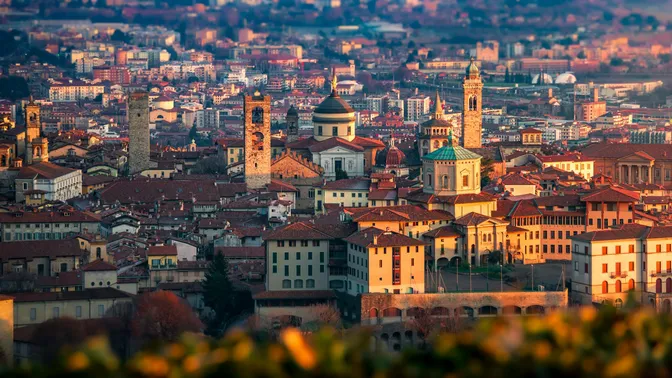
About an hour and ten from Varenna. Park in the lower town and take the funicular up rather than driving in — the upper town is a limited-traffic zone, and arriving by funicular is better anyway, because the walls appear above you rather than around you. Two hours is right: Piazza Vecchia with the Palazzo della Ragione, the Colleoni Chapel and its extravagantly carved front next door, and a stretch of the sixteenth-century Venetian walls that ring the whole upper town. If you only do one thing, sit down in Piazza Vecchia for twenty minutes rather than crossing it. Every side of that square is a different century and none of them are arguing.
Time here: 2 hr 30 min
- Evening
The long drive to Val Gardena
3 hr 5 min from the previous stop
Just over three hours from Bergamo, and almost all of it motorway: the A4 east past Brescia and Verona, then the A22 Brennero north through Trento and Bolzano. It is dull as far as Verona and then improves steadily, with terraced vineyards on both sides of the Adige and the first serious rock walls closing in past Trento. Leave the motorway at Bolzano Nord or Chiusa and climb into the valley; the last twenty minutes are steep hairpins out of the Isarco, and then Ortisei appears in a bowl of meadow with the Odle ridge standing behind it. Four nights here, which means unpacking once.
Day 6: Up onto Alpe di Siusi
The gentlest of the three mountain days and the easiest one to start with, because it asks nothing of you beyond walking on grass. A cable car leaves from the middle of Ortisei and lands you on a high meadow that rolls away for kilometres, where the walking is nearly level and the Sassolungo and Sciliar groups stand around the edges of it like scenery. Deliberately unstructured: this is a day to wander rather than to tick off.
Low cloud on the plateau takes the views away, and the webcams will tell you by eight in the morning. Don’t swap in Seceda or the passes on a grey day — cloud spoils both far more than it spoils a meadow. If it is only overcast, walk the plateau anyway; in real rain, go down to Bolzano for Ötzi at the archaeology museum and move Alpe di Siusi to a clearer day. Four nights here exist partly so that Days 6, 7 and 8 can be reordered on the forecast.
Tonight: Ortisei, Val Gardena
- Morning
The cable car up from Ortisei
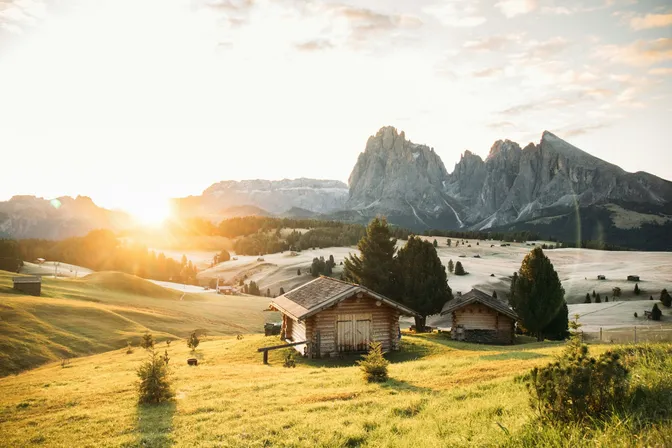
The valley station is in the village, a few minutes’ walk from most of the hotels, which is the reason to take the lift rather than to drive. The road up to the plateau is closed to non-resident cars through the middle of the day, and the two car parks at the top now need an online reservation booked days in advance, so driving is more administration than it is worth. The ride takes a few minutes and puts you out on the northern rim at two thousand metres.
Time here: 1 hr
- Midday
Walking on Alpe di Siusi
1 hr 30 min from the previous stop
From the top station the meadow rolls away south-west for kilometres, and the walking is easy enough that the main risk is doing too much of it. Head towards Compatsch, then keep going on any of the marked tracks past the hay barns — the paths are wide, well signed, and mostly level, and the huts along them serve lunch. Four hours out and back is a comfortable day; if anyone in the group would rather not walk far, the hut right by the Mont Sëuc top station has the same views from a bench. The plateau bus only links Compatsch and Saltria, so it won't shorten the walk back to the gondola. Come down on a lift in the late afternoon rather than the last one, which is busy.
Time here: 1 hr 50 min
- Evening · Optional
Ortisei in the evening
1 hr 40 min from the previous stop
The village centre is pedestrianised, which after a day in the mountains is more of a relief than it sounds. The Luis Trenker Promenade is an easy, tree-lined walk along the hillside above the village, twenty minutes end to end, and it is what the whole town does between six and eight. Ortisei has been carving wood for four hundred years and the workshops along the main street are still working workshops rather than souvenir stands; the difference is obvious once you have looked in one of each.
Time here: 1 hr 30 min
Day 7: Seceda, Then Val di Funes
The hardest-working day in the Dolomites, and the one to pick the weather for. Two cable-car stages lift you onto the tilted grass ridge at Seceda, where the ground simply stops and the Odle spires stand up out of it — the view that turns up on the cover of most books about the Dolomites. Then over the hill in the afternoon to look at the same peaks from the other side, from a valley of hay meadows and two small churches.
If the morning is cloudy, invert the day: Val di Funes works in flat light and Seceda does not, and the ridge is often clear by early afternoon when the valley is not. If you book the Seceda lifts online, check the forecast the night before you book rather than a week out.
Tonight: Ortisei, Val Gardena
- Morning
The Seceda ridge
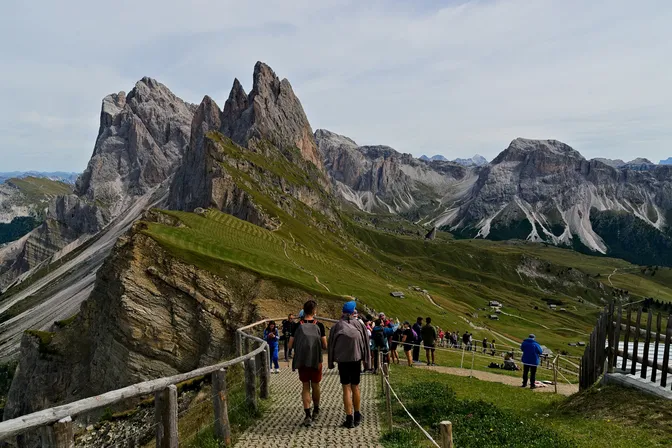
Two stages from Ortisei — a cable car to Furnes, then a second up to the ridge. Book online ahead on seceda.it; the valley cash desks can queue badly and the lift is not covered by the wider Dolomiti Supersummer card, which surprises people who have already bought one. At the top, walk away from the arrival station rather than photographing from it: ten minutes along the crest gets you past everyone, and the path runs the length of the tilted meadow with the spires on your right the whole way. Three hours including both rides and a proper walk. Bring a layer — it is around twenty-five hundred metres and the wind comes across the ridge unobstructed.
Time here: 3 hr
- Afternoon
Over to Santa Maddalena
1 hr from the previous stop
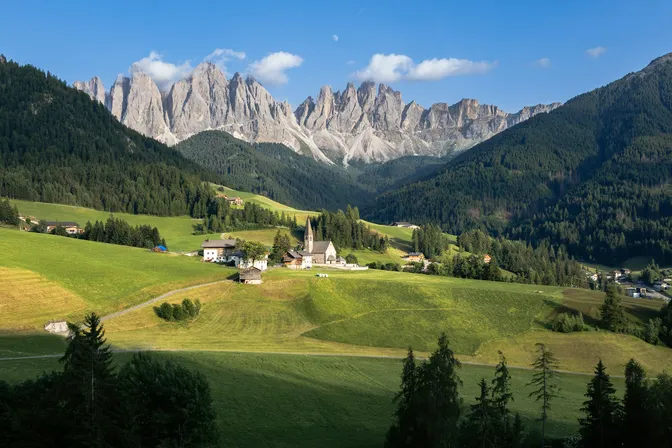
Forty-five minutes by road around the end of the massif into Val di Funes — an hour all in from the top station. Read the parking situation before you set off: the road up to the church and its viewpoint is now barriered to residents and hotel guests from May to November, so day visitors leave the car in the valley and walk up, and when the valley lot fills, cars are sent further down. That walk is twenty to thirty minutes and it is the point of coming — the church sits on a green knoll with the whole Odle ridge behind it, and it is the picture that sells the Dolomites. Late afternoon light is kinder here than midday.
Time here: 2 hr 30 min
- Evening · Optional
San Giovanni in Ranui, if the day has held
10 min from the previous stop
The bonus stop, and the first thing to drop if Seceda or the Funes parking has eaten the afternoon. Ten minutes further up the valley, a small baroque chapel standing alone in a fenced meadow with the same peaks behind it. There is a marked viewing area and a small charge to go in through the gate; from the road you can see it perfectly well for nothing, and most people do. Forty-five minutes, including standing about waiting for the cloud to move off the ridge, which it usually does. Then back over to Ortisei for dinner.
Time here: 45 min
Day 8: The Four Passes
A driving day in a trip that has mostly avoided them, and the one where the car finally earns its keep. The Sella massif is a single block of rock with four passes around it — Gardena, Campolongo, Pordoi and Sella — and the loop is about fifty-five kilometres of hairpins, tunnels and switchbacks. Campolongo you simply cross, on the run between Gardena and Pordoi; the three deliberate stops are the other three. It reads like a morning on the map and drives like a full day, which is the whole trick: each of those three is a place to get out, and the ones you drive past are the ones you will regret.
Drive it clockwise, as described. Check pass conditions the night before rather than the morning of — these roads are listed as open year-round but they shut at short notice for snow and avalanche work, and Passo Fedaia below the Marmolada, which is the obvious extension, is a May-to-October road only. Check the date as well as the sky: on the two Sellaronda Bike Days, one in June and one in September, all four passes close to cars for most of the day and belong to cyclists.
Tonight: Ortisei, Val Gardena
- Morning
Passo Gardena
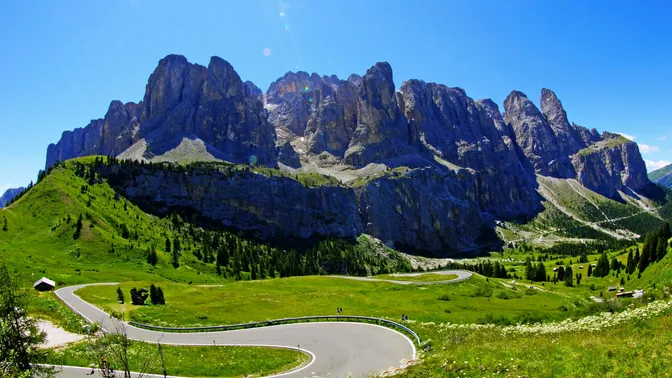
Forty minutes up the valley from Ortisei, climbing past Selva to just over two thousand metres, with the Sella wall on one side and the Cir peaks on the other. Stop at the top rather than at the first viewpoint on the way up: there is a large car park, a couple of huts, and paths leading off in both directions if you want twenty minutes on foot before getting back in. Be aware that South Tyrol has been running a monitoring trial on this pass with a view to restricting day-visitor traffic in future seasons; nothing is enforced yet, but the rules here may not be the rules by the time you drive it, so check.
Time here: 1 hr 15 min
- Midday
Passo Pordoi and the Sass Pordoi cableway
1 hr from the previous stop
An hour on: down to Corvara, over Campolongo to Arabba, and up again. Pordoi is the one with the big car park, the huts and the coach traffic, and the reason to stop is the cableway that goes straight up the rock face beside it to a summit plateau at nearly three thousand metres — a few minutes in the cabin and you are on a stone desert with the Marmolada glacier across the valley. The walking up there is rougher than anything on Alpe di Siusi and the edges are real edges. Three hours with the ride, lunch at the top and time to stand about.
Time here: 3 hr
- Afternoon
Passo Sella and back down
25 min from the previous stop
Twenty-five minutes north-west, and the one with the most scale to it: the road runs through a gap between the Sella block and the Sassolungo, and both of them are directly overhead. Stop at the lay-by below the Sassolungo where the gondola goes up — you do not need to ride it — and look back at the road you have just driven. Then it is a long descent through Selva to Ortisei, and if you have been stopping properly, it will already be early evening. Last night in the mountains.
Time here: 1 hr 15 min
Day 9: Down to Lake Garda the Long Way
A transfer day with a point to it, and the second-longest at the wheel — around three and a half hours all told, which makes it the only day besides Day 5 to pass the three-hour mark. Rather than dropping straight onto the motorway at Bolzano, the route takes the western end of the Great Dolomites Road over Passo Costalunga, pauses at a small green lake with a mountain in it, and then comes down to Garda from the north — so the first sight of the lake is the cliff-walled head of it rather than the flat southern shore everyone else sees. The last half hour, the ledge road south from Riva, is the day’s reward.
Wet weather or a late start? Skip Carezza and take the A22 straight down from Bolzano; it saves about an hour and costs you one lake and one pass, which is a reasonable trade on a grey day. What is not worth trading is the final stretch — do not swap the eastern shore road for the motorway down to Affi. The motorway is twenty minutes quicker and misses the entire reason for arriving at Garda from this direction.
Tonight: Malcesine, Lake Garda (two nights)
- Morning · Optional
Lago di Carezza
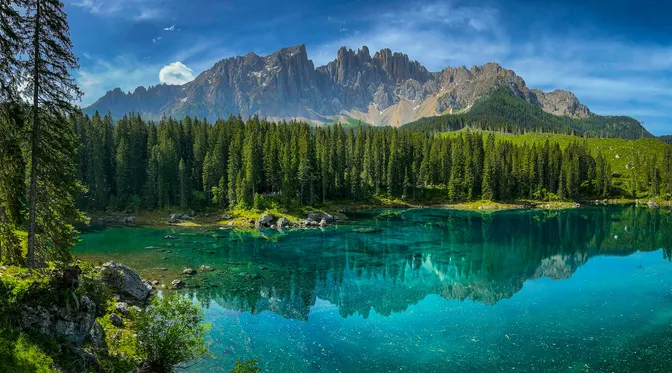
About an hour from Ortisei, dropping towards Bolzano and then climbing the Val d’Ega. Carezza is a small lake immediately beside the road with the Latemar range reflected in it, and it does exactly what the photographs promise in the first half of the day, before the wind gets up and breaks the surface. There is a paid car park with a pedestrian tunnel under the road; the loop around the water takes twenty minutes and the platform at the northern end is where the reflection lines up. An hour is plenty, and Costalunga behind it stays open through the year, unlike some of its neighbours.
Time here: 1 hr 15 min
- Afternoon
The descent to Riva del Garda
2 hr from the previous stop
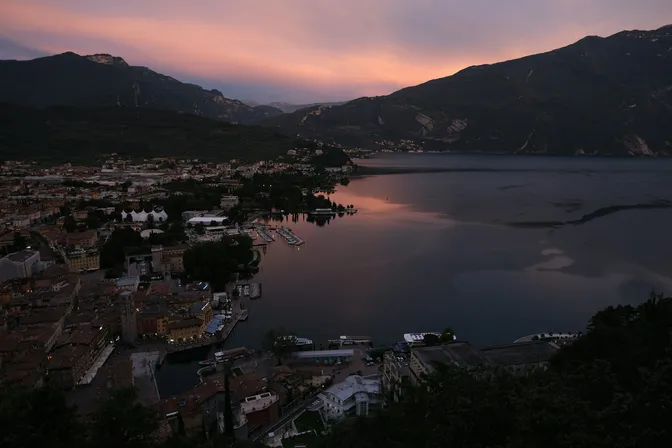
About two hours, most of it the A22 south from Bolzano through Trento and then west at Rovereto. Riva sits at the head of the lake with fifteen-hundred-metre cliffs standing more or less vertically over it, which is not what most people expect Lake Garda to look like. Park once and walk: Piazza III Novembre and the Torre Apponale, then the waterfront out to the foot of the old Ponale road, now cut into the cliff as a walking and cycling route and worth twenty minutes even if you go no distance along it. Ninety minutes here, longer if the afternoon is good.
Time here: 1 hr 45 min
- Evening
The Gardesana Orientale to Malcesine
25 min from the previous stop
Twenty-five minutes south on the SS249, and one of the better short drives in Italy: a ledge cut along the foot of Monte Baldo, a run of rock tunnels, and the lake flat below you the whole way. Malcesine is a knot of stone lanes under a Scaligeri castle on a spur, with a small harbour at the bottom. Park where the hotel tells you, because the centre is closed to traffic, and then spend the evening walking down to the water and back up. Two nights here, and tomorrow has nothing in it that needs an early start.
Time here: 1 hr 30 min
Day 10: A Slow Day on Garda
The one deliberately light day, placed here because this is where it is needed — after four days of mountains and a long descent. One cable car in the morning, one boat in the afternoon, and no plan at all for the hours in between. Garda is a lake to sit beside rather than a list to work through, and by Day 10 the difference matters.
If the summit is in cloud, turn the day inside out: take an early boat over to Limone, spend the morning there, and ride up in the afternoon once the wind has usually cleared the ridge. If the cable car is closed altogether — it shuts for maintenance in March and again from November into mid-December — the substitute is the drive north and up onto the Tremosine plateau above the western shore, on a road that hangs off the cliff the whole way.
Tonight: Malcesine, Lake Garda
- Morning
Monte Baldo by rotating cable car
The valley station sits above the old town, a few minutes uphill on foot, and the second stage has cabins that turn slowly as they climb, so nobody has to fight for a window. The first cabin goes up shortly after eight, with departures guaranteed at least every half hour from 08:30; buy online, which is a little cheaper than the window. At the top you are on a ridge with the whole length of the lake on one side and the Brenta Dolomites on the other, and there is an easy hour of walking along the crest before the ground turns into a proper hike. Two to three hours including the ride.
Time here: 3 hr
- Afternoon
Across to Limone sul Garda
1 hr 10 min from the previous stop
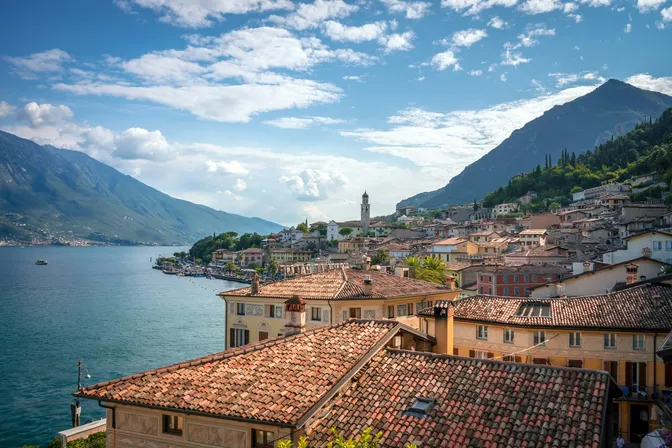
Back down, then the boat across to the western shore. It is a little over an hour door to door once the lift descent, the walk to the pier and the wait for a sailing are counted. The cross-lake service runs on a seasonal timetable and thins right out in winter, so check your dates rather than assuming. Limone is a narrow strip of town squeezed between the water and a wall of rock, and the thing to see is the Limonaia del Castèl — the stone-pillared terraced lemon houses that made the town’s living for centuries, at a latitude where growing citrus commercially was a genuinely improbable idea. An afternoon here does not need a structure. Take a late boat back.
Time here: 3 hr 30 min
- Evening · Optional
The castle above Malcesine
55 min from the previous stop
If there is any light left when you get back, walk up to the Castello Scaligero on its rock above the harbour. It is a thirteenth-century Scaligeri keep with a small museum, a Goethe connection the town is very pleased about, and a tower you can climb for a view down onto the roofs and out across the lake. Forty-five minutes to an hour, and it is a great deal better at the end of the day than in the middle of it.
Time here: 1 hr 15 min
Day 11: Sirmione, Then Verona — the Fullest Day
About two and a quarter hours of driving, broken by a Roman villa. Sirmione is a long thin peninsula at the southern end of Garda with a moated castle at its neck and the ruins of a very large Roman house out on the tip, and it is the last lake stop of the trip. Then east to Verona for the night. Get to Sirmione early — the causeway into the old town becomes a bottleneck by mid-morning in season. This is the fullest day on the route, so decide what goes before you set off rather than at the causeway.
Want the complete lake-to-city day? Keep both Sirmione stops and start early. Want a more relaxed Verona? Keep the Rocca and skip the Grotte di Catullo — that buys back an hour and a quarter, at the cost of the walk out to the point. Want Verona unhurried above all? Drop Sirmione entirely; it is the most easily cut stop of the fourteen days. Closing days bite harder here than anywhere: a Monday costs you the Arena, a Monday tomorrow costs you Castelvecchio, and each of Sirmione’s two ticketed sites closes one day a week, with the day shifting by season. If they collide, move the start date of the trip rather than rearranging this day.
Tonight: Verona
- Morning
Rocca Scaligera
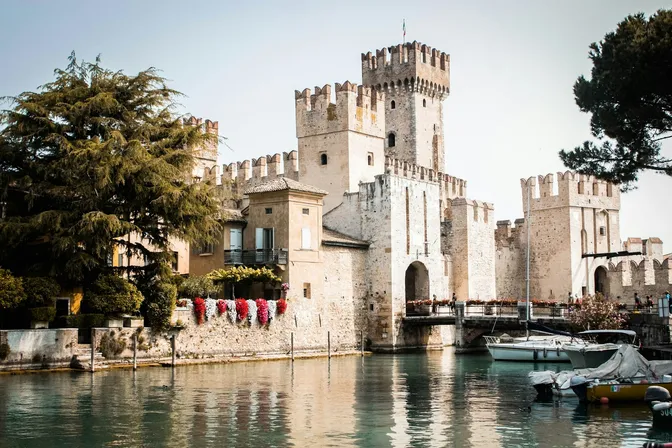
Ninety minutes down the eastern shore from Malcesine, on the road you drove in on. Park at the landward end — the peninsula is closed to general traffic and the large lots are all before the bridge — and walk in over the drawbridge. The castle is thirteenth-century, moated on every side, and has its own enclosed harbour built for a lake fleet, which is an unusual thing to find intact. It is as good from outside as within; forty-five minutes if you climb the tower and rather less if you do not.
Time here: 45 min
- Midday
Grotte di Catullo and the point
25 min from the previous stop
Twenty-five minutes on foot out through the old town, or the small road train if the day is hot. The Grotte are not caves: they are the collapsed remains of a first-century Roman villa spread across the tip of the peninsula among olive trees, with water on three sides and almost no shade, so bring your own water. The site takes a weekly closing day and the ticket office shuts well before the gates, so check both for your date. The walk back into town is the best half hour of the stop — the lanes are frankly touristy, but the view at the end of each one is not.
Time here: 1 hr 45 min
- Afternoon
The Arena and Piazza Bra
45 min from the previous stop
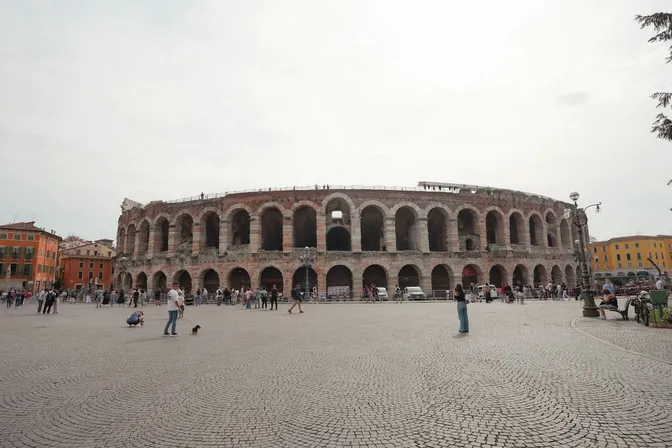
Forty-five minutes east on the A4, and longer on a summer weekend when the Garda exits back up. Leave the car in one of the signposted garages outside the walls, because Verona’s centre is a camera-enforced traffic zone; if your hotel is inside it, it has to file your plate with the local police in advance, which means emailing the hotel the rental’s registration before you travel rather than sorting it at the gate. The Arena is a first-century amphitheatre still in weekly use, and that is the unusual part: through the summer the bowl holds modern stage sets, so what you are looking at is a working theatre rather than a clean ruin. It closes on Mondays, and on days with an evening performance the daytime visit is cut short while the stage is set. Piazza Bra outside is where Verona spends its evening, on paving of the local pink limestone.
Time here: 2 hr
- Evening · Optional
Piazza delle Erbe after dark
10 min from the previous stop
Ten minutes on foot up Via Mazzini. Piazza delle Erbe was the Roman forum and is now a long market square closed in by frescoed houses with the Torre dei Lamberti over one end, and it works best once the crowd around the balcony a street away has gone to dinner. Go on through the arch at the top into Piazza dei Signori, which has half the crowd and twice the atmosphere. Eat somewhere around here, and as a general rule, a street or two off Via Mazzini is where prices drop and the menus stop being printed in five languages.
Time here: 2 hr
Day 12: Verona in the Morning, Venice by Evening
The day the road trip ends and the trip carries on. One more Verona sight on foot, then the car goes back at Porta Nuova and the train does the last leg — because Venice is the one destination on this route where a car is not an asset but a bill. An hour and a bit later you come out of the station onto the Grand Canal, which is a better arrival than any road can give you. Venice gets only two nights, but they are real ones rather than an airport stop: the car is gone, the hotel is on the island, and tomorrow is a full day on foot.
Driving on to Venice instead? It is about an hour and twenty to Piazzale Roma, and you still finish the journey on foot or by boat. That only makes sense if you are flying out of Marco Polo and would rather drop the car at the airport on Day 14 — in which case park at Mestre on the mainland, not on the island, and take the train across.
Tonight: Venice (two nights)
- Morning
Castelvecchio and the Ponte Scaligero
Fifteen minutes on foot west from Piazza Bra, and worth it even on a moving day. Castelvecchio is a fourteenth-century Scaligeri castle that Carlo Scarpa rebuilt as a museum in the 1960s, and the building is as much the reason to go as the collection — Scarpa’s concrete, steel and stone set against the old brick is still studied by architects, and you can see why within the first two rooms. It closes on Mondays. Walk out over the fortified bridge attached to it and look back: the bridge was blown up in 1945 and rebuilt from its own stones, dredged back out of the Adige.
Time here: 1 hr 45 min
- Midday
Hand the car back at Porta Nuova
25 min from the previous stop
Back to the garage for the bags and the car, then the short drive out to Porta Nuova, just south of the old walls. Refuel before you arrive, walk the car round with the agent, and keep the signed check-in sheet: traffic-zone fines can surface months later, and the rental company will forward them with a fee attached. Then upstairs to the platforms.
Time here: 45 min
- Afternoon
The train east, and the Grand Canal
Vyacheslav Argenberg / Wikimedia Commons, CC BY 4.0
1 hr 20 min from the previous stop
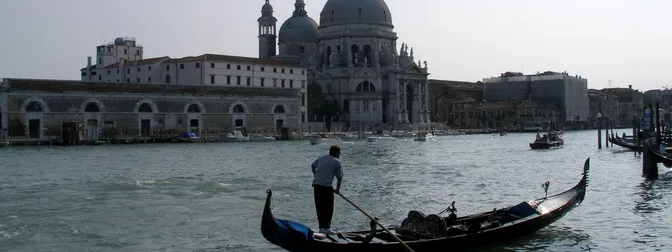
Verona to Venezia Santa Lucia takes a little over an hour on the fast trains and about half as long again on the regional ones, and they run through the day, so book a specific departure only if you want the cheaper advance fare. Santa Lucia is the terminus on the island itself — make sure of that when you book, because Venezia Mestre is on the mainland and is not where you want to get off. Come out of the station onto the canal steps and take the number 1 vaporetto rather than walking: it stops everywhere, takes the best part of an hour to reach San Marco, and one 75-minute ticket covers the ride. Ride it as far as your hotel stop, or all the way and walk back.
Time here: 1 hr 30 min
- Evening · Optional
Cannaregio in the evening
25 min from the previous stop
Whichever sestiere you are sleeping in, the first evening is better spent in Cannaregio than around San Marco. The Fondamenta della Misericordia and the canal-side streets either side of it are where Venetians actually eat and drink, twenty minutes’ walk north-east of the station and usually far quieter than San Marco once the day-trippers have left. Work along the water, stop at whatever has people standing outside it, and do not plan the evening any more carefully than that.
Time here: 2 hr
Day 13: Venice on Foot
The only full day in Venice, and it is arranged as one continuous walk from east to west with two booked appointments at the start. Get the two big San Marco monuments done in the morning while everyone else is still arriving on the day boats, then cross the city on foot through Rialto into Dorsoduro, which is quieter, and finish on the waterfront looking back at the water you have spent the day crossing. San Marco and the Doge’s Palace are the fixed morning; everything after Rialto is choose-as-you-go.
On Sundays and holy days the basilica does not open to visitors until two in the afternoon, though the museum and the Horses Loggia open in the morning as usual. If your only full day falls on a Sunday, flip the day: Dorsoduro and the Accademia in the morning, San Marco after lunch, and the Doge’s Palace before or after depending on what slot you could get.
Tonight: Venice
- Morning
Basilica di San Marco
Entry is by booked time slot, so this is the second appointment of the trip after the Last Supper — buy it online well before you travel and take the earliest one going. The basilica is eleventh-century and almost entirely Byzantine, with something like eight thousand square metres of gold mosaic over the vaults, and the floor beneath it is a warped mosaic pavement that has been moving with the tide for a thousand years. The interior alone is the cheapest ticket; the Pala d’Oro behind the altar and the museum with the original bronze horses are each worth the step up, and the combined ticket covers the lot. Ninety minutes for all of it. Shoulders covered, and no large bags.
Time here: 1 hr 30 min
- Midday
Palazzo Ducale
5 min from the previous stop
Five minutes next door, and a much bigger building than it appears from the square. The route runs through the state rooms — the Great Council chamber is an enormous hall with nothing holding up the middle of its ceiling — and then out over the Bridge of Sighs into the prisons, which is the part that stays with people. The standard ticket also covers the Correr Museum and two more collections around the square, valid on the same day, so if the afternoon turns wet you already have somewhere to go. Buying online at least a month ahead is meaningfully cheaper than buying at the door. Two and a half hours.
Time here: 2 hr 30 min
- Afternoon · Optional
North-west through Rialto
20 min from the previous stop
Now stop looking at the map and start walking. Head north-west out of the square on any street that looks like it is going that way and follow the yellow Rialto signs when you lose the thread. The bridge itself takes five minutes and is mostly a place to be photographed; the reason to come is the market on the far side, best in the morning but interesting at any hour, and the run of small streets behind it in San Polo where the prices halve within two turns of the water. An hour, unhurried.
Time here: 1 hr
- Afternoon · Optional
Gallerie dell’Accademia, or not
20 min from the previous stop
Twenty minutes further south-west over the Accademia bridge. This is the great collection of Venetian painting — Bellini, Carpaccio, Giorgione, Titian, Tintoretto, Veronese, five hundred years of it in one place — and if the painting in Milan meant something to you, this is where the trip pays that off. If it did not, skip it without guilt and spend the same ninety minutes walking Dorsoduro instead, which is the part of Venice that still feels lived in. Either way you end up in the same place.
Time here: 1 hr 45 min
- Evening · Optional
The Zattere at dusk
10 min from the previous stop
Ten minutes south to the long quay facing the Giudecca canal, which is where Venice keeps its western light. This is a working waterway rather than a picturesque one — ferries and freight go past at close range — and it is wide open to the sky in a city that mostly is not. Walk east along it towards the customs point at the tip of Dorsoduro, with the Salute’s dome above you on the left and San Giorgio across the water. Last evening, and the right place for it.
Time here: 1 hr 30 min
Day 14: One Last View, Then Home
A short morning and an unhurried transfer. There is one thing in Venice best left until you have seen everything else, and it takes under an hour: the bell tower across the water at San Giorgio Maggiore, which is one of the few places you can look at Venice from outside it. Then the airport, by boat or by bus depending on what you are carrying.
Flying out of Milan rather than Venice? Do not drive back — the train from Venezia Santa Lucia to Milano Centrale takes around two and a half hours and runs all day, and after two weeks on the move it is a far better last morning than the A4. Budget an early enough departure to still make the Malpensa Express connection at the other end.
- Morning · Optional
The bell tower at San Giorgio Maggiore
A short hop on the number 2 vaporetto from San Zaccaria. The church is Palladio’s and free to enter; the campanile has a lift, costs a few euros in cash and takes about a minute, and the platform at the top looks straight back across the water at San Marco, the Doge’s Palace and the Giudecca — the whole of Venice laid out below you instead of pressing in around you. The queue is usually far shorter than at the campanile in the square. Go early, take the boat back, and collect the bags.
Time here: 1 hr 15 min
- Midday
Out to Marco Polo
1 hr 15 min from the previous stop
Two sensible ways, and the choice depends on your luggage. The Alilaguna water bus goes from several landing stages straight to the airport, takes well over an hour, and is not covered by any ACTV pass you have been using; the ACTV Aerobus, line 5 from Piazzale Roma, takes around twenty-five minutes and costs less. If you are near the water with heavy bags, take the boat. If you are anywhere near Piazzale Roma, take the bus. For an international flight, aim to be at the airport around three hours before departure and work back from your hotel by the transfer you are taking — there is no way to hurry the last mile in Venice, and that is more or less the point of the place. If you can, avoid an early-morning departure altogether.
Don't do this
- Don’t collect the car on arrival day. A car parked overnight in central Milan costs a garage fee and a weekday congestion charge and buys you nothing for two days, since neither Milan day needs one and the Day 3 pickup at Centrale puts you on the road north within twenty minutes.
- Don’t drive around Lake Como to reach Bellagio and the western villas. The shore roads are narrow, slow, walled on both sides and short of parking; the ferry from Varenna takes a quarter of an hour and puts you down at the gates, and generally costs less than a day in a Bellagio car park.
- Don’t bolt Tre Cime di Lavaredo or Lago di Braies on to the Val Gardena base as a spare afternoon. Tre Cime is roughly two hours each way from Ortisei plus a toll road at the end, which turns a relaxed day into a driving day. The eastern Dolomites need their own base, and adding them to this route is what would finally make it a race.
- Don’t treat the Sella Ronda as a half day. Fifty-five kilometres reads like a morning and drives like a full one, and compressing it means passing the best viewpoints without stopping, which is the only real way to waste that road.
- Don’t drive the car on to Venice out of habit. The island has no roads; the municipal garage at Piazzale Roma charges by the 24-hour block whether you use it or not, and you still finish the journey on foot or by boat. Handing the car back in Verona usually works out cheaper once the garage and the extra rental days are counted, though the one-way and drop-off fees depend on the company and your dates — and either way the train that replaces it beats the motorway city-centre to city-centre.
- Don’t book an early-morning flight out of Venice on Day 14 if you can avoid it. Nothing on the island moves faster than walking pace, and the airport transfer, by bus or by boat, can’t be hurried. A late-morning or afternoon departure keeps the last morning’s view and takes the pressure off the transfer.
Useful travel information
Budget estimate
Estimate only, and admissions rather than the whole trip: allow around €400 to €450 per adult if you do everything on the route. The Dolomite lifts are the largest block — Seceda €74 return, Alpe di Siusi €41, Sass Pordoi €32, plus Monte Baldo €30 on Garda. Milan adds the Last Supper (€15) and the Pinacoteca di Brera (€15 for the gallery alone, €20 combined); the Lake Como villas are €13 to €17.50 each; Venice adds the St Mark’s Square museums ticket (€30 booked a month ahead, €35 otherwise), St Mark’s Basilica (€10 to €30) and a 24-hour vaporetto pass (€25). The smaller tickets — the Duomo roof, Sirmione’s castle and Roman villa, the Arena, Castelvecchio, the Accademia and the San Giorgio bell tower — add roughly €80 between them. On top of admissions: motorway tolls of roughly €45 to €60, the one-way rental fee, and the Verona–Venice train. The Gardena Card doesn't pay for this route: only Seceda and the Alpe di Siusi cable car are on it — €115 in single tickets against €124 for a three-day card. Prices checked September 2026; operators change fares and ticket conditions without notice.
Tips
- Book three things before you leave home, and in this order: the Last Supper, which is released months ahead in batches and sells out completely; St Mark’s Basilica, which is timed-entry only; and the Doge’s Palace, where booking at least thirty days ahead is cheaper than booking later. The Seceda lift and Villa del Balbianello follow close behind.
- Most of the historic centres on this route are camera-enforced limited-traffic zones: Bergamo’s upper town, Malcesine, the Sirmione peninsula, central Verona. Park in the signposted lots outside the gates. Where the hotel itself is inside the zone — most likely in Verona — email it the rental’s plate and your arrival date before you travel, because guest access is arranged by the hotel in advance and there is nothing to be done about it once you are at the gate.
- The mountains and the lakes can have completely different weather on the same day, and four nights in one Dolomite base exist partly so that Days 6, 7 and 8 can be reordered on the morning’s forecast. Use that rather than sticking to the numbers on this page.
- Fill up in the valley towns — Ortisei, Corvara, Canazei — rather than at the passes, and check pass conditions the night before Day 8. Those roads are listed as open year-round but they close at short notice for snow and avalanche work.
- Confirm parking when you book the room, not when you arrive. This plan leaves the car standing for two days in Varenna and parked at the edge of a traffic zone twice more, and Varenna, Malcesine and Verona were all laid out before cars existed. A hotel garage or a reserved space in a named lot is worth more on this trip than a better view.
- In Venice, buy a 24-hour or 48-hour vaporetto pass rather than single tickets. A single ride is €9.50 and the day pass is €25, so the pass pays for itself on the third boat — and on Days 12 and 13 you will take more than three without trying.
- Read this page in two layers. The route, the bases, the drive times and the logic of where the car helps are stable, and they are why the trip is shaped this way. The opening dates, lift fares, ferry timetables, parking reservations, traffic-zone rules and Venice’s access-fee calendar are not, and several of them moved during 2026 alone. Everything perishable is in the facts below with the date it was checked, so re-read that list a week before you travel and again the night before any day built around a lift, a boat or a booked slot.
Good to know (30)
- Advance booking for the Last Supper (Cenacolo Vinciano) is compulsory for everyone, including infants and free admissions. The museum opens Tuesday to Sunday, 08:15 to 19:00 with last admission at 18:45, and closes on Mondays, 1 January and 25 December. Full admission is €15, €2 for ages 18 to 25 and free under 18. Each group gets 15 minutes in front of the painting and visitors are asked to arrive 30 minutes before the booked time.Checked September 20, 2026
- The Pinacoteca di Brera opens Tuesday to Sunday, 08:30 to 19:15 with last entry at 18:00, and closes every Monday plus 1 May, 25 December and 1 January. Entry is by reservation through the gallery’s own booking service rather than by queueing, and admission is free with a reservation on the first Sunday of each month.Checked September 20, 2026
- The Castello Sforzesco courtyards in Milan are free and open daily from 07:00 to 19:30, including Mondays. The castle museums open Tuesday to Sunday, 10:00 to 17:30 with the last ticket at 16:30, on a single ticket covering all of them, and close on Mondays, 25 December, 1 January and 1 May.Checked September 20, 2026
- The Duomo di Milano’s rooftop terraces close earlier than the cathedral below them: the cathedral admits visitors until 18:10, but the terraces stop selling and admitting well before that, so the last usable slot is earlier in the day than the cathedral’s closing time suggests. On Fridays to Sundays between early June and mid-September the terraces stay open until 20:00, with the last ticket at 18:50 and last admission at 19:00.Checked September 19, 2026
- Milan’s Area C congestion charge costs €7.50 per day and applies Monday to Friday, 07:30 to 19:30 — except Thursdays, when it ends at 18:00; it is suspended at weekends and on public holidays. The wider municipality is also a low-emission zone banning older diesel and petrol vehicles.Checked September 19, 2026
- The M4 metro runs from Linate Airport to San Babila in central Milan in 12 minutes, on a standard €2.20 ATM ticket. The line runs daily from 06:00 to 00:30.Checked September 22, 2026
- Villa Monastero in Varenna opens daily 09:30–19:30 in April, May and September, 09:30–20:00 from June to August, and 10:00–18:00 in October. In April, May, September and October the House Museum closes on Tuesdays but the botanical garden stays open; there is no Tuesday closure from June to August, and in the winter months both close on Tuesdays. The garden alone is €13; garden plus house museum is €15.Checked September 24, 2026
- Villa Carlotta opens 20 March to 18 October 2026, 10:00 to 19:00 with the last ticket at 18:00, then 10:00 to 18:00 until 8 November. Adult admission is €17.50.Checked September 19, 2026
- Villa del Balbianello opens on set days that change through the season rather than on a fixed weekly pattern, so check its calendar for your date. Park admission is €15 for adults and booking is obligatory even for the gardens; the interior can only be seen on a guided tour, €25 for adults, about 50 minutes, maximum 16 people.Checked September 20, 2026
- Bergamo’s Città Alta is a limited-traffic zone. Park in the lower town instead: a ticket valid for two rides on the city funicular or bus line 1 costs €3.10.Checked September 18, 2026
- The road up to Alpe di Siusi is closed to private cars from 09:00 to 17:00; driving down from Compatsch is unrestricted at any hour, and outside those hours you may drive up only with an online parking reservation. From 29 June 2026, the two plateau car parks require an online reservation, bookable up to six days ahead — P1 Spitzbühl at €15 per car per day, P2 Compatsch at €30. Neither lot allows parking between 23:00 and 05:00.Checked September 20, 2026
- The Ortisei–Mont Sëuc cable car up to Alpe di Siusi runs 1 May to 5 June 08:30–17:00, 6 June to 16 October 08:30–18:00, and 17 October to 2 November 08:30–17:00. An adult ticket is €29 one way and €41 return.Checked September 20, 2026
- The Seceda cable cars from Ortisei run 22 May to 2 November 2026, 08:30 to 17:30. A return ticket covering both stages is €74 for adults. Tickets are also sold at the stations, but the operator recommends buying online in advance because parking in Ortisei is limited, and Gardena Card holders must book on seceda.it.Checked September 25, 2026
- A three-day Gardena Card costs €124 for an adult and €160 for six days, and covers 18 Val Gardena lifts — both Seceda cable cars and the Ortisei–Alpe di Siusi cabin among them. It is valid 6 June to 11 October 2026, and card holders still have to book the Seceda lifts on seceda.it.Checked September 20, 2026
- The wider Dolomiti Supersummer card — €145 for three days out of four, valid 14 May to 8 November 2026 across around 130 lifts — is explicitly not accepted on the Ortisei–Furnes cable car, the Furnes–Seceda cable car or the Fermeda chairlift, which are the only lifts up Seceda. On that card the €74 Seceda ticket is still payable on top.Checked September 20, 2026
- In Val di Funes, a barrier now restricts the road up to the Santa Maddalena church and its panorama viewpoint to residents and hotel guests from May to November; day visitors park in the valley and walk up. There is no booking system for the valley car park — once it fills, cars are directed to spaces further down the valley — and the daily parking fee is being raised.Checked September 20, 2026
- The Sella, Pordoi, Gardena, Campolongo and Costalunga passes are all listed as open throughout the year, subject to temporary closures for snow and avalanche risk. Passo Fedaia, below the Marmolada, is open May to October only.Checked September 20, 2026
- On Sellaronda Bike Day — 5 June and 11 September 2027 — the Gardena, Campolongo, Pordoi and Sella passes are closed to motor traffic and given over to cyclists. The published closure window for the 2026 editions ran 09:00 to 16:00; confirm the hours for your date.Checked September 22, 2026
- Passo Gardena’s planned restriction on day visitors’ cars did not take effect as a physical closure. The trial that began on 1 September 2026 runs as digital monitoring only — traffic is counted, with no roadblocks and no fines — and South Tyrol intends to use the data as the basis for later traffic-calming measures. The final rules had not been announced as of September 2026, so check before you drive it.Checked September 22, 2026
- The Sass Pordoi cableway from Passo Pordoi runs 14 May to 1 November 2026, 09:00 to 17:00, closing at 16:30 from 19 October. A return ticket is €32 for adults.Checked September 20, 2026
- The Malcesine–Monte Baldo cable car runs 4 April to 1 November 2026, first ascent 08:15 and departures at least every 30 minutes from 08:30; the last ascent is 18:00, or 16:00 from 5 October. A return ticket is €30 at the window and €28 online. The lift closes for maintenance in March, and again from November into mid-December.Checked September 20, 2026
- Tourists may drive into Verona’s limited-traffic zone only if their hotel stands inside it, and it is the hotel that notifies the Polizia Locale of the car’s plate in advance, using credentials issued to it by the city’s traffic office. Electronic gates read every plate entering and record the unauthorised ones as violations.Checked September 18, 2026
- Outside the opera season the Arena di Verona is open for daytime visits Tuesday to Sunday, 09:00 to 19:00, with last admission at 18:30. It closes on Mondays, 25 December and 1 January.Checked September 19, 2026
- The Arena di Verona opera festival runs from 12 June to 11 September 2027. During the festival the amphitheatre’s daytime opening is cut short on performance days so the stage can be set and struck.Checked September 19, 2026
- St Mark’s Basilica admits visitors on a booked time slot. Monday to Saturday it opens at 09:30, with last admission at 16:45 and closing at 17:15; on Sundays and public holidays the basilica opens to visitors at 14:00, while the Museum and Horses Loggia open at 09:30. Individual admission is €10 for the basilica, €20 for the basilica with either the Pala d’Oro or the museum and Horses Loggia, €30 for all four areas, and €15 for the bell tower.Checked September 20, 2026
- The Doge’s Palace opens 09:00 to 19:00 from 1 April to 31 October and 09:00 to 18:00 from 1 November to 31 March, with last admission an hour before closing. Its ticket is the combined St Mark’s Square Museums ticket, also covering the Correr Museum, the National Archaeological Museum and the Marciana Library rooms: €35 general admission, €30 if bought online at least 30 days ahead, €15 reduced. From 1 May to 26 September 2026 the palace and the Correr stay open until 23:00 on Fridays and Saturdays, last admission 22:00.Checked September 20, 2026
- Venice’s access fee applied on 60 days between 3 April and 26 July 2026, between 08:30 and 16:00, at €5 if paid by the fourth-last day before the visit and €10 if paid later. Guests staying overnight in an accommodation in the Municipality of Venice are exempt, but still have to register on the portal to obtain a QR code proving the exemption. No calendar for 2027 had been published as of September 2026.Checked September 20, 2026
- A single ACTV vaporetto ticket costs €9.50 and is valid for 75 minutes with unlimited changes on urban lines, excluding the airport routes. Passes cost €25 for 24 hours, €35 for 48, €45 for 72 and €65 for seven days, and run from first validation rather than from midnight.Checked September 20, 2026
- From Marco Polo airport, the ACTV Aerobus (line 5) costs €10 single or €18 return and takes about 24 minutes to Piazzale Roma. The Alilaguna water bus costs €18 one way, calls at every landing stage along its route, and is not covered by ACTV passes — it sells its own.Checked September 20, 2026
- The Autorimessa Comunale at Piazzale Roma, the main car park on the island itself, charges €35 for 24 hours for a car up to 2.20 m high. The minimum charging period is a full 24 hours and cannot be divided. Spaces can be booked online through Venezia Unica, but only until midnight on the day before arrival.Checked September 20, 2026
Frequently asked questions
- Is 14 days enough for Northern Italy?
- For this list of places, comfortably — and that is the point of the length. Fourteen days give Milan a full day, the Dolomites three, Lake Garda a deliberately empty one and Venice a proper one, and still only ask you to unpack six times. What they won’t stretch to is the eastern Dolomites — Cortina, Tre Cime, Lago di Braies — or Florence and Tuscany. Adding either is what would turn this into the race it is designed not to be.
- What if I have 10 days, or more than 14?
- With 10 days, keep the same sequence and take one day out of each stretch: one Milan day, one of the two Lake Como nights, one of the four Val Gardena nights and the slow day on Garda. It works, but Milan shrinks to an arrival evening and the Dolomites lose their weather buffer. With 16 to 18 days, don’t add another city. Spend the extra time on depth instead — a second Dolomite base further east for Cortina, Tre Cime and Lago di Braies, an extra night on Garda, or a third night in Venice.
- Lake Como or Lake Maggiore?
- Como, and the reason is the map rather than the scenery. Maggiore lies west of Milan, so visiting it and then heading for the Dolomites means driving back past the city — well over an hour of pure repetition on a route built to avoid exactly that. Como sits north of Milan, roughly on the line towards Bergamo and the Brennero motorway, so it costs nothing in direction. If Maggiore and the Borromean Islands matter to you specifically, they belong in a trip that begins and ends in Milan.
- Should I rent one-way from Milan to Venice?
- Usually not. From Day 12 the route is two cities where a car is a liability: Verona’s centre is a limited-traffic zone and Venice has no roads, so a car driven to the island sits in a garage at €35 per 24-hour block. Handing it back at Verona Porta Nuova ends the rental two days early, the one-way fee is generally lower than for Milan–Venice, and the train that replaces the last leg beats the motorway city-centre to city-centre. The exceptions are real: if you would rather drop the car at Marco Polo before flying home, or you are going on somewhere the train does not reach, take it — but park at Mestre on the mainland, not on the island, and cross by train.
- Where is the best base in the Dolomites for four nights?
- Val Gardena — Ortisei, Santa Cristina or Selva. Two of the three mountain days here start with a cable car from the village itself, the four passes of the Sella loop form a circuit out of the front door, and Val di Funes is forty-five minutes away. Cortina d’Ampezzo is the other obvious candidate and it is the wrong one for this route: it sits an hour and a half further east, which suits a Tre Cime and Braies trip rather than a west-to-east crossing of the north.
- When is the best time to drive this route?
- For the route as written, June to September is the window in which the Dolomite lifts, the passes, the Lake Como villas and the Garda boats reliably all run at once. June and September are usually the easiest balance of open services and manageable crowds; July and August have the fullest timetables but also the heaviest demand on Como, Garda and in Venice. Late May and early October can work, but treat them as shoulder season: some lifts, boats and villas run reduced timetables, haven’t opened yet or have already closed. Whichever month you pick, check the exact operating dates of the lifts, boats and villas you need rather than going by the month. A winter version is a different trip — the villas close, the lake timetables thin out and the mountain days become ski days.
- Do I need to pay Venice’s access fee?
- Not on this itinerary, because you are sleeping in the city rather than visiting for the day, and overnight guests in the Municipality of Venice are exempt. You may still have to register on the city’s portal to get the QR code that proves the exemption, though, so check when you book the room. Note also that the fee is not a fixture: it ran on 60 specific days between April and July 2026 and no calendar for the following year had been published as of September 2026, so treat the rules as something to verify rather than something to assume.