Last updated September 25, 2026
Croatia
9-Day Croatia Road Trip from Zagreb: Plitvice Lakes, Split & Dubrovnik
A one-way drive down the length of Croatia, from the capital to the far south, with the inland lakes first and the coast after: a highlights route, not an attempt to see the whole country. Plitvice gets a full day on the way south, Zadar a sunset, Split two nights, Hvar one, and Dubrovnik the last two. It suits a first visit that wants the country's main names in one trip and accepts one long travel day to get them. It's not the route for slow island time, several beach days, Istria or Korčula.
Quick facts
- Duration
- 9 days
- Pace
- Balanced
- Best time to go
- June and September
Route map
Trip overview
| Day | Region | Main highlights | Book ahead | Pace |
|---|---|---|---|---|
| Day 1 | Zagreb on Foot | The Upper Town: St. Mark's and the Stone Gate | — | Relaxed |
| Day 2 | Plitvice Lakes, Top to Bottom | Collect the car in Zagreb; Program C, first half: the Lower Lakes; Program C, second half: across Kozjak to the Upper Lakes | Program C, first half: the Lower Lakes | Packed |
| Day 3 | Down to the Coast at Zadar | Zadar's Old Town: the forum and St. Donatus; The Sea Organ and Greeting to the Sun at sunset | — | Balanced |
| Day 4 | Along the Coast to Split and Diocletian's Palace | Diocletian's Palace | — | Relaxed |
| Day 5 | Marjan and a Beach Afternoon | The Marjan viewpoints | — | Relaxed |
| Day 6 | The Ferry to Hvar | The Split–Stari Grad car ferry; Sunset from the Fortica | The Split–Stari Grad car ferry | Balanced |
| Day 7 | Hvar to Dubrovnik via Sućuraj and Ston | Along Hvar to the Sućuraj ferry; Arrive in Dubrovnik via Pile Gate | — | Balanced |
| Day 8 | Dubrovnik's Walls and the View from Srđ | The city walls, early; The cable car up Srđ at sunset | — | Balanced |
| Day 9 | A Last Swim and the Airport | To Dubrovnik Airport | — | Relaxed |
Transportation & practical information
Self-drive from the second morning, one way: collect the car in Zagreb on Day 2 and hand it back in Dubrovnik when you arrive on Day 7. Day 1 is on foot. The Zagreb–Zadar and Zadar–Split legs are largely motorway; the Hvar and southern Dalmatian sections are slower island and coastal roads. The island part uses two car ferries, Split–Stari Grad out to Hvar and Sućuraj–Drvenik back to the mainland, and the Pelješac Bridge then keeps the drive to Dubrovnik inside Croatia. Expect roughly ten to eleven hours of driving across the trip before traffic, parking and ferry queues — about two hours each on Days 2, 3 and 4 and four to four and a half on Day 7. The two ferry crossings take about two and a half hours combined — roughly two hours from Split to Stari Grad and thirty minutes from Sućuraj to Drvenik — but allow additional time for boarding and, on the Sućuraj–Drvenik route, for possibly waiting for the next departure. Every drive time on this page is a planning estimate, not a guaranteed journey time. Croatia drives on the right, the motorways are tolled, and vehicle access is restricted in the historic cores of Zadar, Split, Hvar and Dubrovnik — park at the edge and walk in.
Important — confirm ferry use before you book the car. This route takes the rental car on two domestic car ferries, Split–Stari Grad and Sućuraj–Drvenik, and rental companies' rules differ: some require a separate authorisation or fee for ferry or island travel. Ask in writing whether the vehicle may go on these ferries and whether any extra fee, insurance condition or roadside-assistance limitation applies, and don't pay until you have the answer. Then book a small car one way from Zagreb to Dubrovnik, and compare the total including the one-way fee, not the daily rate.
Day-by-day itinerary
Day 1: Zagreb on Foot
Arrival day, and no car yet. Zagreb's centre is small enough to cover on foot in a day: the Upper Town on its hill first, while it's quiet, then down to the market and the cathedral, and the evening in the Lower Town's squares. Collecting the car tomorrow instead of today saves a night's parking and a car you wouldn't use.
Arriving late? Walk up to the Upper Town for the evening view from the Strossmayer promenade and leave the market for another trip — it's a morning thing and closes early. In rain, the Museum of Broken Relationships is right beside St. Mark's.
Tonight: Zagreb
- Morning
The Upper Town: St. Mark's and the Stone Gate
Diego Delso / Wikimedia Commons, CC BY-SA 3.0
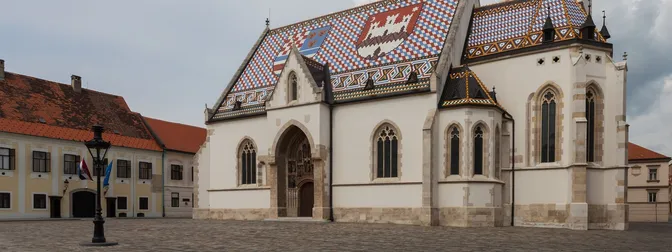
Start up on the hill, around 9:00–9:30, before the tour groups. St. Mark's Church, with the coats of arms laid out in its tiled roof, sits on a small square between the parliament and the government building. From there, walk to the Lotrščak Tower at the edge of the hill — a cannon is still fired from it at noon — and look out over the Lower Town from the Strossmayer promenade. On the way down, go through the Stone Gate, a covered passage with a shrine where people stop to light candles. Allow two to three hours at an easy pace.
Time here: 2 hr 30 min
- Midday · Optional
Dolac market and the cathedral
Nick Savchenko / Wikimedia Commons, CC BY-SA 2.0
15 min from the previous stop
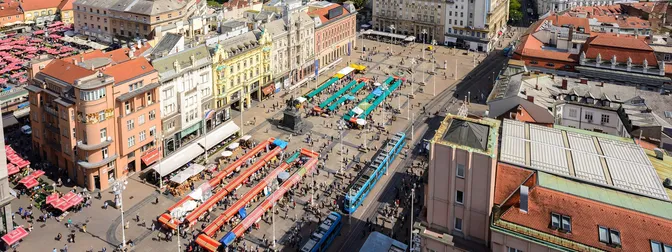
Fifteen minutes' walk down through the Stone Gate and Radićeva street brings you to Dolac, the open-air market on a terrace above Ban Jelačić Square, with its red parasols over fruit, vegetables and flowers and a covered hall below for cheese and meat. It's busiest in the morning and winds down after lunch, so this is the time for it. Zagreb Cathedral is a couple of minutes further on; restoration work after the 2020 earthquake is still going on, so check current access before you go and expect some scaffolding. Then take the afternoon off — tomorrow starts the driving.
Time here: 1 hr 15 min
- Evening · Optional
Evening on Ban Jelačić Square
Jorge Láscar / Wikimedia Commons, CC BY 2.0
10 min from the previous stop
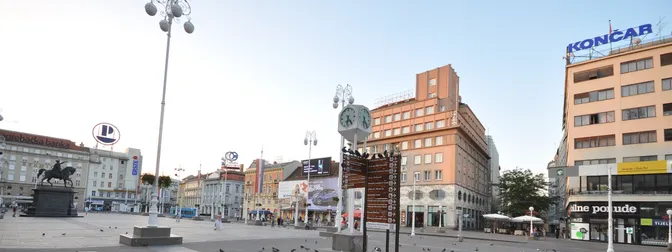
The city's main square is ten minutes from the market and the natural place to end the day: trams crossing, the equestrian statue in the middle, and the café terraces along the edges. From there, the green squares of the Lower Town run south toward the station — Zrinjevac, with its plane trees and music pavilion, is the one to walk through. Tkalčićeva, the café-and-bar street below Kaptol, is a few minutes the other way if you want somewhere livelier to eat.
Time here: 1 hr 30 min
Day 2: Plitvice Lakes, Top to Bottom
The first drive, and the day the national park gets whole — which works best with an early car pick-up; treat the Plitvice entry time as the day's fixed appointment. Collect the car around 8:00–8:30, take the motorway out of Zagreb and turn off at Karlovac for the D1 through Slunj — allow roughly two to two and a half hours to Entrance 1, depending on traffic. From there the park's Program C covers both halves in one circuit: down into the canyon of the Lower Lakes, the electric boat across Lake Kozjak, a walk through the Upper Lakes, and mostly by panoramic vehicle back to the start. The park puts it at four to five hours and eight kilometres — longer with photo stops and a lunch break; the hotel is ten minutes from the entrance.
Short on energy, or arriving late? Take Program B instead — the Lower Lakes, the boat across Kozjak and the panoramic vehicle, three to four hours — or Program A, the Lower Lakes alone in two to three. The Lower Lakes are the section with the canyon and Veliki slap. Rastoke, the mill village on the waterfalls at Slunj, sits right beside the D1 on the way down and makes a half-hour coffee stop if the morning runs smoothly. In heavy rain the boardwalks are slippery but the park stays open; keep the loop short.
Tonight: Near Plitvice Lakes (Selište Drežničko)
- Morning
Collect the car in Zagreb
Pick the car up in the centre as early as the office opens — around 8:00–8:30 if you can — rather than at the airport, which is on the wrong side of the city for the road south. The early start is a buffer, not extra park time: paperwork, city traffic and a coffee on the way all take longer than planned. Photograph the bodywork before you leave, check the fuel policy, and confirm the paperwork shows a one-way drop-off in Dubrovnik and allows the car on ferries. Then out to the A1 toward Karlovac.
Time here: 45 min
Compare car rental prices - Midday
Program C, first half: the Lower Lakes
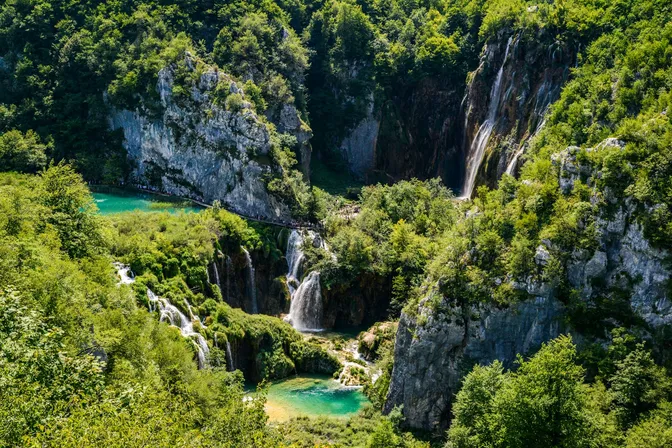
2 hr 5 min from the previous stop
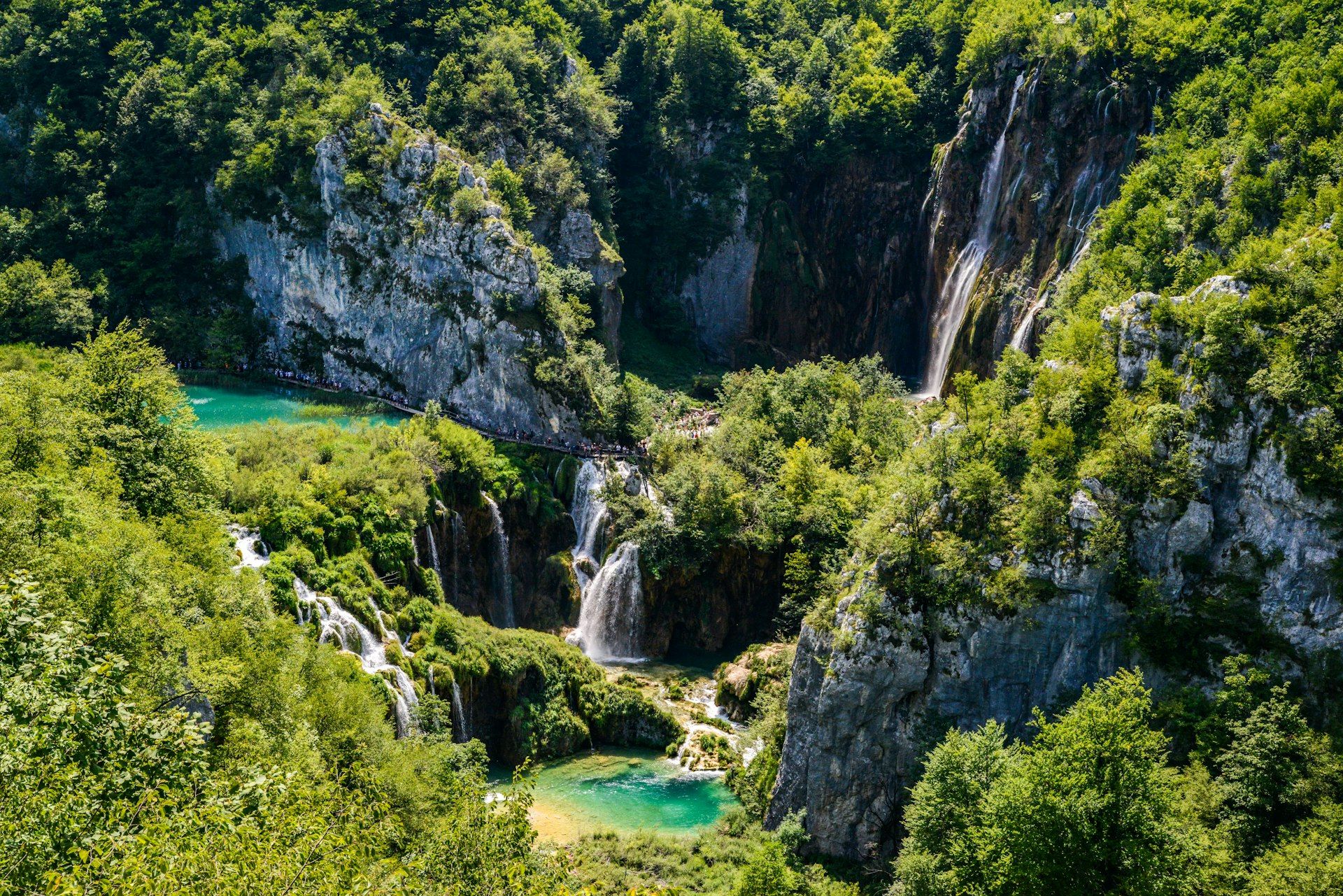
With an 8:00–8:30 pick-up, an entry time around 10:30–11:00 is the target. Book a slot you can realistically reach: if you're unsure about the rental pick-up, build the buffer into the morning — an earlier pick-up — rather than a later entry that leaves Program C short of daylight. Then walk down into the canyon of the Lower Lakes: boardwalks and paths run along and across a chain of smaller turquoise lakes between limestone walls, to the foot of Veliki slap, the tall waterfall at the end of the canyon. Climb back up the far side to the viewpoints above for the view down the whole canyon. Follow the Program C signs from here; allow about two and a half hours for this half, then take the path along Lake Kozjak to the boat landing.
Time here: 2 hr 30 min
- Afternoon
Program C, second half: across Kozjak to the Upper Lakes
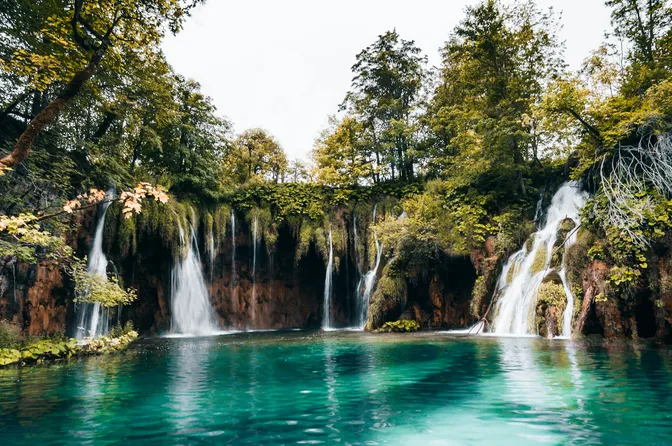
20 min from the previous stop
The electric boat crosses Lake Kozjak, the park's largest lake, and on the far side the Program C route walks through the Upper Lakes — bigger, calmer lakes stepped one above another, linked by rows of small waterfalls spilling over mossy ledges, with the boardwalks sometimes just above the water — before the panoramic vehicle takes you most of the way back to Entrance 1. Boat and vehicle rides within your programme are included in the ticket. Give this half about two and a half hours, and check the last boat and vehicle times at the entrance on the day, since they change with the season.
Time here: 2 hr 30 min
Day 3: Down to the Coast at Zadar
A driving morning and a slow evening by the sea. About two hours on the D1 and the A1 bring you from the mountains down to the coast, arriving at Zadar in time for lunch on the Old Town peninsula. The afternoon goes to the Roman forum and the lanes around it, and the day ends at the tip of the peninsula, where the waves play the steps of the Sea Organ at sunset.
Not in a hurry to leave the lakes? Go back into the park first thing, before the tour buses from the coast arrive, and drive to Zadar after lunch; you'll still make the sunset. On a hot afternoon, the Old Town's waterfront promenade has spots to swim straight off the stone, a short walk from the forum.
Tonight: Zadar
- Afternoon
Zadar's Old Town: the forum and St. Donatus
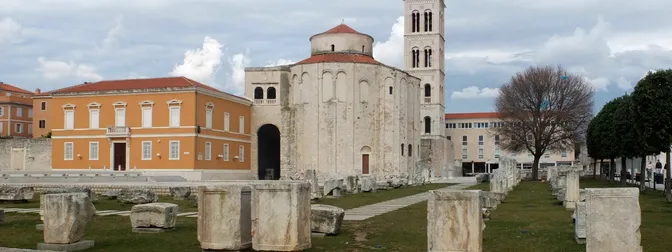
Palauenc05 / Wikimedia Commons, CC BY-SA 4.0
Check out at a relaxed hour and drive about two hours down to the coast. Park outside the Old Town — vehicle access is restricted — and walk in over the footbridge or through the Land Gate. The Roman forum is at its centre, open ground scattered with stone fragments, with the round, bare-walled Church of St. Donatus on one side and the cathedral's bell tower above it. Kalelarga, the main street, runs the length of the peninsula from there. Take the afternoon slowly; the churches' opening hours vary, and the forum and the buildings around it are well worth seeing from outside even when the doors are shut.
Time here: 2 hr
- Evening
The Sea Organ and Greeting to the Sun at sunset
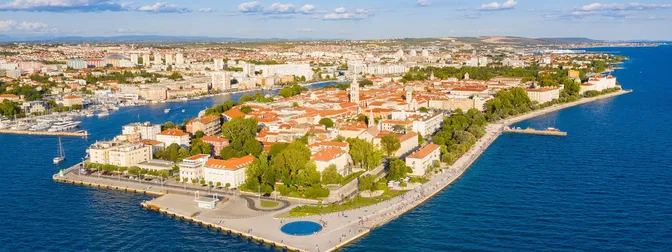
dronepicr / Wikimedia Commons, CC BY 2.0
10 min from the previous stop
Ten minutes' walk to the western tip of the peninsula. The Sea Organ is a flight of white marble steps down into the water with pipes built in underneath, so the waves and the wash of passing boats play low, shifting notes that you hear through slots in the stone. Sit on the steps for the sunset over the islands, then walk a few metres to the Greeting to the Sun, a large glass circle set in the pavement that stores daylight and lights up in patterns after dark. Stay until it switches on.
Time here: 1 hr 15 min
Day 4: Along the Coast to Split and Diocletian's Palace
A short morning on the motorway and an afternoon inside a Roman emperor's palace. It's about an hour and three quarters from Zadar to Split, and once the car is parked you won't need it again until the Hvar ferry. The palace takes the afternoon, when the morning's cruise groups have thinned out, and the Riva the evening.
Leaving Zadar early? Trogir's small walled old town is right off the route just before Split and makes an easy hour's stop — but don't add Šibenik or Krka as well, or you reach Split too late for the palace. In high heat, do the palace's shaded substructures first and the open courtyards toward evening.
Tonight: Split (two nights)
- Afternoon
Diocletian's Palace
Robin Tobin / Wikimedia Commons, CC BY 2.0
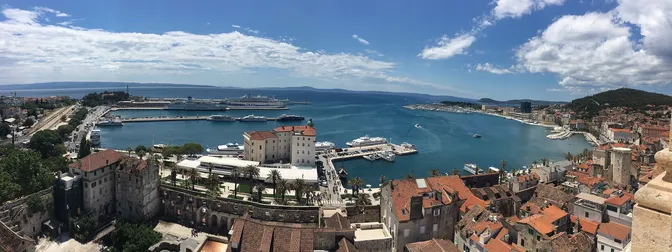
About an hour and three quarters from Zadar, counting Split's traffic at the end. Park for two nights — vehicle access to the historic core is restricted — check in, and walk to the Peristyle, the colonnaded courtyard at the palace's centre. The cathedral on one side of it was the emperor's mausoleum, reused in the Middle Ages; the bell tower beside it is a steep climb for the view over the roofs. Walk through the domed vestibule to the substructures below — the vaulted halls under the palace that show the plan of the rooms that stood above — and then out through the gates to see how medieval and later houses were built straight into the Roman walls. There are separate tickets for the cathedral complex and the cellars. Allow about three hours, and leave the last of it unplanned: the palace isn't something you finish, and part of the appeal of Split is the lanes around it, where people still live, shop and hang washing inside the Roman walls.
Time here: 3 hr
- Evening · Optional
The Riva in the evening
Gordan Sunara / Wikimedia Commons, Public Domain
5 min from the previous stop
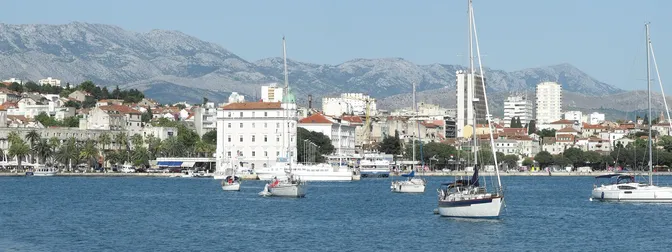
The Riva is a few minutes from the palace's southern gate: a wide palm-lined promenade along the sea wall that fills up after sunset with people strolling, sitting on the benches and watching the ferries come and go. Walk it end to end, then find dinner in the lanes behind it.
Time here: 1 hr
Day 5: Marjan and a Beach Afternoon
The lighter day, with no driving at all, placed in the middle of the trip on purpose. Split's other half is Marjan, the wooded hill at the western end of the peninsula: a morning walking its paths and viewpoints, then an afternoon on a pebble beach on its far side, and the evening back in town with nothing booked.
If you'd rather have sand and a crowd, Bačvice, the city beach a short walk east of the palace, is the swap for Kašjuni. For a change of scene, Trogir is about half an hour away and fills a morning well. In rain, spend the day in the city's museums rather than on the hill.
Tonight: Split
- Morning
The Marjan viewpoints
Start around 9:00, before the heat. From the old town it's twenty minutes on foot through the lanes of Varoš and up a long flight of steps to the terrace café at Vidilica, the first viewpoint, which looks back over the palace roofs, the harbour and out to the islands — Brač and Hvar, where you're going tomorrow, are the long grey shapes on the horizon. From there, shaded paths run on through the pines across the hill. Walk as much of it as you like; two to two and a half hours is an easy pace.
Time here: 2 hr 30 min
- Afternoon · Optional
Kašjuni beach
35 min from the previous stop
A short taxi ride from town is the easy way over after a morning on the hill; it's also thirty-five minutes on foot down the far side if you still feel like walking. This is the recovery day, so take the taxi without guilt. Kašjuni is a long pebble beach in a bay below the pines, clear-watered and much less crowded than the town beaches. Spend the rest of the afternoon here and head back for sunset; the evening in Split is yours.
Time here: 2 hr 30 min
Day 6: The Ferry to Hvar
The first ferry, and the only night on an island. The Split–Stari Grad car ferry leaves from Split's ferry port, close to the old town, and takes two hours to Stari Grad on Hvar's north side, where the car is useful again for the roughly twenty-five-minute drive over the hills to Hvar Town. The core of the day is the ferry, Hvar Town and the Fortica at sunset; Stari Grad and the Pakleni Islands are optional extras if time and energy allow. Otherwise the afternoon is for the town and the sea — lunch, a swim, the waterfront.
For a quieter island, take the shorter crossing to Brač instead — the FAQ below covers the trade-off. If you're tired or arrive on a later ferry, skip the Pakleni Islands: the pebble coves along the promenade west of Hvar Town are a walk from the centre. Whatever gets cut, keep the Fortica at sunset.
Tonight: Hvar Town
- Morning
The Split–Stari Grad car ferry
Take an early morning sailing, and be at the ferry port — close to the old town, but allow for city traffic and the vehicle queue — in good time: Jadrolinija advises arriving 60 minutes before departure in summer. The crossing takes two hours; take what you need for it up to the passenger deck, and watch Brač slide by from outside. Stari Grad's harbour lies at the end of a long inlet, and the plain behind it, where Greek settlers laid out their fields in the 4th century BC, is still divided by the same stone walls. From the ferry, it's twenty-five minutes over the island's spine to Hvar Town; if you're ahead of schedule, Stari Grad's quiet old town is worth half an hour first, but don't try to do both towns properly in one afternoon.
Time here: 2 hr 30 min
- Afternoon · Optional
Optional: the Pakleni Islands by taxi boat
1 hr from the previous stop
Park at the edge of town — vehicle access to the centre is restricted — check in, and have lunch by the harbour. If you still have energy, taxi boats leave from the harbour through the day for the Pakleni Islands, the chain of low pine-covered islands just across the channel. Palmižana, on the largest of them, is about twenty minutes away, with sandy-bottomed coves, a few beach restaurants and paths through the woods between bays. Take a boat back in the late afternoon; check the time of the last return when you buy the ticket. If you'd rather not add another transfer, stay in town and swim off the rocks along the promenade instead.
Time here: 3 hr
- Evening
Sunset from the Fortica
Steve Jurvetson / Wikimedia Commons, CC BY 2.0
45 min from the previous stop
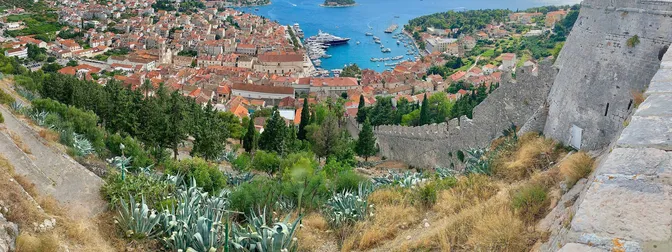
From the harbour, it's a twenty-minute climb through the lanes and up a path through the pines to the Fortica, the fortress above Hvar Town. From its walls you look down on the whole of the harbour and the square behind it, with the Pakleni Islands spread out beyond, and it faces west over the channel for the sunset. Check the opening hours and entry fee locally, since they change with the season. Walk back down to St. Stephen's Square for the evening, where the town gathers once the day-trippers have gone.
Time here: 1 hr 15 min
Day 7: Hvar to Dubrovnik via Sućuraj and Ston
The longest day of the trip, and a transfer day: leave Hvar early, and treat Ston as optional — the first thing to cut if you're delayed. Instead of going back to Split, you drive the length of Hvar to the car ferry at Sućuraj, cross to Drvenik, and follow the coast south over the Pelješac Bridge to Dubrovnik. Roughly an hour and three quarters to Sućuraj, a half-hour crossing plus up to an hour's wait in summer, then about two and a half hours on to Dubrovnik via Ston: about four to four and a half hours of driving, six to seven door to door, more with the stop. Don't plan around a particular sailing, and don't book anything for the evening.
Ston is the stop to drop if the day is running late: behind schedule, drive straight to Dubrovnik and arrive in daylight; well behind, don't think about sightseeing at all. With a second night on Hvar, the drive becomes much easier: split the day and arrive in Dubrovnik by lunchtime. Without a car, the passenger catamaran from Hvar Town to Dubrovnik is the alternative — catamarans carry foot passengers only, not cars.
Tonight: Dubrovnik (two nights)
- Morning
Along Hvar to the Sućuraj ferry
Set off by about 7:30–8:00. The road runs east along the island's spine for an hour and three quarters, much of it narrow and winding past vineyards and lavender terraces and through empty villages, to Sućuraj at the very tip. The Sućuraj–Drvenik car ferry takes half an hour, and on this line the ticket is valid for any departure on its date rather than a particular sailing — so treat the timetable as a sequence of possible departures, not a booking, and allow for the next one if the first is full. Budget up to an hour for the wait in high season, so that missing one sailing costs you Ston, not the day.
Time here: 45 min
- Midday · Optional
Optional: Ston
2 hr from the previous stop
From Drvenik, follow the coast road south past Ploče and the Neretva delta and turn off over the Pelješac Bridge, which keeps the route inside Croatia. About an hour and a quarter from the ferry you reach Ston, at the neck of the Pelješac peninsula, where medieval walls climb the hill above the town. Stop only if the ferry went smoothly. There's no need to climb the walls after a morning like this one, and tomorrow is Dubrovnik's: walk the small grid of streets, maybe the lowest stretch of wall, and have lunch — the bay here is known for its oysters and mussels, though what's on the menu depends on the season. An hour and a half at most.
Time here: 1 hr 30 min
- Afternoon
Arrive in Dubrovnik via Pile Gate
1 hr 10 min from the previous stop
An hour and ten minutes on the coast road, with the first view of the walled city appearing below the road as you come round the last bend. Return the car at your rental company's city office before you go anywhere — or, if you're keeping it for an airport return, leave it in a public car park — because vehicle access to the Old Town is restricted. Walk in through Pile Gate, check in, and take the Stradun, the polished stone main street, to the old port. That's enough for tonight.
Time here: 1 hr
Day 8: Dubrovnik's Walls and the View from Srđ
A full day inside and above the walled city, without the car. The morning goes to the circuit of the city walls, early, before the heat and the crowds; the afternoon is open for the Old Town's churches, cafés and lanes; and the evening for the cable car up Mount Srđ to watch the city from above as the sun goes down.
In high wind or a thunderstorm, the cable car stops — take a taxi up the road to Srđ instead, or save it for the evening of Day 9 if you're staying longer. If the walls are already crowded when you arrive, start from the Ploče entrance on the eastern side instead of Pile.
Tonight: Dubrovnik
- Morning
The city walls, early
Akira Takiguchi / Wikimedia Commons, CC BY 2.0
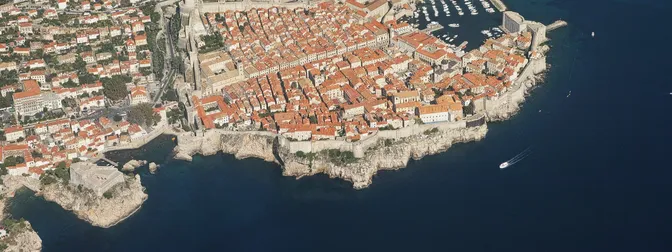
Be at the entrance inside Pile Gate at opening time — check the current hours the day before, as they change with the season. The walk runs the whole way around the Old Town on top of the walls, nearly two kilometres of steps and ramparts, with the red roofs on one side and the open sea on the other. The high point is the round Minčeta Tower on the landward side, with the whole Old Town laid out below it. It takes about two hours without hurrying. There's little shade — bring water and a hat — and keep the ticket: it also gets you into Fort Lovrijenac.
Time here: 2 hr 30 min
- Midday · Optional
Fort Lovrijenac
15 min from the previous stop
A fifteen-minute walk out of Pile Gate and up the steps on the rock beside it brings you to Lovrijenac, the fortress that guarded the city's western approach from the sea. The walls ticket covers it, and from its terraces you look back at the Old Town walls you walked this morning. Half an hour to three quarters is plenty; then go for lunch and back to the hotel through the hottest hours. A shower and a rest before the evening is part of the plan, not time lost; the Old Town's lanes are better in the late afternoon anyway.
Time here: 45 min
- Evening
The cable car up Srđ at sunset
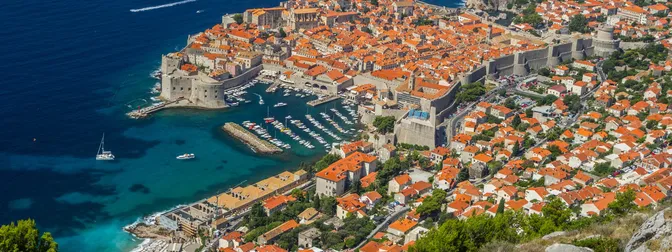
Zysko serhii / Wikimedia Commons, CC BY-SA 4.0
25 min from the previous stop
The lower station is a few minutes' walk uphill from Buža gate, on the north side of the Old Town. Time it to reach the top about an hour before sunset: the cabin climbs in a few minutes to the terrace on Mount Srđ, and from there the Old Town sits below you as a single shape, walls and all, with Lokrum island and the open Adriatic beyond. Stay until the lights come on in the city, then ride down; check the day's final departure and closing time before you go — they change by month — and note that the cable car stops in high wind.
Time here: 1 hr 30 min
Day 9: A Last Swim and the Airport
A slow last morning. Banje beach is just outside the Old Town's eastern gate, with the walls rising behind it — a swim there is the right way to end a coastal trip. Then the airport — allow thirty to forty-five minutes in normal conditions.
Plan the morning around the flight. With a late flight, add lunch in the Old Town after the beach. With a midday flight, swap the beach for a coffee and a short walk along the old port. With an early flight, go straight to the airport — allow extra time in summer, when the coast road out of the city is slow. Lokrum island, a short ferry from the old port, only makes sense with a whole spare afternoon. If you kept the car, return it at the airport before check-in.
- Morning · Optional
Banje beach
Walk out through Ploče Gate, a few minutes from the Old Town's eastern end, and down to Banje, a pebble beach facing Lokrum with the old harbour and the walls behind it. Go in the morning, before it fills up. Swim, sit, have a coffee on the terrace, and give yourself two hours.
Time here: 2 hr
- Midday
To Dubrovnik Airport
40 min from the previous stop
By taxi or the airport bus — or in the car, if you kept it for an airport return. The drive south along the coast road to Čilipi is roughly thirty to forty-five minutes in normal conditions; leave enough extra time for summer traffic on the road out of the city and for the airport's recommended arrival time.
Time here: 30 min
Don't do this
- Don't take the car back through Split to leave Hvar. The ferry off the eastern tip at Sućuraj saves the second two-hour crossing and the drive back down the coast — that one choice takes hours off the Hvar-to-Dubrovnik day.
- Don't try to add Šibenik, Krka and Trogir on the way from Zadar to Split. Any one of them eats into the Day 4 afternoon the palace needs; Trogir, the closest to the route, is the only one worth considering, and only with an early start.
- Don't book a flight out of Dubrovnik on Day 7 or plan anything fixed for that evening. It's the longest day of the trip with two things you don't control, a ferry queue and summer traffic on the coast road.
Useful travel information
Budget estimate
Estimate only, and only for the main entry tickets the route is built around — not the whole trip. A one-day Plitvice ticket is €40 per adult from June to September; the €25 late-entry rate starts after 16:00 in June to August and after 15:00 in September. Parking at the park entrances is €2 an hour in summer. The Dubrovnik cable car is €30 return. Not included here: the Dubrovnik city walls, the separate tickets for Split's cathedral and the palace cellars, the two car ferries (priced per car plus per passenger), motorway tolls, parking in the cities and on Hvar, fuel, and the one-way fee for dropping the car in Dubrovnik, which varies widely between rental companies. Prices and operating information checked September 2026; ferry timetables, rental conditions and attraction hours change with the season.
Tips
- Book the Split–Stari Grad car ferry online as soon as your Day 6 is fixed — Jadrolinija says a ticket on this line guarantees a place on the departure you choose. Check the current timetable and vehicle rules when you book, and take an early sailing.
- Buy the Plitvice ticket online before Day 2, for Entrance 1 and a time you can realistically reach after the car pick-up, and plan on Program C. The ticket covers the electric boat and panoramic vehicle within your programme. Check the park's current programme and timetable a few days before you go.
- Plan to return the car in Dubrovnik on Day 7, at a city drop-off point that is practical for where you are staying — check where it is before you book, as some companies have only one city location and some offer only an airport return. Days 8 and 9 don't need it, and keeping it means paying for parking in a city with very little. Keep it until the airport only if your company has no convenient city drop-off, or if an airport return is clearly cheaper once two days' parking are counted.
- Check HAK, the Croatian Auto Club (hak.hr), before every long driving day — Days 2, 3, 4 and 7. Roadworks, traffic, weather, fire-related closures and ferry conditions can all change the timing, especially in summer.
- Walk early, rest at midday. Plitvice's boardwalks, Marjan, the Fortica, Ston and Dubrovnik's walls are all exposed, and in July and August the hours around lunch are too hot for them — the days on this page already put the long walks in the morning and the viewpoints in the evening, so keep the middle of the day for lunch, shade or a swim.
- If you fall behind, cut these optional stops first, in this order: Lokrum, Rastoke, the Pakleni Islands, Trogir, Ston. They're there to protect the core of the route — Plitvice, the palace in Split, Hvar Town and the Fortica at sunset, and Dubrovnik's walls and Srđ.
- Last checked: September 2026. Ferry timetables, ticket prices, rental conditions and opening hours change with the season — the dated facts below show where each figure comes from, so re-check the ones your plan depends on shortly before you travel.
Good to know (10)
- At Plitvice Lakes National Park, a one-day adult ticket costs €40 from 1 June to 30 September 2026, with a lower €25 price for entry after 16:00 from June to August and after 15:00 in September; it is €23 in April, May and October and €10 from November to March. The ticket includes the electric boat and the panoramic train within the chosen programme. A two-day ticket, valid on two consecutive days, is €60 from June to September. Car parking at the entrances is €2 per hour from June to September.Checked September 26, 2026
- From Entrance 1, Plitvice's Program C is a circular route of about 8 km taking 4 to 5 hours: it covers the Lower and Upper Lakes with a combination of walks and electric-boat rides, and the return to the start is mostly by panoramic vehicle. Program B (about 4 km, 3 to 4 hours) covers the Lower Lakes, the boat across Kozjak and the panoramic vehicle; Program A (about 3.5 km, 2 to 3 hours) is the Lower Lakes only.Checked September 26, 2026
- Plitvice Lakes has been a UNESCO World Heritage Site since 1979. Its lakes are grouped into the upper lakes, on dolomite with gentler, forested shores, and the lower lakes, which are smaller and shallower and lie in a limestone canyon. They are separated by natural dams of travertine (tufa) laid down by the flowing water, a process that is still going on.Checked September 25, 2026
- Diocletian's Palace in Split was built between the late 3rd and early 4th centuries AD. The cathedral inside it was made in the Middle Ages from the Roman emperor's mausoleum, reusing its materials. The historical complex has been a UNESCO World Heritage Site since 1979.Checked September 25, 2026
- Jadrolinija's car ferry line 635 from Split to Stari Grad on Hvar takes about 120 minutes, and buying a ticket on this line guarantees a place on the departure chosen.Checked September 25, 2026
- On Jadrolinija lines with reservations, passengers with a reservation must arrive at the port 30 minutes before departure in winter; for the summer period, Jadrolinija advises arriving 60 minutes before departure.Checked September 25, 2026
- Jadrolinija's car ferry line 632 between Sućuraj, at the eastern tip of Hvar, and Drvenik on the mainland takes 30 minutes. A ticket for this line is valid for any departure on the date printed on it.Checked September 25, 2026
- Stari Grad Plain on Hvar, a UNESCO World Heritage Site since 2008, is the farmland laid out by Greek colonists from Paros in the 4th century BC, still divided into the same geometric plots by dry-stone walls and still farmed, mainly with vines and olives.Checked September 25, 2026
- Dubrovnik's city walls run for 1,940 metres around the Old Town. A ticket for the city walls also includes entry to Fort Lovrijenac, and the walls are open every day of the year except 25 December, with shorter hours from 1 November to 31 March.Checked September 25, 2026
- The Dubrovnik cable car to Mount Srđ costs €30 return and €17 one way for adults in 2026. It runs 09:00 to midnight from June to 14 September and 09:00 to 23:00 from 15 to 30 September, with the last departure from the lower station 30 minutes before closing. It stops in high wind and lightning.Checked September 25, 2026
Frequently asked questions
- Is 9 days enough for Croatia?
- Enough for this line through it — the capital, Plitvice and the central and southern Dalmatian coast — not for the whole country. Istria, Šibenik, Krka, Korčula and the Kvarner islands are all left out, and every stop gets one or two nights, not three. Nine days is enough to make this sequence work, but only if you're comfortable treating Hvar and some of the other stops as highlights rather than extended stays — and accepting that, with a car, the Hvar-to-Dubrovnik leg becomes the long Day 7. Two ways to stretch it: a second night on Hvar makes Day 7 an arrival rather than a push, and a second night at Plitvice lets you see the lakes over an afternoon and the next morning instead of one long day.
- Hvar or Brač — which island should I choose?
- Hvar fits this particular route more neatly. It has the town the day is built around — the harbour, the square and the fortress above them — and its eastern tip has a car ferry that shortens the drive to Dubrovnik. Brač is the quieter choice and its crossing from Split is shorter; its best-known beach, Zlatni Rat at Bol, is on the far side of the island from the ferry. Leaving Brač toward Dubrovnik also works — a car ferry runs from Sumartin to Makarska — but that line runs less often, so confirm it sails on your date before you commit.
- Do I have to cross into Bosnia to reach Dubrovnik?
- No. The traditional coastal route passes through the Neum corridor in Bosnia and Herzegovina, with border checks on both sides, but the Pelješac Bridge now carries traffic across Mali Ston Bay and onto the Pelješac peninsula, and from there to Ston and Dubrovnik without leaving Croatia. It's also the way live routing sends you from the Drvenik ferry, so you don't need to do anything special — just follow the signs for Pelješac and Ston rather than Neum.
- When is the best time to drive this route?
- June and September are the best months for this route: everything on it is running, the sea is warm enough to swim, and the crowds are far thinner than in midsummer. The route as a whole works from late May to late September, because part of its point is the sea — the swimming on Days 5, 6 and 9, the taxi boats to the Pakleni Islands and the ferries' fuller summer timetables. July and August have the warmest sea and the longest evenings, but also the biggest crowds at Plitvice and inside Dubrovnik's walls, long queues for cars at the ferry ports, heavy coast-road traffic, midday heat and the highest wildfire risk. Late May works well for the sightseeing, but the sea is cooler and the swimming less dependable. Outside that window the route still works as a drive — Plitvice and the cities are quieter and cheaper — but the island day loses most of its point.
- Can I rent the car in Zagreb and return it in Dubrovnik?
- Yes — a one-way rental between the two is common, and it's what the whole route assumes. Expect a one-way fee on top of the daily rate; it varies a great deal between companies, so compare the total, not the headline price, and confirm ferry use as described under Getting Around before you pay.