Last updated September 7, 2026
Greece
11-Day Northern Greece Road Trip from Thessaloniki: Olympus, Meteora, Tzoumerka & Zagori
In 11 days you can cover Olympus, Meteora, Tzoumerka, and Zagori without turning the trip into a race between stops. The route generally moves in one direction, so nothing doubles back on itself. It heads south from Thessaloniki to Litochoro at the foot of Olympus, on to the sandstone pillars of Meteora, and farther south into Tzoumerka's quieter mountain villages. From there it turns north into Zagori's world of stone-built villages, drops down to lakeside Ioannina, and heads back east to close the loop. It's built to be relaxed rather than ambitious. Olympus and Meteora each get two unhurried days. Tzoumerka's two days skip the long waterfall hike and cave visit that push some versions of this route into serious-hiking territory, in favor of a cliffside monastery and a stone village at a more relaxed pace. Zagori gets a third day specifically for the stone bridges and gorge viewpoints around Kipoi and Monodendri, which a shorter loop usually has to skip. The last two days are deliberately split, too: Ioannina and the drive back to Thessaloniki share one day, and Thessaloniki keeps a full day of its own before the flight home. That way, a long drive and a flight never have to share the same afternoon.
Quick facts
- Duration
- 11 days
- Pace
- Balanced
Route map
Is 11 days enough?
For this specific shape of trip, 11 days is the right length. Cutting it to eight or nine days means either dropping Tzoumerka entirely and returning to the classic Olympus–Meteora–Zagori–Ioannina loop, or keeping Tzoumerka and losing the dedicated Zagori day for the Kipoi stone bridges, the Stone Forest, and the Oxia viewpoint. The sights in Tzoumerka and central Zagori each involve more than two hours of driving from this route's bases, which makes them difficult to fit into an already full day. Day 11 matters for a different reason. Without it, Day 10's total drive of roughly four and a quarter hours, from Zagori through Ioannina to Thessaloniki, would have to double as departure day for anyone flying out that evening. If you have more than 11 days, spend the extra time on another night in Zagori (splitting Day 9's loop across two lighter days) or in Ioannina. A third Tzoumerka day only makes sense if multi-day trekking in the Tzoumerka mountains is specifically the goal.
Other trip lengths for Greece: 8-Day Road Trip from Athens: Delphi, Meteora & Pelion, 8-Day Peloponnese Road Trip from Athens, 8-Day Road Trip from Thessaloniki: Olympus, Meteora & Zagoria
Trip overview
| Day | Region | Main highlights | Book ahead | Pace |
|---|---|---|---|---|
| Day 1 | Thessaloniki to Litochoro, at the Foot of Mount Olympus | — | Relaxed | |
| Day 2 | A Full Day on Mount Olympus: Enipeas Gorge and Ancient Dion | Enipeas Gorge and Prionia; Ancient Dion, at the foot of the mountain | — | Balanced |
| Day 3 | On to the Rock Pillars of Meteora | Sunset at Psaropetra | — | Relaxed |
| Day 4 | The Monasteries of Meteora | Great Meteoron Monastery; Varlaam Monastery | — | Balanced |
| Day 5 | South into Tzoumerka: the Plaka Bridge | The Plaka Bridge over the Arachthos | — | Relaxed |
| Day 6 | The Wild South of Tzoumerka: Kipina and Syrrako | Holy Monastery of Kipina; Syrrako, above the gorge | — | Balanced |
| Day 7 | On to Zagori: a Shorter Transfer to Papigo | — | Relaxed | |
| Day 8 | Papigo: Astraka Towers and the Voidomatis River | Papingo Rock Pools (Rogovou Ovires); The Voidomatis River Springs, near Vikos | — | Balanced |
| Day 9 | Zagori's Stone Bridges, Stone Forest, and Oxia Viewpoint | Kokkoris (Noutsos) Bridge; The Stone Forest (Petrino Dasos); Oxia Viewpoint | — | Packed |
| Day 10 | Zagori to Ioannina to Thessaloniki | Its Kale Castle (Kastro); Drive to Thessaloniki and the White Tower | — | Balanced |
| Day 11 | Thessaloniki and Departure | — | Relaxed |
Transportation & practical information
This is a self-drive-only trip. There is no practical public-transport option connecting Litochoro, Meteora, Tzoumerka, Zagori, and Ioannina that fits this itinerary. Greece drives on the right, and motorway tolls are paid in cash or by card at staffed booths, so no transponder is needed on a standard rental. Outside the Egnatia Odos and the A1, expect narrow, winding mountain roads with tight hairpin turns, especially inside Tzoumerka around Pramanta, Kipina, and Syrrako, and around Kipoi and Monodendri in central Zagori. Map-based driving times can be optimistic on these roads, and night driving on unfamiliar mountain roads is worth avoiding. Fuel stations become scarce quickly once you're off the Egnatia Odos, so fill up before heading into either Tzoumerka or Zagori rather than counting on finding one in the mountains. Parking is easy and free everywhere on this route except Meteora's monastery car parks in peak season.
A rental car is practically essential for this itinerary, and it's worth booking one further in advance than you would for a city-based trip. Tzoumerka's roads are narrower and more remote than anything on the classic Meteora–Zagori loop, and rental supply in provincial Epirus is thin. A mid-size car with reliable brakes, booked well ahead of the summer season, is a safer bet than arriving and hoping to find one. Pick up at Thessaloniki Airport (SKG) on Day 1 and return it there on Day 11; one rental covers the whole loop. There's no need for a 4x4: every stop on this itinerary, including the Kipoi bridges, the Stone Forest, and Oxia, is accessible by paved road.
Day-by-day itinerary
Day 1: Thessaloniki to Litochoro, at the Foot of Mount Olympus
The first day is deliberately short: pick up the car at the airport, drive straight south to Litochoro, and stop there for the day. There's no reason to rush a schedule on arrival day just because 11 days are on the table.
Tonight: Litochoro, at the foot of Mount Olympus
- Morning · Optional
Pick up your rental car at Thessaloniki Airport (SKG)
The loop starts and ends here. Collect the car and head south on the A1 to Litochoro, roughly 100km away. Allow about an hour and forty minutes rather than a flat hour and a half once you factor in the airport's approach roads, and build in extra time if you've just landed. Nothing else today depends on a tight schedule.
Compare car rental prices - Evening · Optional
Settle into Litochoro
100 min from the previous stop
Litochoro is a stone-built mountain town at the foot of Mount Olympus, and the peaks are often visible from the main square on a clear evening. Tonight is left open. Check into your guesthouse, walk the quiet lanes, and have dinner at a taverna; tomorrow is a full day for the mountain itself.
Day 2: A Full Day on Mount Olympus: Enipeas Gorge and Ancient Dion
Olympus gets a full day of its own, split into two very different halves. The morning is for the alpine gorge; the afternoon, back down at sea level, is for the ancient sanctuary at Dion, where Alexander the Great is said to have made offerings before setting out on his Asian campaign.
Not up for a hike? Just drive the paved road up to Prionia and back (about 35 minutes each way) for the same alpine scenery and mountain air without the full hike, then head to Dion with the extra time.
Tonight: Litochoro, at the foot of Mount Olympus
- Morning
Enipeas Gorge and Prionia
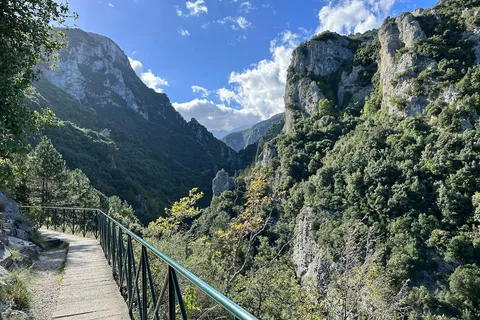
The full Enipeas Gorge trail from Litochoro to Prionia is a serious hike: 11.7 km one way on the E4 path, crossing the stream seven times on wooden footbridges, and 4–5 hours if you walk the whole thing. A more relaxed option is to walk the first hour or so of the gorge from Litochoro and turn back. You can also simply drive the paved road up to Prionia (about 35 minutes each way) for the same waterfalls-and-forest scenery and a look at where the main trails up Olympus begin. Either way, aim to be back on the road toward Dion by early afternoon.
180 min
- Afternoon
Ancient Dion, at the foot of the mountain
40 min from the previous stop
Dion, about 27 km from Prionia via Litochoro, was ancient Macedonia's religious center. Macedonian kings sacrificed to Zeus at its sanctuary, and Alexander the Great is said to have made offerings here before departing for Asia. A single €10 ticket covers the excavated site, its museum, and the archive. It's open into the evening in summer (08:00–20:00) but closes at 15:30 in winter, and is shut on Tuesdays and Wednesdays year-round. Give it an hour and a half; the setting, with Olympus rising behind the ruins, is as much the draw as the archaeology.
90 min
Day 3: On to the Rock Pillars of Meteora
The drive southwest from Litochoro to Meteora follows fast, mostly motorway roads. You should reach the sandstone pillars by early evening, in time to watch the light change on rock that looks nothing like anything you passed this morning.
Tonight: Kastraki, at the base of Meteora
- Afternoon · Optional
Drive to Kastraki
Kastraki, the small village at the base of Meteora's rock pillars, is roughly 150 km southwest and just under two hours away. Most of the drive is motorway, via the A1 and the Larissa-Trikala road, until the landscape flattens onto the Thessalian plain and the pillars appear outside Kalambaka. Check into your guesthouse here rather than in the busier town of Kalambaka; Kastraki sits closer to the rocks and the monastery road.
- Evening
Sunset at Psaropetra
10 min from the previous stop
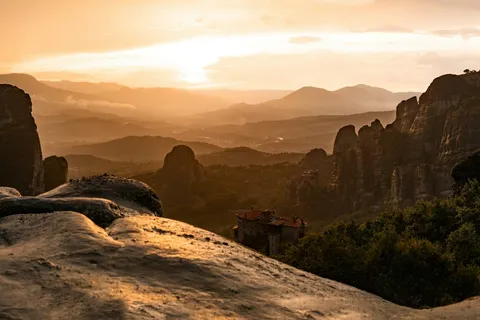
Psaropetra, also called Sunset Rock locally, is a boulder outcrop on the monastery road above Kastraki, about a 10-minute drive or walk from the village center. It's one of Meteora's best-known sunset spots, and for good reason: the Varlaam-Great Meteoron ridge fills the frame, and the whole scene turns gold as the sun drops. Arrive 30–45 minutes before sunset to get a spot on the rock itself rather than the path below it; it fills up quickly in peak season.
60 min
Day 4: The Monasteries of Meteora
A fully dedicated day with no drive to plan around. The aim is to give two of the six monasteries a proper, unrushed visit rather than racing between all of them: Great Meteoron in the morning, Varlaam around midday, then an open afternoon among the rock formations and Kastraki's tavernas.
Tonight: Kastraki, at the base of Meteora
- Morning
Great Meteoron Monastery
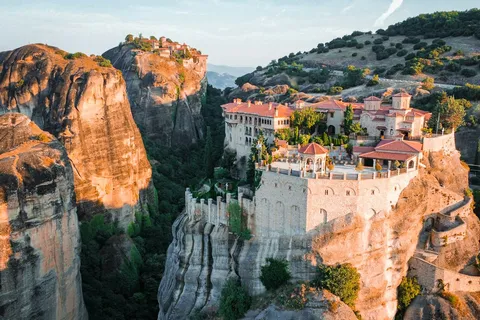
The largest and oldest of the six active monasteries, perched on the tallest of the rock pillars, with a 16th-century main church and a small museum inside. Entry is €5 per person, cash only. It's closed on Tuesdays during the summer season, so check that Day 4 of your own trip doesn't land on one. Give it an hour or so, including the climb up.
75 min
- Midday
Varlaam Monastery
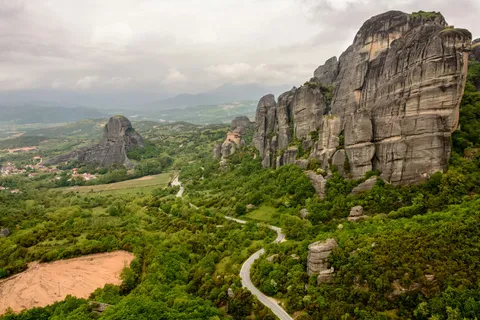
10 min from the previous stop
Varlaam sits on its own pillar a short drive or walk from Great Meteoron, and its 16th-century church holds some of the best-preserved frescoes in Meteora. The same rules apply (€5 cash at the door, no cards). It's closed Fridays in summer, so pair it with Great Meteoron on any other day of the week. Dress modestly for both: women should cover their shoulders and wear a skirt below the knee (loaner wraps are kept at the entrance), men should wear long trousers, and sleeveless tops are not permitted.
60 min
- Afternoon · Optional
Kastraki's old town and tavernas
10 min from the previous stop
With both monasteries visited by early afternoon, the rest of the day is open. Walk Kastraki's old quarter under the rocks, or find a taverna table with a pillar view for a slow late lunch. Nothing else is scheduled today.
Day 5: South into Tzoumerka: the Plaka Bridge
This is the trip's real departure from the classic loop, heading south from Meteora into the Athamanika Mountains rather than north toward Zagori. It's a long driving day, about three and a quarter hours in total, with one main stop about 35 minutes short of Pramanta. Nothing on today's agenda is strenuous.
Tonight: Pramanta, in Tzoumerka
- Midday
The Plaka Bridge over the Arachthos
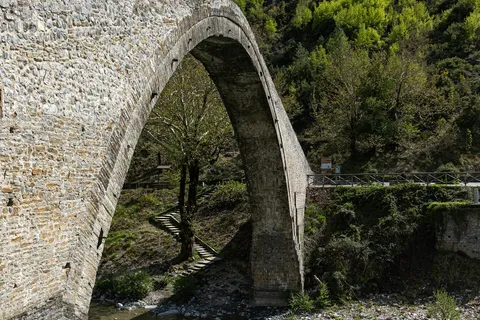
The Plaka Bridge, about two hours and forty minutes south of Kastraki, is a single-arch stone bridge with a 40-metre span, the largest of its kind in the Balkans. It crosses the Arachthos River, the same river that supplies the whitewater rafting trips run out of nearby Arta. Built in 1866, the bridge collapsed in a 2015 flood and was rebuilt stone by stone using the original technique, reopening in 2020. There is no fee and no substantial hike, just a short walk from the roadside to the bridge itself. It's one of the most photogenic stops on the whole route.
30 min
- Afternoon · Optional
On to Pramanta
35 min from the previous stop
Pramanta is the natural base for the next two nights, a mountain village central enough to reach Kipina Monastery and Syrrako without long transfers. Check into a guesthouse and rest; even with the bridge stop, today's drive is one of the longest of the trip.
Day 6: The Wild South of Tzoumerka: Kipina and Syrrako
A full, relaxed day based out of Pramanta, with no long transfer to plan around: a cliffside monastery in the morning, and a stone village perched above a gorge for the rest of the day. It's one of the trip's slowest days.
Both stops are reached by short walks from their respective car parks, with no substantial hiking involved. If you want a lower-key day after the long drive from Meteora, this is it.
Tonight: Pramanta, in Tzoumerka
- Morning
Holy Monastery of Kipina
Kipina, about 26 minutes from Pramanta, is built directly into a cliff face above the Kalarrytikos gorge, and it's a striking sight even before you reach it. The approach is on foot from where the paved road ends: a rock-cut path, a wooden footbridge, and a short final stretch to the entrance. The monastery does not have the fixed visiting schedule used at Meteora. It's generally open from morning to dusk, but a locked gate outside peak hours isn't unusual, since the person who holds the key lives in the nearby village. Dress modestly, as at Meteora.
60 min
- Midday
Syrrako, above the gorge
32 min from the previous stop
Syrrako is one of the best-preserved stone villages in Epirus, its slate-roofed houses stacked up a steep slope above the Kalarrytikos gorge. There's no single sight to check off. Walk the cobbled lanes, find a taverna with a view down into the gorge, and take it slowly. Allow a full two hours before the roughly 48-minute drive back to Pramanta.
120 min
Day 7: On to Zagori: a Shorter Transfer to Papigo
An easier transfer day than the drive into Tzoumerka. The direct drive from Pramanta to Papigo takes just under three hours with no stops to plan around, which leaves a real afternoon and evening to arrive properly rather than rushing in after dark.
Tonight: Megalo Papigo, in Zagori
- Midday · Optional
Drive to Papigo
The roughly 117km from Pramanta to Papigo takes about two hours and fifty minutes, on the Egnatia Odos and the Kozani-Ioannina road past Ioannina before turning north into Zagori. Megalo Papigo and its smaller twin, Mikro Papigo, sit at the foot of the Astraka Towers, where the limestone cliffs of the Tymfi massif rise directly behind the villages. It's a more dramatic backdrop than central Zagori's gentler hills. Check into a stone guesthouse here; it's the base for the next three nights.
- Evening · Optional
Settle in with time to spare
5 min from the previous stop
Because today's drive is direct, you'll likely arrive with hours of daylight left rather than at dusk. Use the extra time to walk the village at an easy pace and, if the sky's clear, watch the light change on the Astraka Towers before dinner. The full walk between Megalo and Mikro Papigo is saved for tomorrow, so there's no need to rush out tonight.
Day 8: Papigo: Astraka Towers and the Voidomatis River
A full day based entirely in Papigo, with no long drives required. Start with a morning walk between the twin villages, visit the natural rock pools a few minutes outside town at midday, and spend the afternoon at the Voidomatis River's spring-fed pools near Vikos village.
Tonight: Megalo Papigo, in Zagori
- Morning · Optional
Megalo Papigo and Mikro Papigo
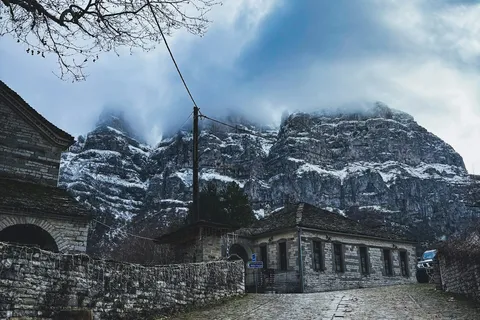
The two villages sit about a 20-minute walk apart along a stone path. Both are built from the same grey local stone with slate roofs, and both look straight up at the sheer limestone walls of the Astraka Towers rising behind them. There's no ticketed sight here, just the villages themselves, Agios Vlasios church in Megalo Papigo, and the view overhead that explains why this is the more dramatic of Zagori's two main bases.
60 min
- Midday
Papingo Rock Pools (Rogovou Ovires)
10 min from the previous stop
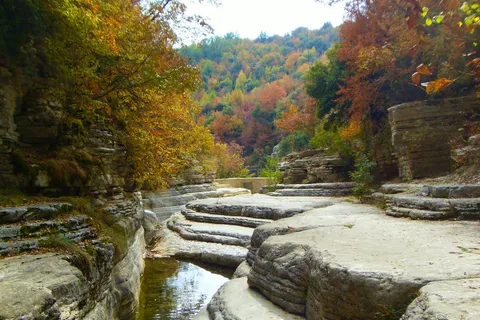
On the road from Megalo Papigo toward Mikro Papigo, a short streamside path leads to a sequence of natural limestone pools carved by the Rogovo stream: clear, cold, and startlingly turquoise in direct sun. Swimming is possible for hardier visitors (the water stays cold even in summer), but it's just as worthwhile as a half-hour walk and a look. A large gravel parking area on the roadside marks the start of the path.
90 min
- Afternoon
The Voidomatis River Springs, near Vikos
30 min from the previous stop
The springs near Vikos village are where the Voidomatis first surfaces: a series of still, plane-tree-shaded pools right where the Vikos Gorge trail begins. The water is clear enough to see the riverbed beneath the surface and cold enough (rarely above 4°C) that a swim is bracing even in August. It's an easy, flat walk from the parking area, and a natural place to end the day before heading back to Papigo for the evening.
90 min
Day 9: Zagori's Stone Bridges, Stone Forest, and Oxia Viewpoint
A scenic driving loop through central Zagori, the world of stone bridges and stacked villages that Papigo's own mountain scenery doesn't include. Expect two bridges near Kipoi in the morning, a short walk through an unusual limestone rock formation at midday, and one of the two or three best views over the Vikos Gorge in the afternoon.
The entire loop follows paved roads, with only short, easy walks at each stop; this is a scenic-driving day rather than a hiking day. Mountain weather in Epirus can change quickly, and the best order depends on the conditions that morning. When the sky starts clear, go to Oxia (and the Stone Forest) first, since clouds typically build over the Pindus as the day warms up. If it's already overcast when you set out, do the two bridges first instead (they look fine in any weather) and swing by Oxia later if it clears. Short on time? Limit the loop to Kokkoris Bridge and Oxia; Plakidas Bridge and the Stone Forest are both optional add-ons a few minutes off the same road.
Tonight: Megalo Papigo, in Zagori
- Morning
Kokkoris (Noutsos) Bridge
Kokkoris, about 54 minutes from Papigo, is Zagori's best-known stone bridge: a single stone arch over the Voidomatis river, built in 1750 with funding from a local benefactor, Noutsos Kontodimos. It's free to visit, with no fixed hours, and all it takes is a short walk down to the riverbank for the classic view of the arch framed against the water.
30 min
- Morning · Optional
Plakidas (Kalogeriko) Bridge
3 min from the previous stop
Plakidas, also called Kalogeriko, is a rarer three-arch stone bridge over the same river, built in 1814. Its three stepped arches, each a different size, give it a distinctive silhouette, locally nicknamed the "moving caterpillar." It's an optional add-on to Kokkoris rather than a separate trip, and most visitors see both in the same short stop.
20 min
- Midday
The Stone Forest (Petrino Dasos)
30 min from the previous stop
The Stone Forest offers an easy, well-marked walk through a field of limestone pillars, thin layers of rock stacked into tower-like shapes by centuries of water and wind, standing among real oak and maple trees at around 1,500m. It's part of the Vikos-Aoös UNESCO Global Geopark, designated in 2015, and the walk takes 20–30 minutes at an easy pace. It also sits directly on the road up to Oxia, so there's no separate detour needed.
30 min
- Afternoon
Oxia Viewpoint
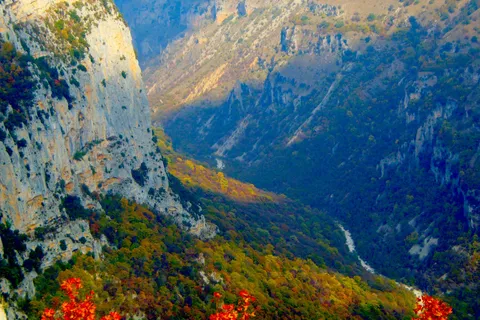
3 min from the previous stop
A short walk from the car park leads to Oxia, one of the two or three defining views over the Vikos Gorge: a cliff-edge balcony looking straight down into one of the deepest gorges in Europe. Allow at least 20 minutes to take in the scale before heading back to Papigo, about an hour's drive away.
30 min
Day 10: Zagori to Ioannina to Thessaloniki
A transition day with two distinct halves: a relaxed morning in lakeside Ioannina, then a long afternoon drive back to Thessaloniki to close the loop. Total driving today comes to about four and a quarter hours, so keep the Ioannina stop reasonably brief.
The boat trip to the island on Lake Pamvotis is a pleasant way to spend an hour, but it is not essential. Skip it without regret if you'd rather get ahead of today's long drive to Thessaloniki.
Tonight: Thessaloniki
- Morning
Its Kale Castle (Kastro)
Ioannina is about an hour and fifteen minutes from Papigo, down from the mountains on the shore of Lake Pamvotis. Its Kale, the old citadel at the heart of the Kastro quarter, is free to enter and open into the evening. The museums inside (the Fethiye Mosque complex, the Treasury, and the Byzantine Museum) charge separately if you want to go beyond the grounds: €6 general admission, €3 reduced in winter. Give the old town's narrow lanes and lake views an hour or two.
90 min
- Midday · Optional
Boat to the island on Lake Pamvotis (optional)
10 min from the previous stop
Small boats leave frequently from the waterfront near the castle for the short crossing (about ten minutes each way) to the car-free island in the middle of the lake, for a modest per-person fare. It's a different pace entirely: a handful of monasteries, lakeside tavernas, and no traffic of any kind. It is worth doing if the morning has gone smoothly and you're not watching the clock. If you'd rather get moving, the old town and lakeside promenade are enough on their own.
60 min
- Afternoon
Drive to Thessaloniki and the White Tower
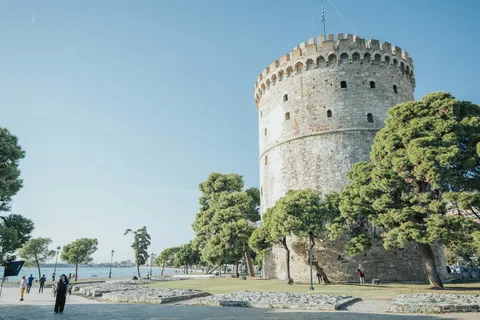
180 min from the previous stop
The drive east back to Thessaloniki covers roughly 260 km in about three hours, almost all of it on the fast, well-surfaced Egnatia Odos, with tolls of around €10 collected in cash or by card at staffed booths. Once you're in the city, walk the waterfront promenade out to the White Tower, Thessaloniki's best-known landmark. It's open 08:00–20:00 in summer (08:30–15:30 in winter) and closed Tuesdays, with €6 admission. The climb inside is worth it for the harbor views if the timing works; otherwise, the waterfront promenade is the real draw.
45 min
- Evening · Optional
Dinner in Ladadika
15 min from the previous stop
Ladadika, back down near the port, is Thessaloniki's liveliest dinner district, with restored 19th-century warehouse buildings and pedestrian streets. There's no single restaurant to recommend; it's simply an easy area to wander into and pick whatever looks good.
Day 11: Thessaloniki and Departure
The final morning is open rather than rushed. This extra day exists specifically so that yesterday's long drive back from Zagori doesn't have to double as departure day. Keep plans flexible and work them around your actual flight time.
- Morning · Optional
Aristotelous Square and the Kapani Market (optional)
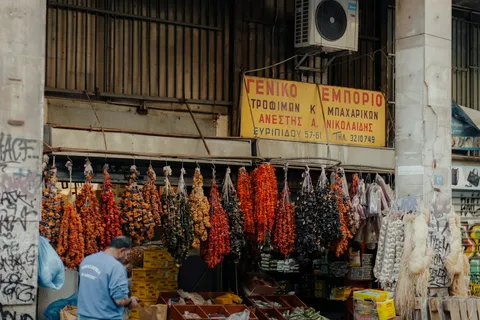
A walk along the Thermaic Gulf waterfront and a coffee are enough on their own if you'd rather not plan anything. If you want a bit more, Aristotelous Square is Thessaloniki's central meeting point, and the Kapani covered market a few minutes inland is a working food market rather than a tourist stop. It's good for wandering, not for a checklist.
60 min
- Midday · Optional
Return the rental car and fly out
30 min from the previous stop
Thessaloniki Airport is about 30 minutes from the city center with no traffic, closer to 45 in rush hour. Allow a generous buffer for refueling, the car return itself, and check-in. There's no long drive competing for time today, which is the whole point of keeping this as a separate day rather than folding it into Day 10.
Don't do this
- Don't rely on paying by card at Meteora or Kipina Monastery. Neither accepts cards, and there's no ATM at either.
- Don't skip fueling up before Tzoumerka's back roads to save a few minutes. Village fuel stations are infrequent once you're past Pramanta, and there's no equivalent stop deeper into the mountains.
- Don't rush the Kipoi–Stone Forest–Oxia loop on Day 9 when the weather is poor. The Oxia viewpoint path is exposed, and the point of the day is to slow down at three easy stops, not tick off three stops in the rain.
- Don't assume the Ioannina lake-island boat trip is essential. It's a pleasant way to spend an hour, not a must-see, so skip it without regret if Day 10's drive to Thessaloniki is already going to run long.
Useful travel information
Tips
- Carry cash for Meteora and for Kipina Monastery. Every Meteora monastery charges €5 per person at the door, cash only, and Kipina operates the same way: no card terminals, and no ATM once you're off the Egnatia Odos. Withdraw enough cash in Kalambaka or Ioannina before heading into the mountains.
- No toll tag is required. Greek motorway tolls, including on the A1 and the tolled sections of the Egnatia Odos, are paid in cash or by card at staffed booths as you pass through, so a standard rental works fine without a transponder.
- Dress appropriately for the monasteries before you arrive: women need shoulders covered and a skirt below the knee (loaner wrap skirts are kept at the entrance if you show up in trousers or shorts), men need long trousers, and sleeveless tops aren't allowed for anyone. The same modesty expectation applies at Kipina.
- Ease into mountain driving before you reach Tzoumerka. The roads around Pramanta, Kipina, and Syrrako are narrower and more remote than Zagori's. Use a lower gear on descents, use pull-offs to let local traffic pass, and avoid driving unfamiliar roads after dark.
- Late-summer wildfire risk is a real concern in this terrain. A major fire burned for over a week in the Northern Pindus National Park near Konitsa in early September 2026, in the same protected landscape that includes Zagori. If you're driving this route in a dry, late-summer month, check the Greek Fire Service's daily fire-risk map and local news before setting out; mountain roads through the park can close on short notice.
- The Kipoi bridges, the Stone Forest, and the Oxia viewpoint are all free, with no tickets and no fixed hours. The short walk out to Oxia, though, is on an exposed cliff-edge path, so skip it in high wind or heavy rain rather than push through for the photo.
- Each of Meteora's six active monasteries (Great Meteoron, Varlaam, Roussanou, Holy Trinity, St. Stephen's, and St. Nicholas Anapafsas) charges €5 per adult, cash only, with children under 12 admitted free; there are no card terminals or ATMs at the site.
- During the summer season, Great Meteoron is closed on Tuesdays and Varlaam on Fridays; each monastery posts its current weekly closure at the entrance, since the Orthodox calendar also closes them for feast days.
- The full Enipeas Gorge trail between Litochoro and Prionia follows the E4 European long-distance path for 11.7 km, crossing the stream seven times on wooden footbridges, and takes 4–5 hours one-way. Prionia itself, at about 1,100m, is also reachable by a paved 19km road from Litochoro (about 35 minutes by car), which is the easy way to reach the same alpine scenery without the full hike.
- The Archaeological Site of Dion, at the foot of Olympus, is open 08:00–20:00 in summer (16 April–31 October) and 08:30–15:30 in winter, closed Tuesdays and Wednesdays year-round; a single €10 ticket (€5 reduced) covers the park, museum, and archive.
- The Plaka Bridge over the Arachthos River, connecting Tzoumerka to Kastanochoria, is a single-arch stone bridge with a 40-metre arch span and 17.61-metre height, built in 1866 and the largest of its kind in the Balkans. It collapsed in a February 2015 flood and was fully rebuilt using traditional stone techniques, reopening in 2020.
- Greek motorway tolls, including on the A1 and the tolled sections of the Egnatia Odos, are collected in cash or by card at staffed booths; there is no vignette, and rental cars don't need a transponder to use any Greek motorway.
- The Voidomatis River, which surfaces from springs near Vikos village, has been part of the Vikos-Aoös National Park since 1973; its water stays close to 4°C year-round and is clear enough to see the riverbed beneath the surface.
- A major wildfire burned in the Northern Pindus National Park near Konitsa from late August into mid-September 2026, threatening the Aoos Gorge and the forests around Tymfi, in the same protected landscape that includes Zagori. Late-summer travel through this region carries a recurring wildfire risk, so check conditions before departure.
- Ioannina's Its Kale citadel and grounds are free to enter and open into the evening; only the museums inside (the Fethiye Mosque complex, the Treasury, and the Byzantine Museum) charge admission: €6 general, €3 reduced in winter.
- The White Tower is open 08:00–20:00 from April through October and 08:30–15:30 from November through March, closed Tuesdays; standard admission is €6, with free entry for EU citizens under 25 with ID.
- The Kokkoris (or Noutsos) Bridge near Kipoi is a single-arch stone bridge over the Voidomatis river, 36.4 metres long with a 13.3-metre arch height, built in 1750 with funding from local benefactor Noutsos Kontodimos and later restored in 1910.
- The Plakidas (or Kalogeriko) Bridge near Kipoi is a rarer three-arch stone bridge, 56 metres long, built in 1814; its three stepped arches of decreasing size give it a distinctive silhouette, locally nicknamed the "moving caterpillar."
- The Stone Forest (Petrino Dasos), a field of layered limestone pillars near Monodendri at about 1,500m, sits inside the Vikos-Aoös UNESCO Global Geopark, which was designated in 2015.
Frequently asked questions
- Why add Tzoumerka to the classic Meteora-Zagori loop?
- Because it offers genuinely different terrain that most visitors on the classic loop never see: a monastery built into a cliff face at Kipina, and a stone village, Syrrako, perched above the same gorge that feeds Epirus's whitewater rafting trips on the Arachthos River. Geographically, it sits between Meteora and Zagori but well south of the direct route between them, so the detour adds real distance. In return, it has the same wild, mountainous character as Zagori in a much less-visited corner of Epirus.
- Is 11 days enough for this route?
- Yes, and it is long enough to keep the itinerary relaxed rather than rushed. Olympus, Meteora, and Zagori each get at least two days, and Tzoumerka's two days stay light rather than adding a strenuous hike or cave visit. The final two days are split so that neither the Ioannina–Thessaloniki drive nor the flight home has to compete with sightseeing. An 8- or 9-day version of this route means dropping Tzoumerka entirely or skipping the Zagori bridges day, not compressing everything evenly.
- Do I need a 4x4 for Tzoumerka or Zagori's roads?
- No. Every stop on this itinerary, including Kipina Monastery, Syrrako, the Kipoi bridges, the Stone Forest, Oxia, Papigo's rock pools, and the Voidomatis springs, is accessible by paved road in a standard rental car. The roads are narrow and switchback-heavy in places, which calls for slower driving, not a different vehicle.
- Why stay in Papigo instead of Monodendri?
- Papigo puts the Astraka Towers' limestone cliffs directly overhead, with the natural rock pools and Voidomatis springs a few minutes' drive away. That makes it a more dramatic, nature-focused base than central Zagori's gentler village-and-viewpoint setting. Day 9's loop already reaches the stone bridges and Oxia viewpoint near Monodendri and Kipoi as a day trip, so staying in Papigo doesn't mean missing them. It just means driving out to them instead of waking up next to them.
- Why does the itinerary end with a relaxed day in Thessaloniki instead of flying home after Day 10?
- Because Day 10's drive back from Zagori to Thessaloniki already adds up to roughly four and a quarter hours, including the leg to Ioannina. A same-day flight after that leaves no real buffer for traffic, the rental return, or the airport itself. Giving Thessaloniki its own final day removes that risk entirely rather than asking you to plan carefully around it.
- Is wildfire a real concern on this route?
- It can be, especially in a dry, late-summer month. The Zagori region sits inside the Northern Pindus National Park, which saw a significant wildfire near Konitsa in early September 2026. Check the Greek Fire Service's daily fire-risk map and local news before setting out on this loop in peak fire season. It is not necessarily a reason to skip the trip, but it is a reason to check current conditions rather than assume the route is always clear.